Hungary has announced a two-day suspension of rail traffic between the country and Ukraine after a Russian drone struck near a railway station in western Ukraine, close to the Hungarian border.
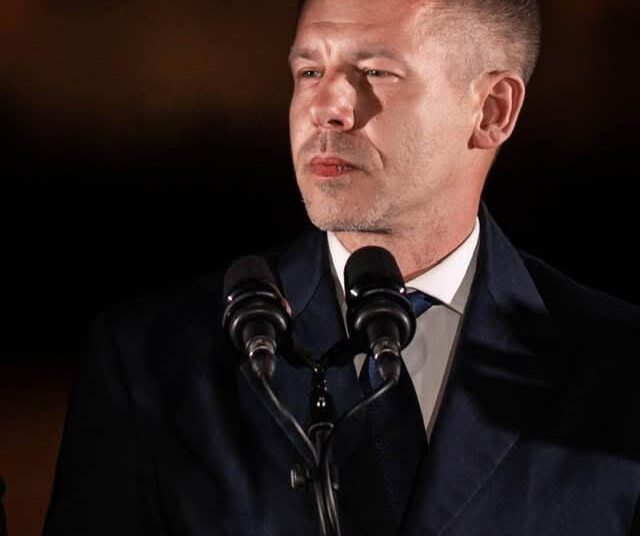
Hungarian Prime Minister Péter Magyar stated that the decision followed a drone strike approximately 300 metres from Mukachevo railway station in Ukraine’s Transcarpathia region. The incident prompted the removal of a Hungarian train crew from a service arriving from Hungary.
In a statement posted on Facebook, Magyar confirmed that rail services between the two countries would be suspended for two days.
“Recently, in Transcarpathia, a Russian drone struck 300 meters from the Mukachevo railway station. The Hungarian crew of the train arriving from Hungary has been taken off the train.
“We are suspending rail traffic between Hungary and Ukraine for today and tomorrow.”
Péter Magyar
Mukachevo is located in western Ukraine, close to the Hungarian border, in a region with a sizeable ethnic Hungarian community. The drone strike has raised fresh concerns about the security of an area that has been relatively shielded from the direct effects of Russia’s attacks since the start of the full-scale invasion.
Hungary Reports Multiple Drone Strikes In Transcarpathia
Hungarian Foreign Minister, Anita Orbán provided further details of the incident, saying that Russian drones had targeted parts of Transcarpathia in several waves.
In a post on X, Orbán said that the attacks involved Geran-2 drones targeting areas around Mukachevo and Uzhhorod.
“At around 10am Hungarian time, Russian Geran-2 drones attacked Transcarpathia in three waves, primarily targeting the areas around Mukachevo and Uzhhorod.”
Anita Orbán
According to the Foreign Minister, Ukrainian air defence forces intercepted several of the incoming drones, although some strikes were also reported.
“Ukrainian air defence forces responded effectively and shot down several of the attacking drones. Unfortunately, reports have also come in of multiple drone strikes, and the extent of the damage is currently being assessed.”
Anita Orbán
She warned that the incident was not the first aerial attack against Transcarpathia and suggested that the region could face further strikes as Russia continues its military campaign across Ukraine. “This is not the first air attack against Transcarpathia, and unfortunately it is unlikely to be the last,” she said.
Orbán argued that the region’s geographical position had offered it a degree of protection from attacks until now, but warned that Russia’s expanding strikes against Ukrainian civilian areas could expose it to greater risks.
Hungary Warns Of Difficult Winter for Ukraine
The Hungarian Foreign Minister also pointed out the potential humanitarian consequences of continued Russian attacks on Ukraine’s energy infrastructure, warning that the coming winter could be the most difficult of the war so far.
She said that electricity networks and district heating systems were already under severe pressure, particularly in Kyiv, Kharkiv and southern Ukraine.
Orbán warned that further attacks on power generation facilities could disrupt electricity supplies, water services and heating for millions of people. “Without electricity, water supplies in cities are also disrupted, millions of people are left without heating and power, and everyday life becomes increasingly difficult,” she said.
Her remarks depict concerns about the vulnerability of Ukraine’s energy infrastructure as temperatures fall and the country faces continued attacks on facilities essential to civilian life.
Additionally, the Hungarian Foreign Minister expressed solidarity with the ethnic Hungarian community in Transcarpathia and the wider Ukrainian population, acknowledging the challenges civilians have faced during the war.
“I express my solidarity with the Hungarian community in Transcarpathia and with the entire Ukrainian people, who have now had to face the horrors of war every day for nearly five years and are making extraordinary efforts simply to get through daily life.”
Anita Orbán
The suspension of rail services is a temporary measure intended to address immediate security concerns following the strikes. However, the incident emphasizes the growing risks facing areas of western Ukraine that have been relatively distant from the main front lines.
With the extent of the damage still being assessed, the duration of the disruption and the timing of the resumption of cross-border rail services remain uncertain.
READ ALSO: Afenyo-Markin Questions Removal of Big Six from New Banknotes