Ghana’s digital finance revolution is expanding rapidly, but a major weakness remains hidden beneath the impressive growth in mobile money and electronic payments. A significant portion of the value moving through digital channels is still ending up as physical cash.
Bank of Ghana Governor Dr. Johnson Asiama has raised concerns about this pattern, warning that the country’s progress toward a cashless economy cannot be measured simply by the number of digital accounts or transactions being recorded.
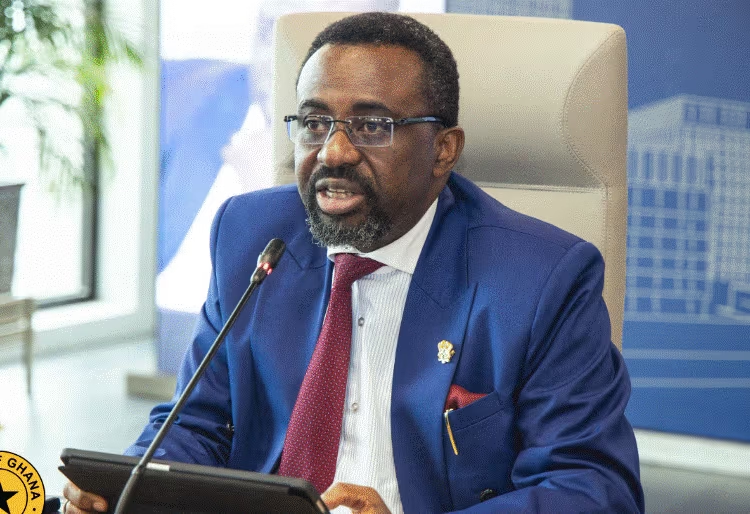
Speaking at the launch of the digital payment platform Sao Pay at the Labadi Beach Hotel, Dr. Asiama said too much digital value is still being converted into cash, particularly at merchant points.
“It is still unfortunate that too much digital value ends its journey as cash, and at many merchant counters, cash remains the default payment method.”
Dr. Johnson Asiama
His comments expose a critical gap in Ghana’s digital finance ambitions. While millions of consumers can now access mobile money and other electronic payment services, the continued preference for cash means the digital ecosystem is not yet delivering its full economic value.
Digital Transactions Still Ending In Cash
The expansion of digital payments has transformed how Ghanaians transfer and receive money. Mobile money has become a major part of everyday financial activity, while banks, fintech companies and electronic money issuers continue to introduce new payment solutions.
Yet the Governor believes the journey should not end when digital funds are withdrawn as cash. “Changing that is now the task of every issuer in this market,” he said.
The concern goes beyond consumer convenience. When money remains in digital form, it can circulate through electronic payment systems, creating a wider network of transactions and potentially supporting greater financial visibility.
A heavy reliance on cash, however, can interrupt that cycle.
A customer may receive money electronically, withdraw it, and subsequently use physical currency to pay a merchant. The transaction may therefore begin digitally but ultimately leave the formal electronic payment chain.
That is the conversion problem Dr. Asiama wants the industry to confront.
Mobile Money Has The Reach, But Not Enough Active Users
Mobile money remains one of Ghana’s strongest tools for expanding financial access. The scale of the sector is enormous, with millions of registered accounts and billions of cedis held in customer balances.
“According to our latest economic and financial data, there were about 85.8 million registered mobile money accounts in August 2026, holding nearly GH¢40 billion in customer balances,”
Dr. Johnson Asiama
Those numbers underline the enormous potential of mobile money to deepen Ghana’s digital finance ecosystem.
However, the Governor cautioned against interpreting the number of registered accounts as evidence that digital finance has already reached its full potential.
“But reach is not the same as value, as only about 26.4 million of those accounts had been used in the previous ninety days, fewer than one in three.”
Dr. Johnson Asiama
The distinction is significant. A large registered customer base can create the appearance of widespread digital financial participation, while actual usage may be considerably lower.
That gap presents an important challenge for payment companies seeking to move Ghana beyond basic money transfers and toward a broader digital payment culture.
Merchant Payments Remain A Critical Battleground
The merchant environment could become one of the most important fronts in Ghana’s cashless push.
If consumers continue withdrawing electronic funds before making purchases, merchants remain heavily dependent on cash. This limits the extent to which digital payment infrastructure can reshape everyday commerce.
The launch of Sao Pay comes against this backdrop, with the platform entering a market where payment providers are increasingly expected to make digital transactions easier, safer and more practical.
The challenge will not simply be convincing people to open digital accounts. Payment providers must also create an environment where customers have strong reasons to keep funds digitally and merchants are comfortable accepting those funds.
That requires reliability, trust and broad acceptance.
BoG Puts Regulatory Compliance Under Spotlight
Alongside the cash conversion problem, Dr. Asiama highlighted another issue that could determine the sustainability of Ghana’s digital payment expansion: regulatory compliance.
“Weak regulatory compliance has been among the root causes of problems in the digital payments sector, adding that it is an area that always deserves sustained attention.”
Dr. Johnson Asiama
The warning places additional responsibility on electronic money issuers and other payment service providers.
As digital balances grow, the systems supporting them must remain properly reconciled and adequately backed. Any weakness in that process could undermine confidence in the sector.
The Governor therefore placed particular emphasis on reconciliation for dedicated electronic money issuers such as Sao Pay.
“At all times, the value represented electronically to customers must be properly accounted for and supported by the funds required under the applicable regulatory framework.”
Dr. Johnson Asiama
Ghana’s Cashless Ambition Faces Its Next Test
Ghana has already built a substantial foundation for digital finance. Mobile money has become deeply embedded in economic activity, while fintech innovation continues to introduce new ways of moving money.
The next stage, however, could be more difficult.
The focus must increasingly shift from simply putting money into digital systems to keeping that value within the digital ecosystem. That means encouraging merchants to accept electronic payments, improving consumer confidence and ensuring payment providers maintain strong regulatory standards.
The figures from August 2026 show just how large the opportunity is. With 85.8 million registered mobile money accounts and nearly GH¢40 billion in customer balances, Ghana has considerable digital financial capacity.
Yet with only about 26.4 million accounts used during the previous 90 days, significant room remains to convert access into sustained activity.
READ ALSO: Ghana Inflation Rises to 5.2% as Domestic Pressures Persist