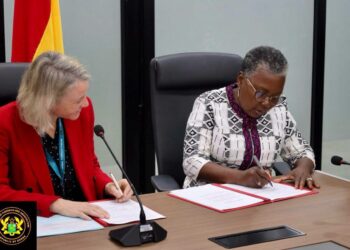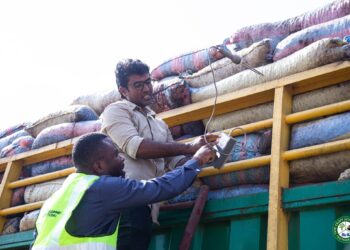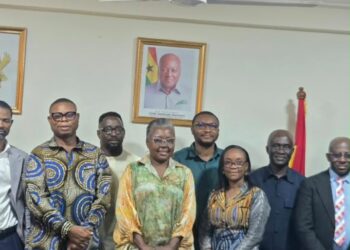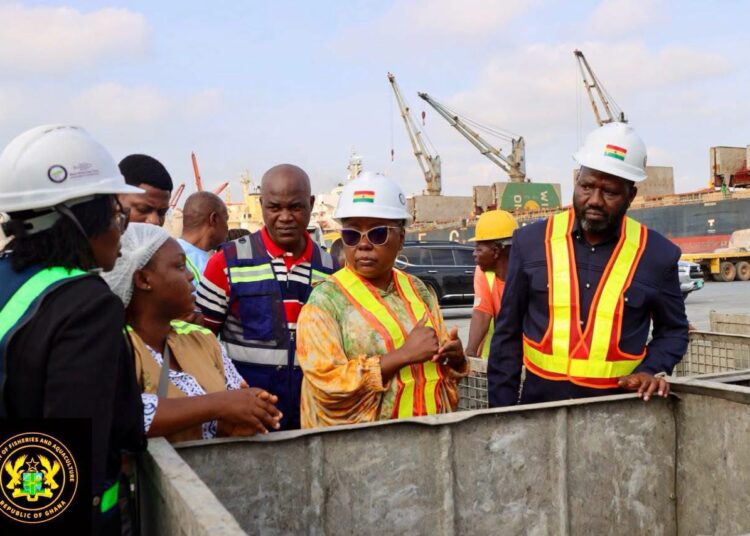
The Minister for Fisheries and Aquaculture, Hon. Emelia Arthur, has intensified efforts to strengthen transparency and regulatory compliance in Ghana’s fisheries sector following a working visit to the Tema Fishing Harbour to assess fish-weighing procedures and identify gaps in the monitoring of fish landings.
The visit focused on improving the accuracy of fish landing records, examining the feasibility of installing weighing scales at the harbour and addressing concerns associated with Ghana’s European Union (EU) yellow card status over illegal, unreported and unregulated (IUU) fishing.
The initiative forms part of broader efforts to improve fisheries governance and restore confidence in the country’s monitoring and enforcement systems.
During the inspection, the Minister and her delegation observed fish landing operations and engaged relevant officials on existing weighing practices, operational challenges and opportunities to improve the recording of catches.
She was accompanied by the Port Operations Head, representatives of the Marine and Coastal Surveillance Division (MCSD) of the Fisheries Commission, and the Commission’s Executive Director, Prof. Benjamin Campion.
“Reliable fish landing data and transparent weighing procedures are essential for effective fisheries governance, regulatory compliance and sustainable management of Ghana’s fisheries resources.”
Minister for Fisheries and Aquaculture, Hon. Emelia Arthur
Fish Weighing Central to EU Yellow Card Reforms
The inspection comes as Ghana continues efforts to address the concerns that led to the EU issuing a yellow card over IUU fishing in 2021. The warning identified weaknesses in fisheries governance, including concerns about monitoring, control and surveillance, as well as illegal transshipment practices commonly known as saiko.

The EU yellow card signals that a country needs to address deficiencies in its efforts to combat IUU fishing. Although it is not an outright trade ban, failure to resolve the underlying concerns can have implications for fisheries cooperation and seafood trade, including access to the European market.
Fish weighing is an important component of these reforms because dependable landing figures help authorities reconcile the quantities reported by fishing vessels with the volumes received by processors and other buyers.
Without effective verification, inconsistencies in reported catches can undermine fisheries statistics, complicate enforcement and weaken the evidence available for management decisions.
The Minister’s assessment therefore examined the feasibility of introducing weighing scales to improve the measurement and documentation of fish landed at Tema Fishing Harbour. Such systems, supported by appropriate verification and supervision, can help reduce discrepancies between estimated and actual quantities.
The European Commission has also emphasised the importance of reliable weighing systems in fisheries control. In August 2026, it adopted harmonised rules for weighing fishery products within the EU, with implementation scheduled for January 2027.
The framework highlights accurate weighing as essential for producing reliable catch data and checking compliance with fisheries regulations. Although these rules apply within the EU, they illustrate the broader importance of credible weighing and documentation systems in fisheries governance.
”The assessment of fish weighing procedures at Tema Fishing Harbour is intended to improve the accuracy and reliability of fish landing records while strengthening monitoring and compliance.”
European Union
Fisheries Commission to Strengthen Operational Oversight
A significant outcome of the working visit was an agreement that the Fisheries Commission would initiate arrangements to deploy its officers at all fish-receiving and weighing points to monitor operations and promote transparency in the measurement and recording of fish quantities.
The proposed arrangement is expected to strengthen regulatory oversight by ensuring that the quantities recorded during fish reception and weighing are properly documented.
The presence of officers at these points could also help authorities identify discrepancies, improve compliance with established procedures and strengthen the accountability of operators across the fisheries value chain.
Ghana’s fisheries sector remains important to food security, employment and economic activity. The 2024 National Annual Progress Report estimated that fisheries and aquaculture accounted for approximately 4 per cent of gross domestic product and employed about 10 per cent of the population.
It also reported that fish supplied an estimated 60 per cent of the country’s animal protein intake, underlining the importance of effective fisheries management to national nutrition and livelihoods.
For these reasons, strengthening landing data systems is not simply an administrative exercise. It is part of building a more accountable fisheries industry in which production figures, commercial transactions and regulatory decisions are supported by dependable evidence.
”The Fisheries Commission will initiate arrangements to deploy officers at all fish-receiving and weighing points to monitor operations and ensure transparency in the weighing and recording of fish quantities.”
Ministry for Fisheries of Aquaculture, Hon. Emelia Arthur

Tuna Processing and Traceability Under Review
As part of the working visit, the Minister also inspected Cosmos Foods Limited, a tuna-receiving and processing facility, where she observed the reception and weighing of tuna and examined the associated documentation and traceability procedures.
The visit provided an opportunity to assess how fish quantities are recorded and tracked from reception through processing. Traceability systems are important because they help establish the origin and movement of fish products, support verification of supply records and improve accountability between fishing vessels, receiving facilities and processors.
The inspection highlighted the need for effective coordination between landing sites, fish-receiving facilities and the Fisheries Commission. Monitoring only at the harbour may not provide a complete picture if records at subsequent receiving and processing stages cannot be reconciled with the original landing figures.
The Commission’s planned deployment of officers at receiving and weighing points could support this process, provided the arrangements are implemented consistently and backed by adequate staffing, equipment and record-management procedures.
”Accurate weighing, proper documentation and effective traceability are essential for ensuring reliable fish landing records and strengthening monitoring across the fisheries value chain.”
Ministry of Fisheries and Aquaculture, Hon. Emelia Arthur
The Ministry of Fisheries and Aquaculture, working through the Fisheries Commission and relevant stakeholders, is expected to continue pursuing measures to improve transparency, monitoring and compliance in the sector.