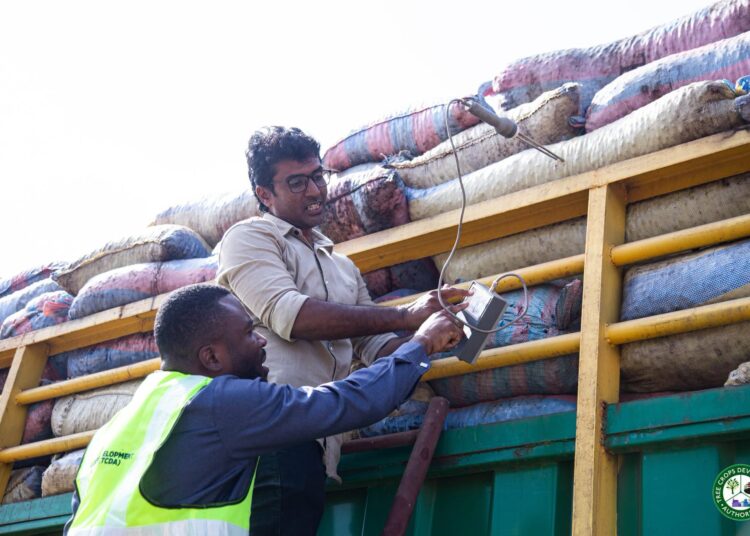
The Tree Crops Development Authority (TCDA) has warned companies operating in Ghana’s shea industry that breaches of minimum producer prices, moisture content standards, licensing requirements and commodity traceability rules could result in prosecution, licence revocation and other sanctions under the law.
The warning follows a joint enforcement operation conducted in Accra and Tamale in the Northern Region. The exercise involved the Ghana Armed Forces, the Ghana Police Service and National Security as part of efforts to strengthen regulatory compliance, protect shea producers and improve accountability throughout the industry.
The Chief Executive Officer of the TCDA, Dr Andy Osei Okrah, said the Authority was intensifying enforcement of the Tree Crops Development Authority Act, 2019 (Act 1010), and the Tree Crops Regulations, 2023 (L.I. 2471), following preliminary findings of alleged violations involving purchases below the approved minimum price, quality standards and licensing obligations.
“We will not allow companies to disregard the laws governing the shea industry. The approved minimum producer price and quality standards must be respected. Any company found violating these requirements will be held accountable in accordance with the law.”
CEO of TCD, Dr. Andy Osei Okrah
The enforcement action places renewed emphasis on the GH¢9.01 minimum producer price per kilogramme of raw shea nuts, equivalent to GH¢765.63 for an 85-kilogramme bag.
The approved price, which took effect on June 1, 2026, is intended to establish a regulated minimum payment for producers and improve transparency in commercial transactions.

Minimum Price and Quality Standards Under Scrutiny
According to the TCDA, preliminary findings indicated that some companies were purchasing raw shea nuts below the approved minimum producer price. Other businesses were reportedly buying and selling nuts with moisture content exceeding the permitted maximum of 10 per cent.
The Authority’s quality parameters for the 2026 crop season specify moisture content of 8–10 per cent, free fatty acid levels of 6–8 per cent and impurities ranging from 2–4 per cent.
These requirements form part of the pricing framework and provide benchmarks for assessing the quality of shea kernels traded within the regulated market.
The minimum producer price also establishes a regulatory reference point for transactions between producers, aggregators, traders and processors. Compliance is intended to prevent purchases below the approved threshold and provide a clearer basis for monitoring payments made to suppliers.
Ghana’s shea industry contributes to agricultural commerce, rural livelihoods and non-traditional exports. Ghana Statistical Service data in its 2024 trade report placed exports of crude shea oil and fractions at approximately GH¢1.93 billion, while shea nut exports were valued at about GH¢1.04 billion.
The figures cover different shea products and should not be interpreted as the industry’s total value, but they demonstrate the contribution of both raw materials and processed products to Ghana’s export earnings.
Licensing and Traceability Enforcement Intensifies
During the October 15 operation, the joint task force inspected companies and buying centres to establish whether businesses were registered, appropriately licensed and maintaining the records required under the regulatory framework.
The Officers examined invoices, receipts, purchase registers, payment evidence, purchase orders and contracts to determine whether transactions were properly documented and recorded prices reflected actual payments.
The exercise also identified alleged irregularities involving unlicensed operations, incomplete supplier information and failures to produce valid conveyance certificates for consignments in transit.
The TCDA said the inspections were necessary to establish the origin, ownership and destination of shea consignments and verify the parties involved in commercial transactions.
”It is important for the Authority to know who is buying, who is supplying, where the produce comes from and where it is going. Without proper documentation and traceability, effective regulation becomes difficult.”
CEO of TCDA, Dr. Andy Osei Okrah
The regulation 55 of L.I. 2471 provides a framework for strengthening oversight of commodity movements and establishing the origin and destination of produce. The requirement supports the Authority’s efforts to improve traceability and ensure that the movement of shea nuts can be monitored through the supply chain.

The TCDA’s registration and licensing framework also covers different categories of participants in the shea value chain, including aggregators, traders and exporters.
The Authority requires businesses to provide relevant registration information and supporting documentation as part of the licensing process.
Companies Face Possible Sanctions
The Authority said companies identified as non-compliant during preliminary checks had been directed to submit comprehensive lists of their suppliers and aggregators to facilitate verification of their registration and licensing status.
Dr Okrah urged affected companies to regularise their operations, provide accurate documentation and cooperate with the Authority’s regulatory processes.
”Processors, traders, buyers, exporters and aggregators must comply with the laws governing the industry and maintain accurate records of their transactions.”
CEO of TCDA, Dr. Andy Osei Okrah
The enforcement exercise forms part of broader efforts to improve governance across Ghana’s tree crops sector, which includes shea, cashew, mango, coconut, oil palm and rubber. Under Act 1010, the TCDA is mandated to regulate and develop the production, processing and trading of these commodities.
For the shea industry, consistent enforcement of producer prices, quality standards and licensing requirements is central to building a transparent trading environment.
The immediate challenge is to ensure that companies comply with the rules while producers, processors and exporters operate under a clear and verifiable regulatory system.
The Authority has reiterated its call for all participants in the shea value chain to comply with Act 1010 and L.I. 2471, warning that businesses must meet their legal obligations to avoid sanctions.
”The Authority will continue to strengthen regulation, enforce approved producer prices, improve commodity traceability and promote fair business practices across the shea value chain.”
CEO of TCDA, Dr. Andy Osei Okrah
The outcome of the enforcement drive will depend on sustained monitoring, accurate transaction records and consistent application of the law.
For Ghana’s shea industry, stronger compliance could provide a firmer foundation for protecting producers, improving product quality and maintaining confidence among domestic and international buyers.
READ ALSO:Ato Forson Vows Ghana Will Outgrow IMF’s 5.7% Forecast