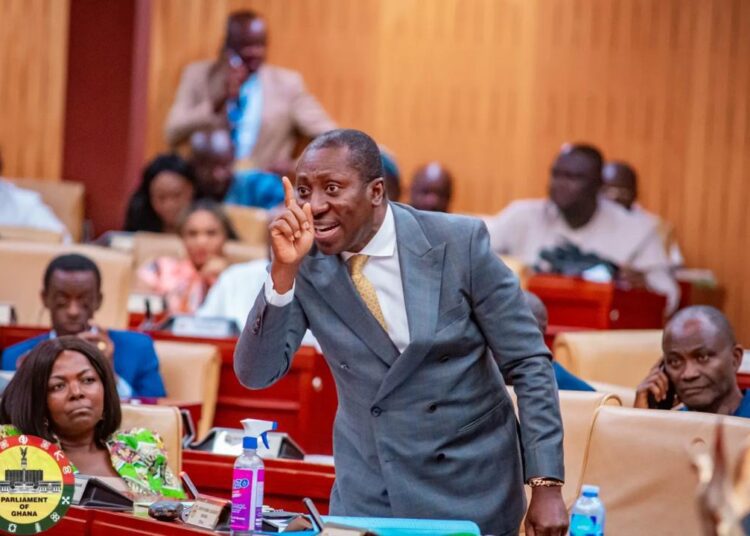
The Minority Caucus in Parliament has initiated a fierce political showdown by demanding the immediate resignation or dismissal of Ghana Gold Board (GoldBod) Chief Executive Officer Sammy Gyamfi following controversial public statements regarding small-scale mining permits.
According to parliamentary opposition members, Mr. Gyamfi’s remarks strongly imply that small-scale miners possess the latitude to conduct operations across the nation without acquiring mandatory legal licenses and regulatory permits.
The opposition caucus contends that such statements from the head of a major state gold institution fundamentally undermine regulatory compliance and compromise the legal framework governing Ghana’s extractive sector.
” Sammy Gyamfi should resign immediately as CEO of GOLDBOD; failing that, he should be dismissed to restore the institution’s credibility. To declare a state of emergency in all the red flag galamsey hotspots and to formalise the establishment and operations of NAIMOS through an L.I. to give meaning and structure to it.”
Minority Caucus
Escalating their opposition to the remarks, the Caucus has called for an unqualified apology from Mr. Gyamfi alongside swift executive sanctions from the presidency to restore regulatory order.
Furthermore, the Minority has pressed President John Mahama to present a transparent, actionable roadmap aimed at completely eradicating illegal mining, locally referred to as galamsey.
In a formal statement issued, opposition lawmakers sharply questioned the legal justification for allowing small-scale mining activities outside restricted zones without proper authorization, warning that endorsing such exemptions severely weakens law enforcement across the entire mining industry.
Legal Statutory Violations and Broader Governance Risks
To demonstrate the precedent created by these comments, the Minority raised critical comparisons regarding the selective application of statutory environmental rules.
Lawmakers asked whether similar regulatory exemptions could reasonably be extended to authorize mining operations within public institutions and protected locations, including schools, hospitals, market centers, places of worship, Parliament, and even the Jubilee House.
To substantiate their stance, opposition members cited key statutory provisions within the Minerals and Mining Act, 2006 (Act 703).
Specifically, they pointed to Sections 9(1) and 82(1), which explicitly mandate proper licensing prior to undertaking any mining operations, alongside Section 89, which establishes strict procedures for the formal designation of official small-scale mining areas.
Beyond statutory compliance, the Caucus highlighted severe institutional vulnerabilities that arise when state executives trivialize licensing requirements.
By permitting operators to bypass environmental clearance protocols, the state risks losing statutory revenue, accelerating deforestation, and polluting vital water bodies.
The opposition noted that institutional integrity remains the bedrock of natural resource management; thus, allowing high-ranking officers to condone unlicensed extraction severely compromises environmental governance and damages public confidence in state oversight agencies.
Comprehensive Audits and Policy Reform Demands
The political fall-out has sparked urgent calls from parliamentary members for full transparency within Ghana’s primary gold-trading mechanisms.
As part of its formal demands, the Minority requested a comprehensive, independent audit of GoldBod’s internal procurement records.
This audit must definitively establish whether gold purchased by the board can be fully traced from original mine sites to international buyers, ensuring all commercial transactions strictly align with international responsible-sourcing standards.

Opposition lawmakers insisted that without total supply-chain transparency, state institutions risk facilitating the laundering of illegally mined gold into global markets.
To permanently address the threat of environmental degradation, the Caucus urged the executive branch to publicly condemn Mr. Gyamfi’s utterances and uphold strict legal accountability.
Their policy demands include declaring a state of emergency across high-risk galamsey hotspots and formalizing the National Anti-Illegal Mining Operations Secretariat (NAIMOS) through a Legislative Instrument (L.I.) to grant it real enforcement structure.
Finally, the Minority appealed to civil society organizations, traditional leaders, religious bodies, media houses, and professional associations to unite in holding the government accountable to its 2024 election pledges regarding illegal mining.
Assessing the Imperative for Institutional Reform
This parliamentary initiative represents a pivotal moment for Ghana’s extractive governance framework.
Allowing public officers to suggest that statutory licenses are optional creates legal ambiguity, encouraging unchecked environmental destruction and undermining lawful small-scale miners who adhere to environmental assessments.
Strengthening statutory enforcement, auditing gold supply chains, and legally establishing NAIMOS are essential steps toward ensuring responsible resource extraction.
Without firm institutional accountability and strict adherence to Act 703, national efforts to protect water bodies, curb illegal mining, and maintain international market credibility will remain significantly compromised.
READ ALSO: Mbappé Double Ends Barcelona’s Perfect LaLiga Start