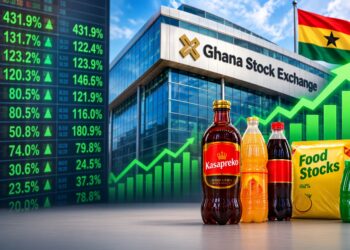
The Ghana Stock Exchange (GSE) has suffered another setback after its benchmark Composite Index dropped below the psychologically significant 14,000-point mark, raising fresh concerns about the market’s short-term momentum following months of impressive gains.
The GSE Composite Index (GSE-CI) declined by 146.04 points, representing a 1.03% loss, to close at 13,966.79 points at the end of the latest trading session. The decline pushed the index below the 14,000-point threshold, adding to the growing pressure on equities listed on the local bourse.
The latest performance also reflects a difficult period for the market over shorter investment horizons. The benchmark index recorded a one-week loss of 1.96% and a four-week decline of 0.41%, suggesting that the recent weakness is becoming more noticeable despite the market’s strong performance earlier in the year.
However, the broader market picture remains considerably stronger, with the GSE-CI still posting an impressive year-to-date gain of 59.25%.
Ghana’s Stock Market Faces Fresh Selling Pressure
The latest trading session exposed the extent of the pressure confronting equities on the Ghana Stock Exchange, as several major listed companies recorded losses while trading activity weakened considerably.
A total of 996,583 shares changed hands, representing a market value of GH¢6,962,223.83. Compared with the previous trading session on Wednesday, November 4, trading volume declined by 62%, while total turnover fell by 37%.
The sharp reductions in both trading volume and turnover suggest that investors were considerably less active during the session.
Although lower trading activity does not automatically translate into a sustained market downturn, the combination of declining indices and weaker participation highlights the challenges facing the exchange as it attempts to maintain its strong annual performance.
In total, 26 listed equities participated in trading, with four recording gains and six ending in negative territory. The remaining participating equities closed without gains or losses.
The imbalance between advancing and declining stocks further reflected the negative sentiment that characterised the session.
Cocoa Processing Company Defies the Market Downturn
While the broader market struggled, Cocoa Processing Company emerged as the strongest performer, delivering an impressive 9.76% increase in its share price.
The company’s shares closed at GH¢0.45, making it the biggest gainer of the session and offering a rare bright spot amid widespread selling pressure.
Intravenous Infusions followed with a 1.89% appreciation, while Kasapreko gained 1.10%. SIC Insurance Company also recorded a marginal improvement of 0.21%.
These four companies were the only listed equities to register gains during the session, highlighting the limited opportunities for positive returns across the market.
Cocoa Processing Company’s performance was particularly notable given the weakness across several other counters. Its nearly 10% appreciation demonstrated that individual stocks could still attract buying interest even when the broader exchange was experiencing a difficult session.
However, the performance of a handful of gainers was insufficient to reverse the overall market decline.
TotalEnergies and Ecobank Lead Market Losers
On the losing side, TotalEnergies Marketing Ghana recorded the steepest decline, with its share price falling by 7.15% to close at GH¢34.80.
Ecobank Ghana followed closely after shedding 6.03% of its share price, making it another major contributor to the negative performance among actively traded equities.
MTN Ghana also experienced selling pressure, declining by 1.21%, while Enterprise Group recorded a relatively modest loss of 0.35%.
The declines involving TotalEnergies Marketing Ghana, Ecobank Ghana and MTN Ghana are particularly noteworthy because of the visibility and significance of these companies within the Ghanaian investment market.
Their weaker performance contributed to the unfavourable market atmosphere, although the available trading figures do not establish the precise reasons behind the individual share price movements.
Meanwhile, CalBank recorded the highest trading volume, with 282,568 shares changing hands. MTN Ghana followed with 280,590 shares, while GCB Bank recorded 97,415 shares.
Ecobank Transnational also featured prominently, recording 83,285 traded shares.
Financial Stocks Index Extends Its Decline
The weakness was not restricted to the benchmark Composite Index, as the GSE Financial Stocks Index (GSE-FSI) also experienced a difficult session.
The financial sector index declined by 1.07% to close at 7,268.98 points, reflecting the broader pressure affecting financial stocks.
Its short-term performance was equally concerning, with the index recording a one-week loss of 2.15% and a four-week decline of 2.01%.
Despite these setbacks, the GSE-FSI remains significantly higher on an annual basis, posting a year-to-date gain of 56.42%.
The performance highlights the contrast between the exchange’s impressive annual returns and its more challenging recent trading sessions.
GSE Retains GH¢263 Billion Market Valuation
Despite the latest decline, the Ghana Stock Exchange continues to command a substantial market valuation.
Its total market capitalisation currently stands at GH¢263 billion, equivalent to approximately US$22.5 billion.
This valuation demonstrates the considerable expansion of the local equity market, even as recent price movements point to weakening momentum.
The benchmark index’s 59.25% year-to-date gain also suggests that investors who entered the market earlier in the year have experienced significant appreciation despite the latest setbacks.
Nevertheless, the decline below 14,000 points introduces another important development into the market’s performance trajectory.
Attention will now turn to whether the benchmark index can recover the lost ground and reclaim the 14,000-point level, or whether selling pressure will continue to weigh on listed equities.
With trading volume and turnover also declining sharply, the coming sessions will be important in determining whether the latest weakness represents a temporary pause after substantial gains or the beginning of a more prolonged period of market consolidation.
READ ALSO: Trump’s Memorial Arch Faces 14-Day Construction Halt