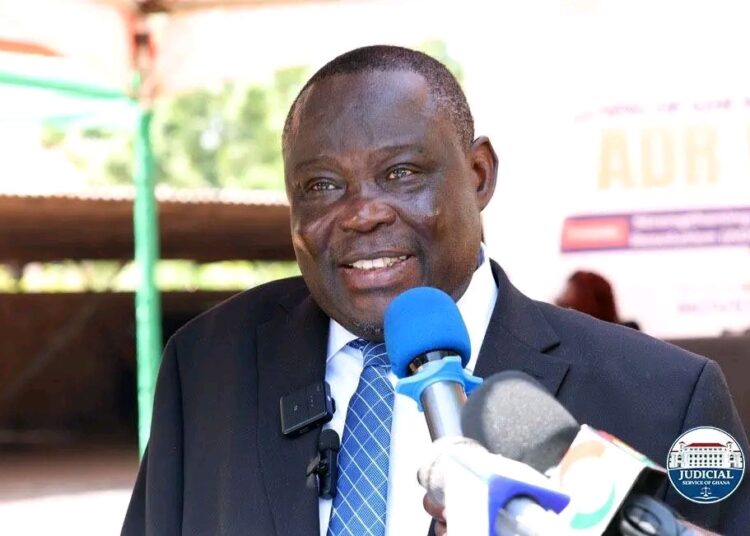
Ghana’s Acting Chief Justice, Justice Gabriel Scott Pwamang, has called for increased investment in Court-Connected Alternative Dispute Resolution (CCADR), urging development partners, businesses and philanthropists to support its expansion to all courts across the country.
He made the appeal on Monday, November 16, 2026, during the official launch of the Judicial Service’s 2026/2027 ADR Week at the High Court in Tamale, under the theme, “Strengthening the Foundations of Justice through Alternative Dispute Resolution (ADR) and Technology.”
Justice Pwamang highlighted the programme’s contribution to reducing court congestion, revealing that it had helped clear 41,431 cases from the conventional court system since its introduction in 2005.
He maintained that the next phase of the initiative must focus on extending its reach and using technology to make dispute resolution more accessible, particularly for people who face financial and geographical barriers to justice.
ADR Programme Records 41,431 Cases Resolved
Providing an overview of the programme’s achievements, Justice Pwamang disclosed that 138 courts nationwide had been connected to the ADR initiative, with 336 trained mediators supporting its operations. He further revealed that in 2025, 6,836 cases were referred for mediation, of which 2,722 were successfully settled.
The Acting Chief Justice described the figures as evidence that ADR had moved beyond a theoretical approach to dispute resolution and was delivering practical results for the justice system.

“Over the last two decades, the programme has successfully reduced our case backlog by 41,431 cases. In 2025 alone, out of 6,836 cases referred to ADR, 2,722 were successfully settled. This shows that the use of ADR is not just theoretical, but practical.”
Acting Chief Justice, Justice Gabriel Scott Pwamang.
Court-Connected ADR allows judges and magistrates to refer suitable disputes to mediation, where an impartial third party helps the parties negotiate a mutually acceptable settlement. Where an agreement is reached and adopted by the court, it can become a consent judgment.
The approach is intended to reduce the time and expense associated with prolonged litigation while easing pressure on judges and court facilities. Ghana’s broader ADR framework is also supported by the Alternative Dispute Resolution Act, 2010 (Act 798), which provides a legal basis for mechanisms including mediation, arbitration and customary arbitration.
Judicial Service Targets Technology-Driven Mediation
Beyond expanding the number of participating courts, Justice Pwamang identified technology as a major opportunity to improve the programme’s reach and efficiency. He explained that virtual mediation could reduce the need for disputing parties to travel long distances, making the process more convenient and affordable for individuals and businesses.
“The Service has identified that if we are able to deploy technology and conduct Court-Connected ADR mediations virtually, the impact will be immense and hugely beneficial to the Ghanaian public.”
Justice Gabriel Scott Pwamang, Acting Chief Justice.
He consequently invited development partners, the business community and philanthropists to collaborate with the Judicial Service in extending the programme nationwide and introducing digital solutions into its operations.
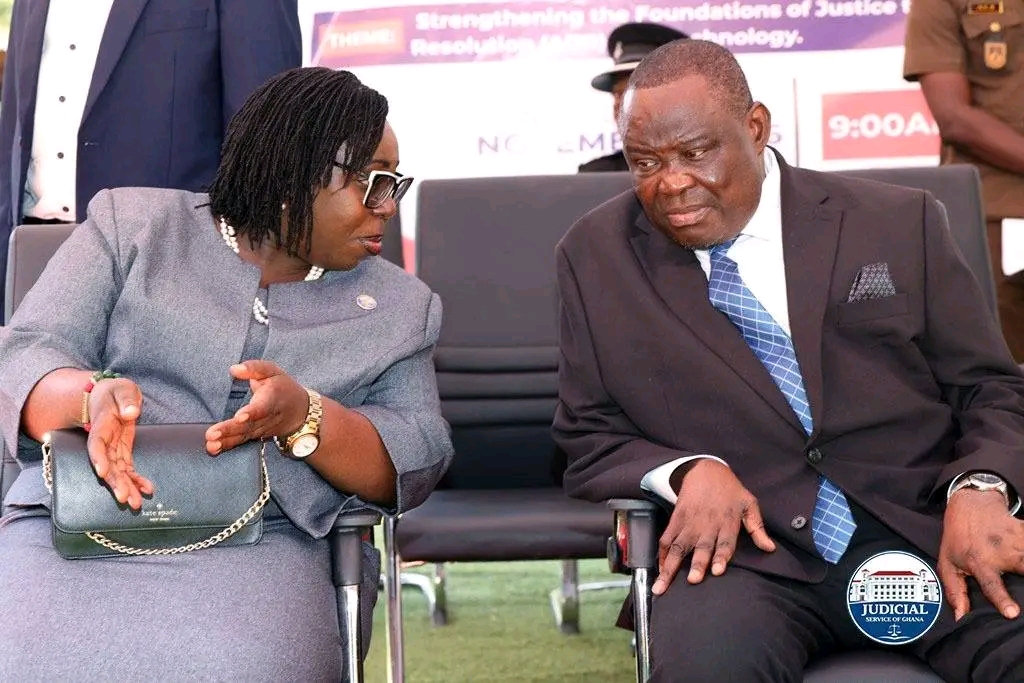
The call reflects a wider push within Ghana’s justice system to adopt technology in court administration and service delivery. The Judicial Service has previously highlighted virtual platforms as a potential means of supporting mediation, particularly for people in rural communities.
However, successful implementation will require investment in digital infrastructure, reliable connectivity, mediator training and safeguards to ensure that virtual proceedings remain confidential and accessible.
Traditional Leaders Back Digital Access to Justice
The Chairman for the occasion, Naabapira Sakpe-Naa, Paramount Chief of the Sakpe Traditional Area, supported the call for technology-driven dispute resolution, emphasising that justice mechanisms must evolve alongside changing patterns of communication and commerce.
“Disputes have gone digital, justice must follow,” he declared.
He argued that as businesses and everyday interactions increasingly move online, citizens should not be burdened with unnecessary travel, high costs and delays when seeking to resolve disagreements.
His remarks reinforced the need to make justice more responsive to the realities of modern society, particularly as digital transactions create new forms of disputes that may require flexible resolution mechanisms.
Stakeholders Pledge Support for ADR Expansion
For her part, the Judge-in-Charge of ADR, Justice Angelina Mensah-Homiah, reaffirmed the Judicial Service’s commitment to modernising dispute resolution and bringing justice closer to the public. She emphasised the importance of adapting the ADR process to changing times by incorporating technology into its operations.

Her position aligns with earlier calls for stronger ADR infrastructure and wider access to mediation services across the country. Stakeholders from the Northern Region, including the Legal Aid Commission, the Commission on Human Rights and Administrative Justice (CHRAJ), the Ghana Bar Association, the Office of the Attorney-General and the Regional Minister, also pledged their commitment to promoting ADR.
Their participation signals the importance of cooperation among judicial institutions, legal practitioners, traditional authorities and public agencies in strengthening alternative dispute resolution. The 2026/2027 ADR Week, running from November 16 to 20, is expected to provide court users with pending cases an opportunity to explore mediation and reach amicable settlements.
With 138 courts currently connected to the programme, the Acting Chief Justice’s appeal places renewed emphasis on funding, institutional partnerships and technology as essential requirements for making ADR accessible nationwide.
READ ALSO: Lauryn Hill to Headline Detty December Fest Lagos