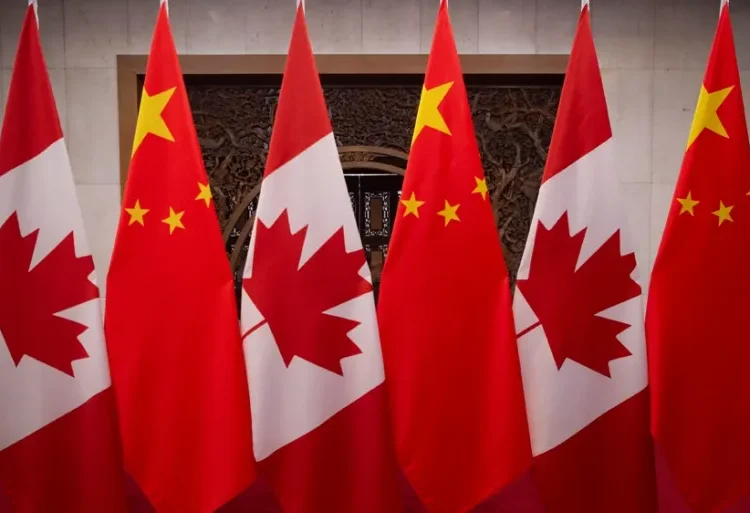
Chinese President Xi Jinping and Canadian Prime Minister Mark Carney have called for stronger bilateral relations, signalling renewed efforts to deepen economic cooperation as Ottawa navigates strained trade relations with the United States.
The two leaders met today, Tuesday, November 17, 2026, ahead of the Asia-Pacific Economic Cooperation (APEC) leaders’ summit, where they welcomed improvements in diplomatic engagement and highlighted the benefits of their countries’ growing economic relationship.
Their meeting comes as Canada seeks to diversify its international trade partnerships amid uncertainty surrounding negotiations with US President Donald Trump, whose trade policies have raised concerns about the future of North American economic integration.
Xi asserted that closer relations between Beijing and Ottawa would serve the interests of both countries and contribute to wider international stability.
“Improving and developing China-Canada relations serves the interests of the people of both countries and is also conducive to safeguarding world peace, stability, development and prosperity. This is the right choice.”
Xi Jinping
Carney also welcomed the progress made in recent months, stating that exchanges between the two countries had increased and their relationship had become more predictable.
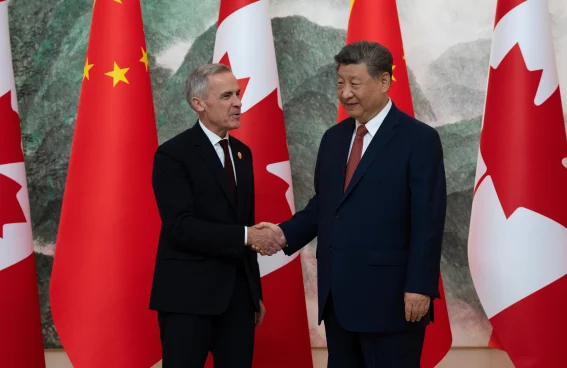
He described the improvement in bilateral trade arrangements as evidence of cooperation to address disagreements and pursue practical solutions. “The stabilization of our bilateral trade arrangement is indicative of how we can work together more broadly, pragmatically, to solve problems,” Carney said.
The meeting reflects efforts by both governments to consolidate recent diplomatic progress after a period of strained relations, particularly over trade restrictions and tariffs.
Canada Considers Chinese Automakers Amid US Trade Uncertainty
The discussions followed Carney’s remarks on Monday that Canada could turn to Chinese automakers if negotiations with Washington failed to preserve an integrated North American automotive industry.
His comments depict Ottawa’s concern about the future of its automotive sector, which is closely connected to manufacturing and supply chains across the United States, Canada and Mexico.
Canada has traditionally relied heavily on the US market for automotive trade, making the outcome of negotiations with Washington particularly important for manufacturers, workers and suppliers.
However, Carney’s willingness to consider alternatives signals that Ottawa is prepared to explore other partnerships if trade discussions with the Trump administration fail to deliver an arrangement that protects the industry.
China, meanwhile, is seeking to expand its presence in international electric vehicle markets, making Canada a potentially important destination for its manufacturers.
The prospect of closer automotive cooperation has therefore become one of the significant economic dimensions of the improving relationship between Beijing and Ottawa.
January Agreement Opens Canadian Market To Chinese EVs
The renewed engagement builds on a trade agreement reached by Xi and Carney in January, under which Canada agreed to reduce tariffs on Chinese electric vehicles.
Under the arrangement, Canada lowered its 100 per cent tariff on Chinese electric vehicle imports to 6.1 per cent, initially allowing up to 49,000 vehicles into the country annually. The import limit is expected to increase over time.
In return, China agreed to reduce tariffs on selected Canadian agricultural products, including canola.
The agreement improved their trade relationship, with both countries seeking to address some of the restrictions that had affected their commercial exchanges.
The arrangement also demonstrates how economic negotiations can help rebuild diplomatic engagement between countries despite broader geopolitical disagreements.
Ottawa Seeks Greater Trade Diversification
Carney’s engagement with Xi comes as Canada reassesses its economic dependence on the United States, its largest trading partner.
Trump’s approach to tariffs and trade negotiations has increased uncertainty for Canadian businesses, particularly those operating within integrated North American manufacturing industries.
The automotive sector is especially exposed because vehicles and their components frequently cross borders during production. Disruptions to trade arrangements can therefore affect manufacturers and suppliers throughout the regional supply chain.
Canada’s efforts to strengthen relations with China form part of a wider attempt to maintain access to international markets and reduce its vulnerability to changes in US trade policy.
However, closer economic cooperation with Beijing also presents challenges, given the wider strategic and commercial competition between China and the United States.
The meeting between Xi and Carney therefore carries significance beyond the immediate trade agreement. It signals a willingness by Ottawa and Beijing to pursue a more stable relationship while navigating competing economic and geopolitical interests.
As the APEC summit approaches, the two governments will face the task of translating their renewed diplomatic engagement into sustained cooperation across trade and other areas of mutual interest.
READ ALSO: Imran Khan Appeals to Pakistan’s Top Judges Over Medical Care