
Gen Z voters now favour Dr Cassiel Ato Forson over Dr Mahamudu Bawumia by 59 percent to 31 percent in a hypothetical 2028 race, according to Global InfoAnalytics polling. Executive Director Mussa Dankwa released the findings in a series of analyses of the firm’s September 2026 poll.
Mr Dankwa compared the data with the firm’s October 2024 poll, the last face-to-face survey before the 2024 elections, and found that young voters’ view of the country’s direction has reversed. He also reports high satisfaction among them with the Big Push and other government programmes.
“We don’t have to wait until the 2028 election to see how Gen Z would vote and the data so far shows they are backing the current government, which, according to polling data, it has not failed.”
Mussa Dankwa, Pollster and Executive Director of Global InfoAnalytics
Gen Z Optimism Doubles in Two Years
In October 2024, only 31 percent of Gen Z respondents believed Ghana was headed in the right direction. Today the figure stands at 63 percent. The share who saw the country heading the wrong way fell from 62 percent to 28 percent.
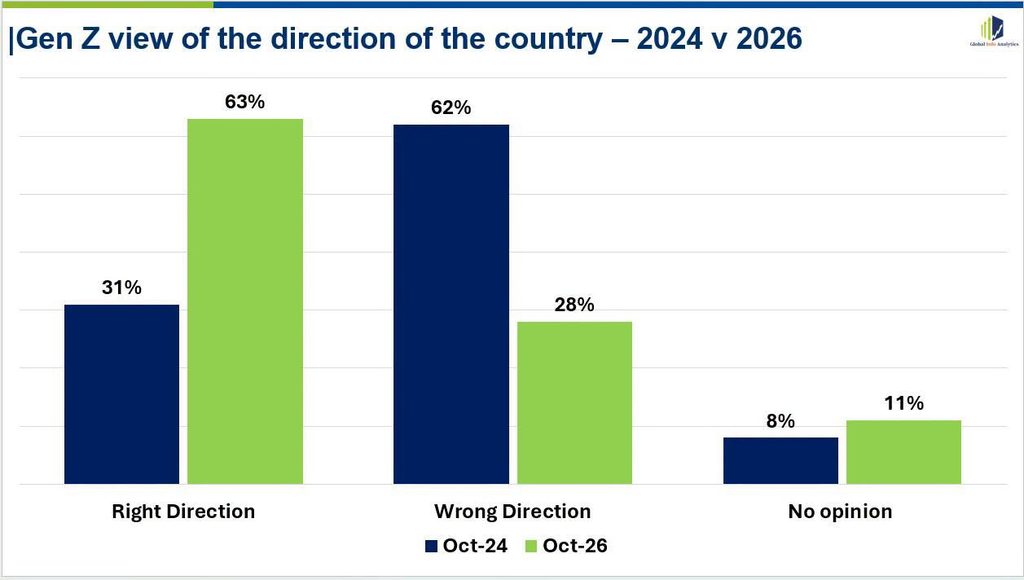
Mr Dankwa described “a completely different view” compared with two years ago. He argues that the shift adds another layer of evidence for the firm’s current 2028 numbers among young voters.
Mahama’s 2024 Lead Among Gen Z Grew
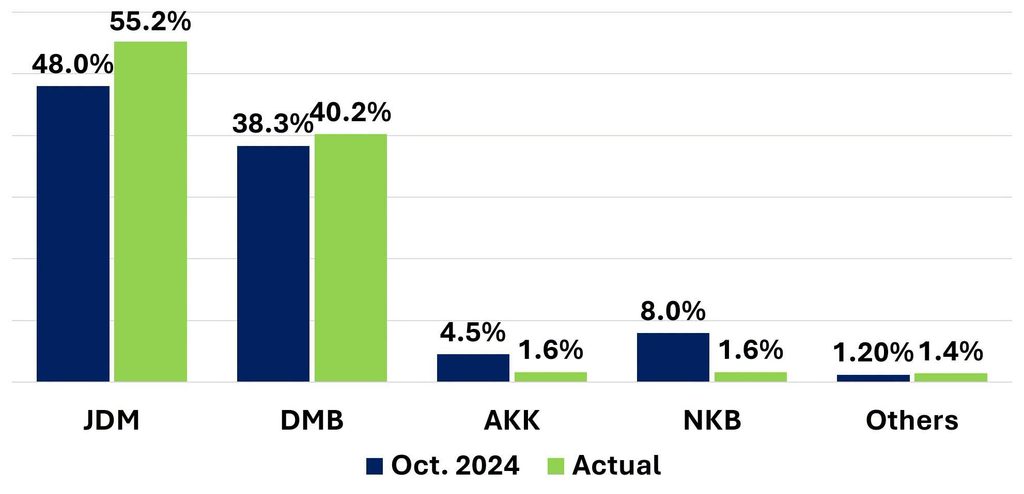
Gen Z voting intentions in October 2024 favoured John Dramani Mahama with 48 percent against 38 percent for Dr Bawumia. Nana Bediako took 8 percent, Alan Kyeremanten 4.5 percent, and other candidates 1.2 percent.
The September 2026 post-election poll shows President Mahama actually received 55 percent of Gen Z votes, a gain of seven points. Dr Bawumia gained nearly two points. Kyeremanten and Bediako, Mr Dankwa notes, “suffered a disastrous collapse,” which fed President Mahama’s 2024 landslide.
Ato Forson Outpaces Bawumia in 2028 Matchups
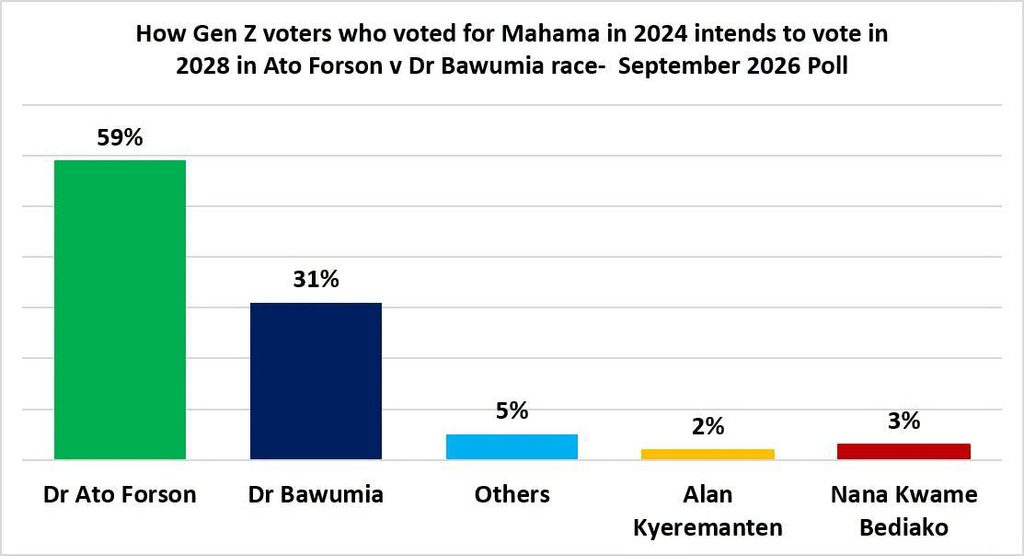
Mussa Dankwa tested two hypothetical NDC options. Against Dr Bawumia, Ato Forson takes 59 percent of Gen Z voters and Dr Bawumia 31 percent, with Nana Bediako on 3 percent, Kyeremanten on 2 percent, and others on 5 percent.
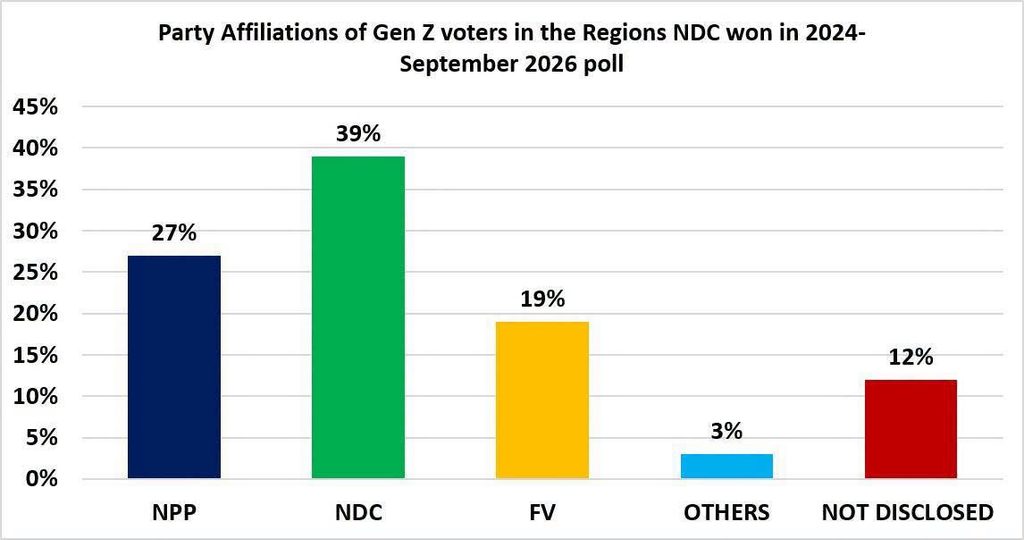
Johnson Asiedu Nketiah fares worse. He leads Dr Bawumia 45 percent to 35 percent, with Nana Bediako at 8 percent, Alan Kyeremanten at 7 percent, and others at 5 percent. The party affiliations of Gen Z voters show that 19 percent are floating voters.
Mr Dankwah used that group to make a point about age. “Using the Gen Z floating voters, one can clearly see the effect of age on the support for the candidates.” The pattern fits other surveys. A head-to-head poll in June put Dr Ato Forson at 54 percent against Dr Bawumia’s 35 percent, and he has won young delegates inside the NDC.
“The race between Ato Forson and Dr Bawumia resulted in a significant drop of votes for Dr Bawumia and a near collapse of Alan and Bediako votes as Ato Forson hit nearly 60% support.”
Mussa Dankwa, Pollster and Executive Director of Global InfoAnalytics
Jobs and Cost of Living Shape the Vote
Mussa Dankwa listed what moves these voters, disclosing that the poll also shows that Gen Z voters will be influenced by the job situation, economy, cost of living, and education. According to him, the government holds the advantage on favourability. Among Gen Z, the NPP’s net favourability stands at +5 percent and the NDC’s at +24 percent.
Satisfaction with specific programmes runs high. The Big Push draws 64 percent, Free Education 63 percent, No-Fee-Stress 61 percent and Adwumawura 57 percent. The 24-Hour Economy draws 50 percent, though most voters overall remain dissatisfied with it. Mr Dankwa reads that as voters “giving the government time.”
Loyalty and Defections Among 2024 Voters
Dr Bawumia’s 2024 Gen Z voters mostly stay with him. In a race against Dr Ato Forson, he keeps 81 percent, while 16 percent move to Dr Ato Forson and 1 percent each go to Alan Kyeremanten, Nana Bediako, and others.
Against Asiedu Nketiah, he retains 84 percent, and Asiedu Nketiah collects 12 percent, Alan Kyeremanten 3 percent, and others 1 percent, while Nana Bediako gets almost nothing.
However, President Mahama’s 2024 Gen Z voters split more under the same tests. With Dr Ato Forson on the ballot, 16 percent defect, of whom 11 percent go to Dr Bawumia, 2 percent to Alan Kyeremanten, 1 percent to Nana Bediako, and 2 percent to others.
With Asiedu Nketiah, defections rise to 26 percent, with 14 percent going to Bawumia, 5 percent to Nana Bediako, 2 percent to Alan Kyeremante, and 5 percent to others. The gap suggests that Dr Ato Forson holds more of President Mahama’s young base than Asiedu Nketiah does. The matchups are hypothetical, and nobody should read them as a forecast.
Mussa Dankwah’s analyses give no sample size, margin of error, or age range for Gen Z, so the subsample could carry wide error. The pollster has also warned that floating voters could decide the 2028 race and that the NPP faces an uphill battle.
READ ALSO: BoG Warns 2027 Budget Could Threaten Ghana’s Economic Stability