Ghana’s economic recovery could face another major test as the Bank of Ghana (BoG) prepares to scrutinise the government’s 2027 Budget, with concerns emerging over how public spending, domestic borrowing and fiscal financing arrangements could influence inflation, liquidity and exchange rate stability.
The central bank has signalled that it will not assess the upcoming budget merely as a government spending document. Instead, it intends to examine how the fiscal decisions of the government could affect the broader economy, particularly the progress made in restoring macroeconomic stability.
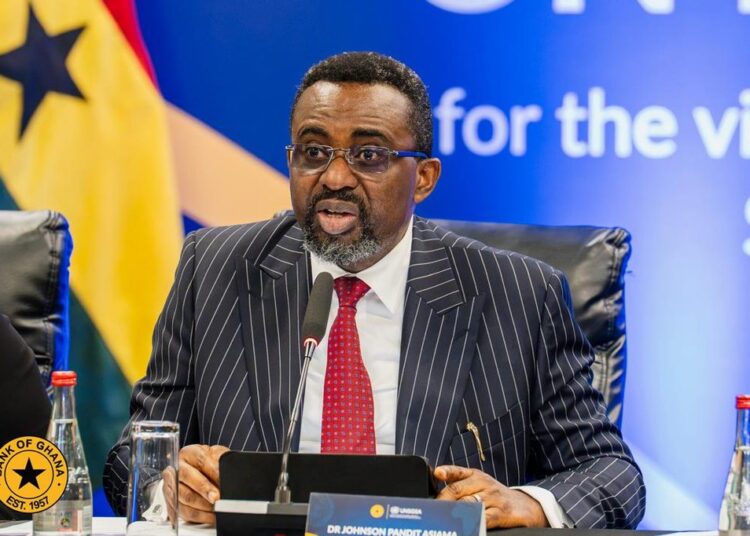
Governor of the Bank of Ghana, Dr Johnson Asiama, disclosed this during the opening of the 133rd Monetary Policy Committee (MPC) meeting, stressing that the financing arrangements and expenditure plans contained in the 2027 Budget would receive considerable attention from monetary policymakers.
His comments introduce an important dimension to Ghana’s economic outlook, as the government seeks to consolidate its recovery while increasing investment in productive sectors and stimulating economic growth.
BoG Raises Red Flags Over Government Spending
At the centre of the Bank of Ghana’s concerns is the potential relationship between government expenditure, domestic financing requirements and inflationary pressures.
Although the government is expected to pursue growth-oriented spending, the central bank believes the composition and timing of that expenditure could have significant consequences for liquidity conditions and the stability of the cedi.
Dr Asiama explained that the Monetary Policy Committee would carefully examine the government’s fiscal position, including the size and composition of the fiscal surplus and the methods through which its financing arrangements would be managed.
“The committee will need to carefully assess the size and composition of the fiscal surplus, its financing arrangements, and the likely implications for aggregate demand, for liquidity, for inflation, and for the exchange rate.”
Dr Johnson Asiama
This assessment could prove particularly important at a time when Ghana is working to protect the gains achieved through its recent monetary and fiscal adjustment efforts.
An increase in government spending, especially when supported by substantial domestic borrowing, could introduce additional liquidity into the financial system and complicate the central bank’s efforts to manage inflation.
The concern is not necessarily that government spending is undesirable, but that poorly coordinated fiscal decisions could weaken the effectiveness of monetary policy.
The Cedi and Inflation Face Another Critical Test
One of the biggest issues emerging from the Governor’s remarks is the potential impact of the 2027 Budget on exchange rate stability.
Ghana’s currency performance remains an important component of the country’s economic recovery, given the influence of exchange rate movements on imported goods, production costs, consumer prices and business confidence.
If government financing requirements increase pressure on domestic financial markets or create excess liquidity, the consequences could extend beyond the banking sector.
Inflationary pressures could re-emerge, while renewed currency instability could increase the cost of imports and place additional pressure on households and businesses.
The BoG is therefore particularly interested in understanding how the government’s expenditure decisions will interact with prevailing monetary conditions.
Dr Asiama indicated that the timing and distribution of government spending would be equally important in determining liquidity conditions across the financial system.
This suggests that even when overall expenditure remains within planned fiscal limits, the manner in which funds enter the economy could influence the central bank’s policy considerations.
Domestic Borrowing Could Complicate Monetary Policy
Another critical area under scrutiny is the government’s domestic financing requirement.
When government relies heavily on the domestic financial system to finance its expenditure, it can influence interest rates, liquidity availability and the amount of credit accessible to private businesses.
Such developments could complicate efforts to maintain favourable monetary conditions, particularly when policymakers are attempting to encourage private sector activity without reigniting inflation.
The BoG’s assessment will therefore extend beyond the headline fiscal figures to examine how the government’s financing strategy could affect monetary policy transmission.
This is especially significant as Ghana seeks to strengthen private sector participation in economic growth and expand productive investment.
A fiscal strategy that places excessive pressure on domestic financing sources could undermine these objectives by affecting credit conditions and liquidity distribution.
BoG Demands Stronger Fiscal-Monetary Coordination
Beyond the immediate concerns surrounding government spending, Dr Asiama emphasised the importance of maintaining coordination between fiscal and monetary authorities.
The Governor believes that the country’s economic stability will depend partly on ensuring that government budgetary decisions support, rather than undermine, the objectives of the central bank.
“The objective is to ensure that the fiscal and monetary policy frameworks remain coherent and mutually reinforcing in preserving macroeconomic stability,” he added.
The statement highlights the importance of policy consistency as Ghana moves towards another budget cycle.
While the government seeks to accelerate economic growth through productive investments, the Bank of Ghana must ensure that these ambitions do not create fresh inflationary pressures or destabilise the exchange rate.
Ultimately, the 2027 Budget will face scrutiny not only over how much government intends to spend, but also how that expenditure will be financed and distributed throughout the economy.
With the MPC preparing to assess the implications of the government’s fiscal direction, the relationship between public spending and monetary stability is emerging as one of the defining economic questions ahead of 2027.
READ ALSO: BoG Targets Banking Bottlenecks in Major Monetary Policy Review