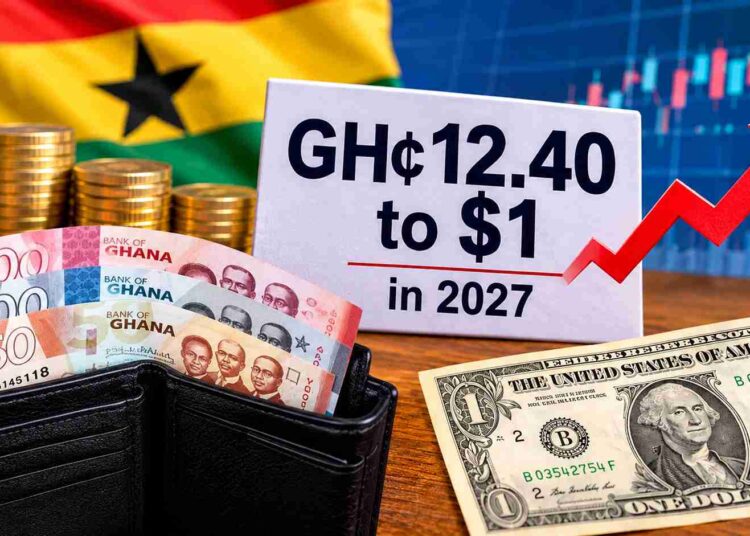
Ghana’s currency could be heading for another difficult year in 2027, with Fitch Solutions projecting that the cedi will average GH¢12.40 to the US dollar as emerging external pressures threaten to reverse some of the gains recorded in the foreign exchange market.
The forecast raises fresh concerns about the sustainability of the cedi’s recent performance, particularly as Ghana seeks to rebuild its foreign exchange reserves while navigating an uncertain outlook for international gold prices.
According to Fitch Solutions, the combination of moderating gold prices and the government’s efforts to accumulate foreign exchange reserves could reduce the volume of dollars entering the domestic market, creating renewed pressure on the local currency.
Associate Director at Fitch Solutions, Mike Kruiniger, disclosed the projection at a Post-Budget Forum, warning that the anticipated developments could also revive price pressures across the economy.
“We expect to see the currency to weaken a little bit, and that is going to bring back some important price pressures next year.”
Mike Kruiniger
His remarks introduce a potentially difficult dimension to Ghana’s 2027 economic outlook, particularly at a time when policymakers are working to consolidate macroeconomic stability, contain inflation and strengthen the country’s external position.
GH¢12.40 Forecast Raises Fresh Cedi Concerns
Fitch Solutions expects the Ghana cedi to trade at an average of GH¢12.40 to the US dollar in 2027, reflecting what the firm considers a challenging combination of external and domestic foreign exchange pressures.
The projection is partly linked to expectations that international gold prices will moderate, potentially reducing Ghana’s export earnings and the foreign currency inflows available to support the local currency.
Gold has become an increasingly important source of foreign exchange for Ghana, particularly as authorities intensify efforts to leverage the country’s mineral resources to strengthen external reserves.
Any significant moderation in international gold prices could therefore have implications beyond the mining industry, affecting the country’s foreign exchange supply, reserve accumulation efforts and exchange rate stability.
The concern is that a reduction in dollar inflows could leave the domestic foreign exchange market with fewer resources to meet demand from importers, businesses and other economic operators.
Kruiniger explained that the expected developments could combine to create additional pressure on the cedi.
“So put these two things together, we think there will be a little less foreign currency flowing into the domestic market next year, which will create some pressure on the cedi.”
Mike Kruiniger
Reserve Accumulation Could Tighten Dollar Supply
Another important factor behind Fitch Solutions’ projection is the government’s commitment to rebuilding Ghana’s foreign exchange reserves under the Ghana Reserve Accumulation Programme (GANRAP).
The programme forms part of broader efforts to strengthen the country’s external buffers and improve its capacity to withstand external economic shocks.
Although accumulating reserves is important for protecting the economy against future vulnerabilities, the process could have implications for the immediate availability of foreign currency within the domestic market.
As the authorities seek to retain more foreign exchange to strengthen reserve holdings, the amount of dollars circulating in the domestic market could become relatively constrained.
This creates a delicate policy balance between strengthening the country’s external position and ensuring that businesses and other market participants have sufficient access to foreign currency.
Ghana’s ability to manage this balance will be particularly important in 2027, when external conditions could become less favourable.
The challenge is not necessarily that reserve accumulation will weaken the cedi on its own, but that it could coincide with softer gold prices and reduced foreign exchange inflows, creating additional pressure on the exchange rate.
Weaker Cedi Could Reignite Inflation Pressures
Beyond the exchange rate itself, Fitch Solutions’ projection raises concerns about the potential consequences for domestic inflation.
A weaker cedi generally makes imported goods and services more expensive, particularly when importers must spend more local currency to obtain the same amount of foreign exchange.
Ghana’s dependence on imported fuel, machinery, pharmaceutical products, industrial inputs and other essential commodities means that exchange rate movements can quickly influence production costs and consumer prices.
Businesses that rely heavily on imported raw materials could face higher operating expenses, potentially forcing them to increase prices or absorb additional costs at the expense of their profit margins.
Consumers could also feel the effects through higher prices of imported products and locally manufactured goods that depend on foreign inputs.
This could complicate the inflation outlook, especially if exchange rate depreciation coincides with other cost pressures within the economy.
The concern is particularly significant because Ghana has spent considerable time bringing inflation down from the elevated levels recorded during the country’s recent economic crisis.
A renewed depreciation cycle could therefore test the Bank of Ghana’s monetary policy efforts and complicate the task of sustaining price stability.
Stronger Dollar and Falling Gold Prices Pose External Risks
Fitch Solutions has also identified movements in the US dollar and international gold prices as important external risks that could shape Ghana’s economic performance in 2027.
Kruiniger indicated that a stronger US dollar could exert downward pressure on international gold prices, potentially reducing Ghana’s export earnings.
Such a development could create a difficult chain reaction for the economy.
Lower gold prices could reduce foreign exchange earnings, while a stronger dollar could increase pressure on the cedi. The resulting depreciation could then feed into domestic prices, raising the cost of imports and potentially reviving inflationary pressures.
These risks highlight Ghana’s exposure to developments in international financial and commodity markets, where domestic policymakers have limited control over the forces driving prices and currency movements.
2027 Could Test Ghana’s Economic Stability
Fitch Solutions’ GH¢12.40 exchange rate forecast places the cedi’s outlook among the important economic issues Ghana must confront in 2027.
The projection does not necessarily mean that the currency will experience a disorderly decline, but it signals that maintaining exchange rate stability could become more challenging as the country pursues reserve accumulation and faces uncertainty over gold earnings.
The government’s ability to sustain foreign exchange inflows, strengthen export earnings and manage reserve accumulation without creating excessive pressure on domestic dollar supply will be crucial.
The Bank of Ghana will also have to monitor the relationship between exchange rate movements, inflation expectations and foreign exchange market conditions.
While Ghana’s reserve accumulation ambitions remain important for long-term economic resilience, the emerging risks suggest that protecting the cedi will require careful coordination between external sector policies and domestic macroeconomic management.
READ ALSO: BoG Deputy Governor Exposes Critical Gap in Ghana’s Banking Management