The money for the Accra–Kumasi Expressway is largely in the bank. The dates, the railway’s price tag and the procurement details are not in the budget. They are what citizens should demand.
Every budget season produces large numbers. The 2027 Budget has plenty: GH¢98.4bn in planned capital expenditure, a GH¢27.8bn “Big Push” programme and a GH¢11.3bn allocation to the Ministry of Roads and Highways. Behind those figures stand two flagship projects, a six-lane expressway between Accra and Kumasi and a railway into the country’s mineral heartland.
I read the budget alongside my earlier analysis of Ghana’s road plans, checking what is firmly committed and what is left open. The funding story is stronger than many expected. The delivery story is thinner than the headlines suggest.
The expressway: money in the bank, a thin cushion
The budget describes the Accra–Kumasi Expressway as a 198.7-kilometre, six-lane road. The engineer’s construction estimate is US$2.98bn.
That works out at roughly US$15m per kilometre, my own calculation from the budget’s figures. The estimate includes contingencies, supervision, land acquisition and compensation, and it is more than US$1bn below an earlier figure of about US$4bn.
The funding side is unusually concrete. As at 11 November 2026, the dedicated project account at the Bank of Ghana held US$2.2bn and GH¢9bn, which the budget puts at about US$3bn.
Petroleum revenue channelled through the Annual Budget Funding Amount (ABFA) and mineral royalties fund it, with no borrowing. The budget also says US$556m of ABFA was transferred in the first ten months of 2026.
That is a real achievement, and it deserves credit. Two cautions apply, though.

First, the cushion is thin. About US$3bn in the account against a US$2.98bn estimate leaves almost no margin, and “about US$3bn” is a rounded figure. The headline saving of more than US$1bn is an estimate, not a bid. Only the tender will show what the road actually costs.
Second, the budget does not explain how the account reached its balance. It does not break down the contributions by source or by year. Citizens can see the balance but not the build-up.
What the budget does say about procurement
On procurement, the budget is clearer for the expressway than for anything else. Tenders have been issued through international competitive tendering and are due to conclude by the end of 2026, about five weeks from now. Awards require commitment-control approval and a value-for-money assessment. The budget does not describe the process as single-source or sole-source.
That matters because the alternatives carry different risks. Open competition gives the best chance of finding a fair price and limits favouritism, though it is slower and depends on rigorous evaluation. A restricted tender, where only invited firms bid, is faster but narrows competition and can be gamed through the shortlist.
A single-source or sole-source award, a direct deal with one supplier, can be defensible when work is urgent or the technology is proprietary. It also carries the highest price risk and the weakest transparency. Such exceptions normally need justification and approval under the Public Procurement Act.
Readers should check the current text of the Act, because this point comes from general procurement practice rather than the budget.
The open questions are practical ones. How many firms will bid? Will the evaluation report and the award price be published? And what is the Ghana Armed Forces’ role? The budget says the military is securing the right of way. It does not say whether the Armed Forces will do anything beyond that.
The railway: a promise without a price
The Western Corridor Railway is the harder case. The budget describes a line from Takoradi through Nsuta and Awaso to Nyinahin, with construction planned from 2027. It is meant to move manganese and bauxite, and from 2030 the line is to extend north to Hamile, linking a planned inland port that would serve Burkina Faso, Mali, Niger and the wider Sahel. The budget cites about one billion tonnes of bauxite estimated at Awaso and Nyinahin.
The strategic logic is easy to understand. Stranded minerals could be moved to the coast and processed locally, creating jobs and adding value. A freight line could also ease pressure on the roads.

The planning gaps are harder to understand. The budget says the railway will be built with the government’s own resources, with petroleum revenue and mineral royalties dedicated to it in 2027 and 2028. The wording is a proposal that needs Parliament’s approval. Yet it publishes no total cost, no line length and no design standard. It names no procurement route.
The Armed Forces are securing the right of way while feasibility, engineering design, costing and environmental and social studies are all still ongoing. In plain terms, the plan is to start building in 2027 before the studies that should justify the design and price are complete.
The 2027 vote for “ongoing railway development” in the budget appendix is only GH¢174m. The budget does not say that this line is the Western Corridor. The mining side also has loose ends. The Nyinahin mining lease still needs parliamentary ratification and environmental permits from the Environmental Protection Agency in 2027.
The funding source adds a further risk. The budget projects ABFA falling from US$665.6m in 2027 to US$515.5m in 2028, a drop of 22.6%. A railway funded partly from an oil-linked stream that is shrinking needs a clear funding plan. The budget does not say how much of the combined envelope goes to the railway, or whether those revenue lines overlap with money already counted inside the capital totals.
Four totals for the same programme
The most basic accountability problem is that the budget gives different numbers for the same things.
The 2027 Big Push appears as GH¢27.8bn in one place, GH¢28bn in another and GH¢29.8bn in a third. Total capital expenditure appears as GH¢98.3bn, GH¢98.4bn and GH¢100.4bn in the main fiscal appendix, and GH¢120.5bn when transfers are included. The roads ministry’s capital spending is GH¢7.8bn in the narrative and GH¢7.6bn in the appendix, which shows GH¢7.77bn once staff costs are counted.
Some of these differences may be rounding or definitions. Two of them are not obviously so: the gaps in the capital total and in the Big Push are each about GH¢2bn, and the budget does not say whether they are linked. The Ministry of Finance should explain it.

There is also an opacity problem inside the Big Push. Only GH¢2.4bn is named, GH¢2bn for the Market Access and Connectivity project and GH¢400m for the Volivo Bridge. That is 8.6% of the programme. The remaining GH¢25.4bn sits in a single line with no project list. The programme is also set to grow, with indicative figures of GH¢46.3bn in 2028 and GH¢59.5bn in 2029. A fund of that size, with no published project list, is hard for the public to follow.
Allocations do not equal completions
Why does this matter? Because the record on turning allocations into finished roads is mixed. Capital spending between January and October 2026 reached GH¢41.4bn against a target of GH¢45.3bn, about 91%, by my calculation.
The budget’s own progress table for the four Accra–Kumasi by-passes, at Osino, Anyinam, Enyiresi and Konongo, shows the gap. Only one of the eight carriageways, Anyinam North Bound, is reported complete. The other seven stand between 62% and 77%. These by-passes are far smaller than the expressway.
Who answers for what
The budget names institutions, but responsibility is spread across them. The Ministry of Finance handles commitment control and value-for-money assessments. The Bank of Ghana holds the expressway account.
The Ministry of Roads and Highways oversees the road programme. The Ministry of Transport and the Ghana Railway Development Authority cover rail. The Armed Forces secure the right of way.
The new Value for Money Office, created under Act 1172, is meant to strengthen accountability for public investment. GIADEC and Parliament handle the Nyinahin lease and the revenue dedication.
What the budget does not do is name one owner for the expressway or one lead agency for the Western Corridor, and it does not say what the Value for Money Office will examine on these projects. When responsibility is spread across institutions, accountability tends to slip.
What to watch
The budget is not a delivery plan, so the public needs its own checkpoints. I would track eight things:
- Tender outcome: the winning price against US$2.98bn, and the number of bidders.
- Approvals: whether the commitment-control and value-for-money reports are published before award.
- The project account: its balance, drawdowns and sources, reported quarterly.
- Physical progress: percentage complete against a milestone plan, with an independent engineer.
- The Big Push list: a project-level breakdown, ideally at the Mid-Year Budget Review.
- Railway readiness: the cost, completed studies, permits and procurement route published before construction.
- Right of way: land secured, compensation paid and the Armed Forces’ exact role.
- Audit: review by Parliament and the Auditor-General.
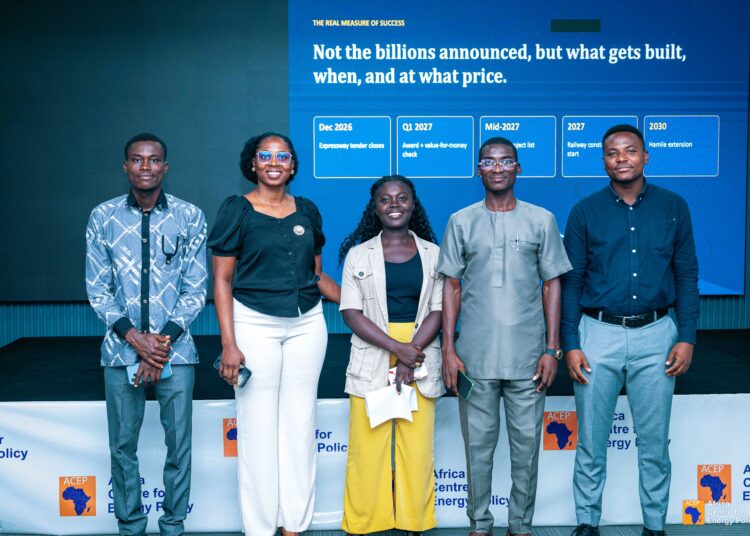
The first firm date is close. The expressway tender is due to close by the end of this year, and the award and value-for-money checks follow. The railway’s 2027 start and the Hamile extension from 2030 are further out.
The real measure
The budget gives Ghana a real asset in a funded expressway account and a bold plan for mineral rail.
It also leaves unanswered the questions that decide whether big projects deliver value: when work starts and ends, what the railway will cost, how the contracts are awarded, who answers for them and how progress will be reported.
The measure of success is not the billions announced. It is the roads and rails that get built, on time, at a fair price, with the evidence published for citizens to see.
By: Participants of African Centre for Energy Policy’s (ACEP) Post Budget Workshop (GROUP FOUR)
READ MORE: Ghana Woos Tunisia for Auto Investment Supply Hub in Winneba