Even though inflationary pressures continue to ease as the economy recovers from the COVID-19 pandemic, the cost of vegetables has been the major source of food price increments over the past 11 months of the year.
Over the years, food has been the major driver of inflation in Ghana. Careful analyses revealed that the vegetable subclass of the food category has always been among the top subclasses with the highest rates of inflation every month.
Even though the average price of vegetables has seen a decline as COVID-19 restrictions continue to ease, they are still well above rates recorded before the first case of the virus was recorded in March.
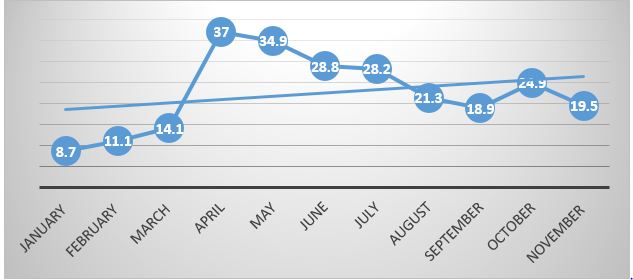
In November 2020, Food contributed 53.0% to the total inflation and was the predominant driver of year-on-year inflation. Within the food Division, vegetables recorded a rate of 19.5% which is the subclass with the second-highest rate behind fruits and nuts (21.7%).
Presenting the CPI rate, the government statistician, Prof. Samuel Anim Kobina said “even though Vegetable inflation is still higher than average Food inflation and overall inflation, it was 5.4 percentage points lower this month compared to last month (24.9%)”.
In October 2020, the Food and Non-alcoholic beverages recorded a year-on-year inflation rate of 12.6 percent, 1.4% higher than 11.2% recorded for September 2020. Within Food subgroups, Vegetables recorded a rate of 24.9%, higher than the group’s average.
Within Food subgroups, Vegetables recorded inflation rates of 18.9% higher than the group’s average rate of 13.7 % in September 2020. Food contributed 47.6% to the total inflation and thus was the predominant driver of year-on-year inflation.
Year-on-year inflation rates for vegetables
Source: Ghana Statistical Service
The Food and Non-alcoholic beverages recorded a year-on-year inflation rate of 11.4 percent for August. The rate is 2.3% lower than the 13.7% recorded for July 2020. The vegetable subgroup still recorded the highest rates of inflation.
“Two subgroups recorded inflation rates higher than the group’s average rate of 13.7 percent, they are Vegetables (21.3%), Fish and other Seafood (14.3%) and this translates to Food being the predominant driver of year-on-year inflation in August”, said Prof. Anim.
A similar trend was observed in July. The Food and Non-alcoholic beverages inflation rate was 13.7 percent, 1.0% lower than the 13.8% recorded for June 2020.
Even though the vegetables subclass still recorded the highest rates, three subgroups recorded inflation rates higher than the group’s average rate of 13.7 percent. They were Vegetables (28.2%), Fish and other Seafood (16.1%), Fruits and Nuts (13.0%) and this translates to Food being the predominant driver of year-on-year inflation in July.
Furthermore, food and non-alcoholic beverages recorded a year-on-year inflation rate of 13.8 percent in June. Three subgroups recorded inflation rates higher than the group’s average rate of 13.8 percent; Vegetables (28.8%), Fruits and Nuts (17.4%), and Fish and other Seafood (14.3%). As usual, this translates to Food being the predominant driver of year-on-year inflation
In May, the Food and Non-alcoholic beverages recorded a year-on-year inflation rate of 15.1 percent, 0.7% higher than 14.4% recorded for April 2020. With a rate of 34.9%, the vegetable subgroup recorded an inflation rate higher than the group’s average rate of 15.1 percent. Food was the predominant driver of year-on-year inflation.
Vegetables recorded an inflation rate of 37.0% in April which is higher than the group’s average rate of 14.4 percent.
The Food and non-alcoholic beverages recorded a year-on-year inflation rate of 8.4 percent in March, 0.5% higher than 7.9% recorded for February 2020. Eight subgroups recorded inflation rates higher than the group’s average rate of 8.4 percent. Vegetables recorded the highest rates of 14.1%.
However, in February 2020, eight subgroups recorded inflation rates higher than the group’s average rate of 7.9 percent. They were Fruits and Nuts (14.1%), Cocoa drinks (14.1%), Vegetables (11.1%), Ready-made food (10.5%), Fish and other seafood (9.9%), Coffee and coffee substitutes (9.7%), soft drinks (9.7%), Soft drinks (9.7%) and Fruits and Vegetable Juices (9.5%).
And in the first month of the year, Food and the non-alcoholic beverages inflation rate was 7.8 percent, 0.6% higher than 7.2% recorded for December 2019. Eight subgroups recorded inflation rates higher than the group’s average rate of 7.8 percent. The vegetable subgroup recorded a rate of 8.7%.
Based on these analyses, inflation can be reduced drastically if the prices of vegetables can be brought down to the barest minimum. Subsidies to vegetable farmers, provision of storage facilities to farmers to ensure constant supply and reduce post-harvest losses, provision of irrigation facilities to vegetable farmers are all measures that can be taken to reduce the cost of vegetables in Ghana.
More importantly, proper road networks should be built to link the rural farming communities to areas where there is a market for their produce. This will reduce the transportation costs that are mainly responsible for the increasing vegetable prices in the cities.