The seismic aftershocks of Russia’s invasion of its neighbour, Ukraine, on 24 February 2022 continues to reverberate across the globe.
As members of the United Nations Security Council, Ghana, Kenya and Gabon have publicly condemned Russia’s actions in a vote cast during an emergency session on 25 February 2022. While the reasons for the invasion are many, the conflict is already taking its toll on an already fragile global economy barely recovering from one of the worst economic downturns since the Great Depression.
The conflict has added more uncertainty to the prospects of an even and equitable recovery, which is already under the strain of vaccine inequity, supply chain shocks and resultant global inflationary pressures.
To put things into context, the crisis has already sent oil prices to near 14-year highs, with Brent crude hitting over US$130 per barrel. There have been similar spikes in global gas markets. And equities and soft commodities, like wheat, have also seen significant volatility.
Even before the start of the Russia-Ukraine conflict, several emerging market economies like Ghana were already classified as being at high risk of debt distress. Further compounding the debt issue is that any hikes in interest rates by the US Federal Reserve System will cause some portfolio outflows from Ghana and increase the cost of international financing – 30% of Ghana’s domestic debt is held by individual investors, firms and institutions.
The elevated debt pressures also come amid rising inflation concerns.
Finally, access to the international capital markets, such as Eurobonds, by the government to finance the 2022 budget has also become increasingly difficult in the face of recent sovereign risk downgrades and tight global financial conditions.
Given this context, a prolonged Russian-Ukraine conflict will cause further economic dislocations to Ghana. This will happen primarily via two channels: oil prices and sourcing inputs for the agricultural sector.
Ghana’s vulnerabilities
Ghana became a crude oil-exporting nation in December 2010. Since then production has risen by 173% from 68,000 barrels of oil equivalent per day (bopd) 2011 to 185,000 bopd from three fields as of December 2020.
Ghana is a net exporter of crude oil as the figure below shows. Oil exports amounted to US$3.9 billion (5.4% of GDP) at the end of 2021.
Ghana crude oil import and export 2000-2020 (thousand bbls per day)

Ghana crude oil import 2000-2020 (thousand bbls per day; %)
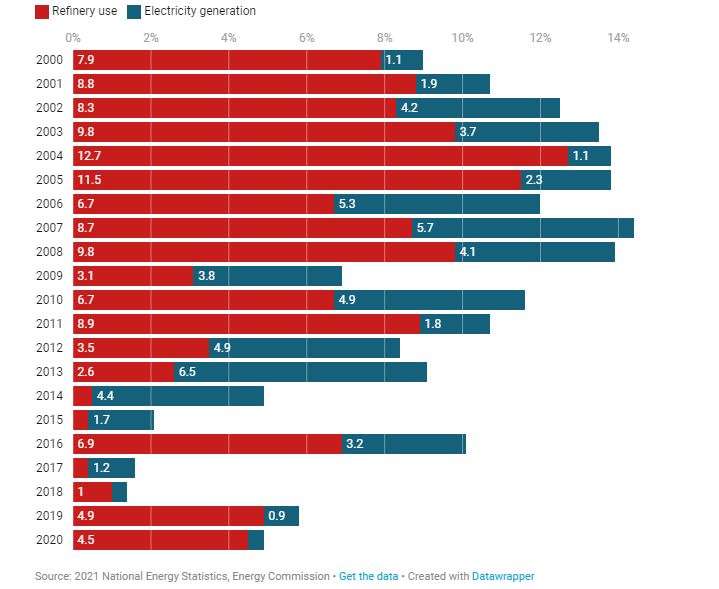
As a net exporter of crude oil, the spike in the oil price should be positive for Ghana’s trade balance. But, in fact, the country is highly vulnerable to oil price shocks. This is because, although it prefers to export its relatively higher-grade crude to attract premium prices, it nonetheless imports a significant share of petroleum products. This includes petrol and diesel.
Bank of Ghana data show that the country’s oil import bill amounted to US$2.7 billion (3.8% of GDP) at the end of 2021.
Years of under-investment and neglect has resulted in inadequate local refining, especially at the country’s main oil refinery – Tema Oil Refinery. This means that the country imports about 80% of finished petroleum products.
In addition, fuel prices are a key driver of inflation in Ghana. This means that any hikes in global oil prices feeding through into petroleum product imports will significantly escalate inflation. The January 2022 year-on-year inflation rates by major consumption groups published by the Ghana Statistical Service show that transportation (17.4%) and housing, electricity and gas (28.7%) are the biggest inflation drivers.
This is all the more concerning given that inflation, currently at 13.6% for January 2022, is already outside of the central bank’s 6% – 10% target range.
The war in Ukraine will affect Ghana in other ways too. Take agri-inputs. Data from the Canadian government indicate that both Russia (20%) and Belarus (17.6%) control almost 40% of the total global potash (potassium chloride) fertiliser exports. The imposition of sanctions on Russia will significantly constrain the supply of potash fertilisers and lead to higher prices for farmers and eventually consumers. In 2019, Ghana imported 17% of its potash from the Russian Federation.
Energy is also an input cost, putting further cost pressures on fertiliser production.
Ghana’s trade with Russia is small. Nevertheless, a spike in fertiliser prices will be felt in the country, as as well restrictions on grain imports. Russia and Ukraine between them supply about 30% of total global wheat exports.
Ghana’s wheat imports for 2020/21 were estimated by the United States Department of Agriculture at 990,000 metric tons. It has historically grown at an average of 5% per year.
About 85% of wheat flour imported into Ghana is used for making bread and the rest for other pastries. Ghana imports about 50% of its wheat from Canada, with the remainder coming from Russia, France and the US.
Another possible indirect impact of the conflict will be increased compliance risks. Countries and businesses doing business with Russia, or Russian businesses are likely to face additional scrutiny. In addition, Russia being locked out of the global SWIFT system will make transactions difficult.
Mitigation strategies
The COVID-19 pandemic and now the impact of the Russia-Ukraine conflict continues to expose fundamental structural weaknesses in Ghana’s economy: the lack of diversification and stalled structural transformation despite the commodities price boom of the past 10 to 15 years.
As we showed in a recent paper, fiscal policy is related to commodity and electoral cycles. Our analysis shows a constrained fiscal space over the medium term – from 2022 to 2024.
To improve on the country’s finances and ensure more inclusive growth, we proffer the following:
Firstly, countries like Ghana should increasingly seek self-sufficiency and reliance as an all-round strategy in the long term. Agriculture, in particular, offers opportunities. For example, the country could grow and process enough of staples like tapioca (cassava flour) and corn flour as substitutes for wheat flour. Nigeria has demonstrated this self-sufficiency possibility with rice production. The development literature shows that cleverly designed import substitution policies linked to the development of especially agri-industrial value chains can support trade balances and create much needed jobs.
Secondly, Ghana must speed up renewable energy programs to further diversify its energy mix, improve energy security, and urban mobility initiatives to improve efficiency. This will help reduce fiscal shocks due to expensive oil product imports for power generation and transportation. In addition, the Tema Oil Refinery must also be functional instead of just being used as a tank farm by importers of petroleum products.
Thirdly, post-COVID-19 budget financing needs to move from just counting inputs such as building roads and hospitals to measuring outcomes — that is, establish clear links to reducing the country’s rising poverty and inequality. Ghana has clear competitive advantages. Examples include digitalization of government and governance services to reduce corruption and improve administrative efficiencies.
Finally, Ghana needs to strengthen its public procurement systems backed by effective internal and external audits to ensure value for money. Spending in areas like infrastructure, health, education, social security should deliver operational efficiency: value-for-money, optimal utilization, thereby ensuring budget credibility.
READ ALSO: USD5 Billion Revenue Target From Non-Traditional Exports By 2022 Cannot Be Achieved – Economist