The African Development Bank (AfDB) President, Dr Akinwumi Adesina, has stated that the global financial architecture constrains Africa’s development. He thus recommends five ways it can be made fairer.
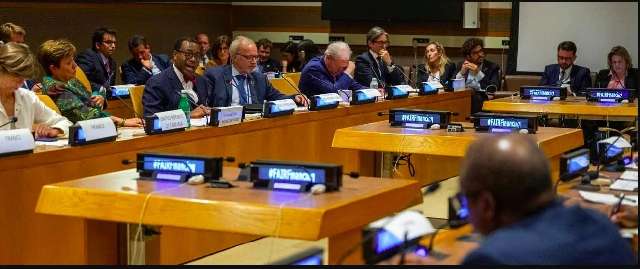
Speaking at a high-level roundtable, Adesina noted that the international financial architecture was not delivering the scale of resources needed to allow Africa to achieve its growth and development priorities. He said Africa faced a financing gap of $1.2 trillion through 2030 to finance its Sustainable Development Goals.
Adesina noted that the second constraint is that the international financial architecture was not providing climate financing at the scale needed for Africa to adapt to climate change. Adesina said “Africa contributes only 3% of global emissions and suffers disproportionately from climate change, losing $7–15 billion annually. This figure is expected to rise to $50 billion by 2030. Yet, Africa faces a climate financing gap of $213 billion annually through 2030”.
The third constraint, the Bank chief noted, is that the current international financial architecture makes debt restructuring too complex to achieve, since debt restructuring is disorderly, protracted, and costly. He explained that this poses serious risks for African countries facing debt distress.
According to Adesina, the global financial architecture also skews international emergency financial resources in favour of richer countries that least need the resources. He noted, for example, that of the $650 billion in Special Drawing Rights (SDRs) issued by the International Monetary Fund (IMF), Africa received just $33 billion or 4.5%.
The fifth constraint the African Development Bank head underlined is that the current international financial architecture delivers uneven fiscal responses for developing countries during times of global shocks. He said while total fiscal measures taken to fight the COVID-19 pandemic amounted to $17 trillion or 19% of global GDP, Africa received just $89 billion, which represented 0.5% of global value.
Ways The Global Financial Architecture Could Be Made Fairer
Adesina offered five ways in which the global financial architecture could be made fairer. First, scaling up financing for global development provides opportunities to leverage the private sector.
Adesina averred that multilateral development banks must deploy risk mitigating instruments—including foreign exchange risk mitigation—to leverage the almost $145 trillion in assets under management by institutional investors for climate-related projects.
A second solution, he said, is to simplify the global climate finance architecture, making it better coordinated, and strengthening the capacity of countries to access climate funds. He suggested that loans should contain contingency clauses that free up countries from loan repayments when they face climate shocks.
Thirdly, Adesina urged multilateral development banks to change their business models to deliver greater volumes of concessional financing for countries. He said it is necessary to fast-track the G20 Common Framework for Debt Treatments to deliver debt restructuring and debt resolution faster.
The African Development Bank chief’s fourth recommendation is better capitalisation of multilateral development banks. According to Adesina, this requires an increase in their capital base, especially through large increases in paid-in capital, which is needed to leverage more financing.
Adesina’s fifth recommendation for making the global financial architecture fairer is for a portion of IMF Special Drawing Rights (SDRs) from SDR donor countries to be channelled to multilateral development banks. He explained that the African Development Bank and the Inter-American Development Bank hadve developed a model that would allow for SDRs to be leveraged by a multiple of three to four, while preserving their reserve asset quality.
The Bank chief said what was needed now was for five donor countries to form a group and help rechannel SDRs to Africa through the African Development Bank. IMF Managing Director Kristalina Georgieva, seated next to Adesina, said her institution supported the model.
Adesina said a $25 billion SDR rechannelling would create $100 billion in additional financing for Africa.
The African Development Bank head said SDR rechannelling would be at no cost to taxpayers in donor countries and there were zero risks of loss. He explained that SDR-rechannelling through multilateral development banks was the best model available to leverage and deliver the trillions of dollars needed for development to be accelerated.
He intimated that the issuance of $500 billion in new SDRs to tackle climate change—if re-channelled through multilateral development banks, would deliver $2 trillion in global development financing, complementing the IMF’s efforts.
“To achieve a fair, more just, and equitable world, we must change the structure, conduct and performance of the global financial architecture,” Adesina concluded, adding that the world’s collective future depended on it.
READ ALSO: UNDP Partners Absa Bank to Launch MSMEs Challenge to Empower Businesses