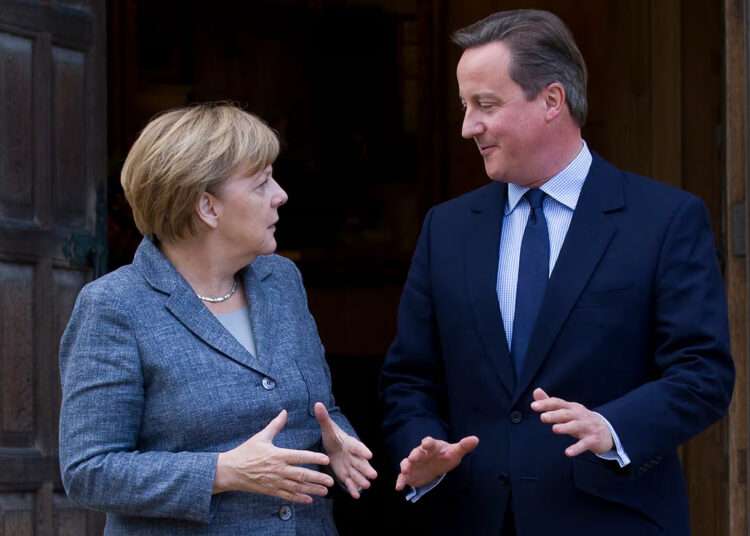
Angela Merkel, the former German Chancellor, has reflected on the Brexit referendum, calling the result a “humiliation, a disgrace” for the European Union.
In her autobiography, Freedom, set for release onTuesday, November 26, Merkel delves into her struggles to assist then-British Prime Minister David Cameron in keeping the UK in the EU, while ultimately attributing the Brexit outcome to Cameron’s own political decisions.
Merkel, who left office three years ago, dedicated five pages of her 700-page memoir to Brexit.
She traced the roots of the UK’s eventual departure to Cameron’s 2005 proposal for Conservative MEPs to leave the European People’s Party (EPP), the EU parliament’s main center-right alliance, over its support of the Lisbon Treaty in 2009. The treaty, which introduced significant changes to the EU’s structure, was labeled undemocratic by anti-European critics.
The referendum result, which saw Britain vote to leave the EU, left Merkel feeling deeply disheartened. “To me, the result felt like a humiliation, a disgrace for us, the other members of the European Union – the United Kingdom was leaving us in the lurch,” she wrote.
Merkel recounts “trying wherever possible to help David Cameron” despite opposition from other EU leaders, who viewed Cameron’s demands as unreasonable.
She recalls standing by Cameron’s side during a pivotal February 2016 summit of EU leaders where a deal was brokered to address Britain’s renegotiation demands.
“My support of him rendered me an outsider with my other colleagues … And yet, during the summit, I steadfastly remained by David Cameron’s side for an entire evening.”
Angela Merkel
Past Decisions Haunt Brexit Outcome
Despite her efforts, Merkel ultimately concluded that Brexit was unavoidable, citing a series of missteps that had fueled Euroscepticism in the UK. Among these, she highlighted Britain’s decision not to impose transitional restrictions on workers from Eastern Europe when 10 new member states joined the EU in 2004. This policy, enacted under the Labour government, led to an influx of migrants, which Eurosceptics used to tarnish the concept of freedom of movement.
In contrast, France and Germany implemented gradual labor market access for Eastern Europeans, not fully opening their borders until 2011. Merkel argued that these contrasting approaches contributed to Britain’s growing divide with its European counterparts.
She also identified Cameron’s 2005 pledge for the Conservatives to leave the EPP as a pivotal moment that limited his capacity to negotiate effectively within the EU. “He therefore, from the very beginning, put himself in the hands of those who were sceptical about the European Union, and was never able to escape this dependency,” she wrote.

Lingering Regrets
Merkel admitted that the referendum left her “tormented” by doubts about whether she could have done more to prevent Brexit. “After the referendum, I was tormented by whether I should have made even more concessions toward the UK to make it possible for them to remain in the community,” she confessed.
However, she concluded that political realities within the UK at the time made it nearly impossible to prevent Brexit. “Even with the best political will, mistakes of the past could not be undone.“
Merkel’s account underscores her belief that Brexit demonstrated “in textbook fashion” the dangers of political miscalculations. While she sought to preserve unity within the EU, she ultimately acknowledges that the forces driving Britain out of the bloc were beyond her ability to counter.
Merkel’s reflections offer a rare glimpse into the behind-the-scenes negotiations and emotions surrounding one of the most significant geopolitical events in recent history.
READ ALSO: Shallipopi Recounts Financial Struggles Before Stardom