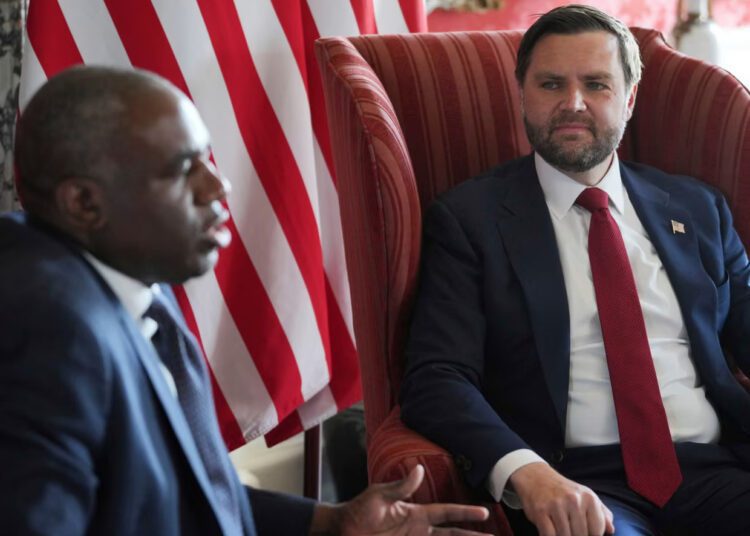
US Vice-President JD Vance has acknowledged “disagreements” between Washington and London over the Gaza conflict, including the question of recognising a Palestinian state. His comments came as he arrived in England for a summer vacation, marking a visit that blended personal camaraderie with diplomatic gravity.
Vance spoke just before a formal meeting with UK Foreign Secretary David Lammy at Chevening House, a stately 17th-century residence reserved for senior British ministers. Though the two leaders share a bond shaped by their Christian faith and challenging upbringings, their positions diverged when it came to the ongoing crisis in the Middle East.
Before their bilateral discussions, the pair were seen fishing together in a pond near Chevening. Vance, light-heartedly commenting on their outing, noted, “All of my kids caught fish, but the foreign secretary did not.” He called Lammy a “good friend” and a “gracious host”, joking that fishing success was the “one strain on the special relationship.”
The vice-president is staying at Chevening with his wife and children and will continue the weekend with Lammy’s family before heading to the Cotswolds. Praising the UK for its shared values with the US, he reflected on the spirit behind the heritage of Chevening. The people who had built and maintained it, he said, “really love the human spirit.” He added that both nations must continue to work together to “bring greater peace” to the world.

Gaza Policy A Point Of Divergence
While framed as a private visit, the two officials held a structured bilateral meeting on Friday, discussing the situation in Gaza, including Israel’s recent move to take control of Gaza City, the war in Ukraine, and ongoing US-UK collaboration on trade and technology. According to a government source, the conversation was “constructive.”
However, Vance acknowledged that on Gaza, “there may be disagreements” between the White House and Downing Street. Despite shared intentions to end the war, he hinted at diverging tactics.
Speaking to reporters, Vance responded to questions about the UK’s possible recognition of a Palestinian state.
“Obviously, the United Kingdom is going to make its decision. We have no plans to recognise the Palestinian state. I don’t know what it would mean to really recognise a Palestinian state given the lack of functional government there. We may have some disagreements about how exactly to accomplish that goal, and we’ll talk about that today.”
Vice-President JD Vance
This is not the first time Vance has challenged the UK on policy grounds. In February, he criticised what he saw as limitations on freedom of speech in Britain, particularly concerning buffer zone laws around abortion clinics. At the time, he warned that a “backslide away from conscience rights has placed the basic liberties of religious Britons” at risk. Vance said his concerns applied broadly to Western democracies.
“I think the entire collective west, the transatlantic relationship, our NATO allies, certainly the United States under the Biden administration, got a little too comfortable with censoring rather than engaging with a diverse array of opinions.”
Vice-President JD Vance
Lammy, addressing the political differences, said, “Commonalities and differences” in public debate were part of the “joy of living in a democracy like ours.”
Meanwhile, the meeting followed remarks by UK Prime Minister Keir Starmer, who urged Israeli Prime Minister Benjamin Netanyahu to reconsider Israel’s military takeover of Gaza City. Starmer argued that the decision would only lead to further violence.
“Every day the humanitarian crisis in Gaza worsens and hostages taken by Hamas are being held in appalling and inhuman conditions,” Starmer said. “What we need is a ceasefire, a surge in humanitarian aid, the release of all hostages by Hamas and a negotiated solution.”
READ ALSO: Aviation Analyst Demand Independent Probe into Helicopter Crash