Nigeria’s economy has posted its strongest expansion in nearly four years, recording a 4.23 percent year-on-year growth rate in the second quarter of 2025. The performance was driven by higher oil production alongside gains in agriculture and industry, according to new figures released by the National Bureau of Statistics (NBS) on Monday.
The latest Gross Domestic Product (GDP) report marks the second release since the bureau carried out a rebasing exercise aimed at capturing structural changes in Africa’s largest economy. The rebased GDP, which uses 2019 as the new base year, provides updated benchmarks for measuring the country’s economic performance.
Nigeria’s average daily oil production between April and June stood at 1.68 million barrels per day (bpd), up from 1.41 million bpd in the same quarter of 2024. The increase pushed the oil sector’s annual growth to 20.46 percent.
Agriculture expanded by 2.82 percent year-on-year, while industry grew by 7.45 percent. The services sector also posted a modest increase of 3.94 percent, edging higher than the 3.83 percent recorded in the second quarter of 2024.
Economist Bismarck Rewane explained that the rebasing exercise has been crucial in presenting a more accurate picture of Nigeria’s economy. “The rebasing of the GDP … has helped to reflect current economic realities,” he said.
Tinubu Sets Ambitious Growth Target
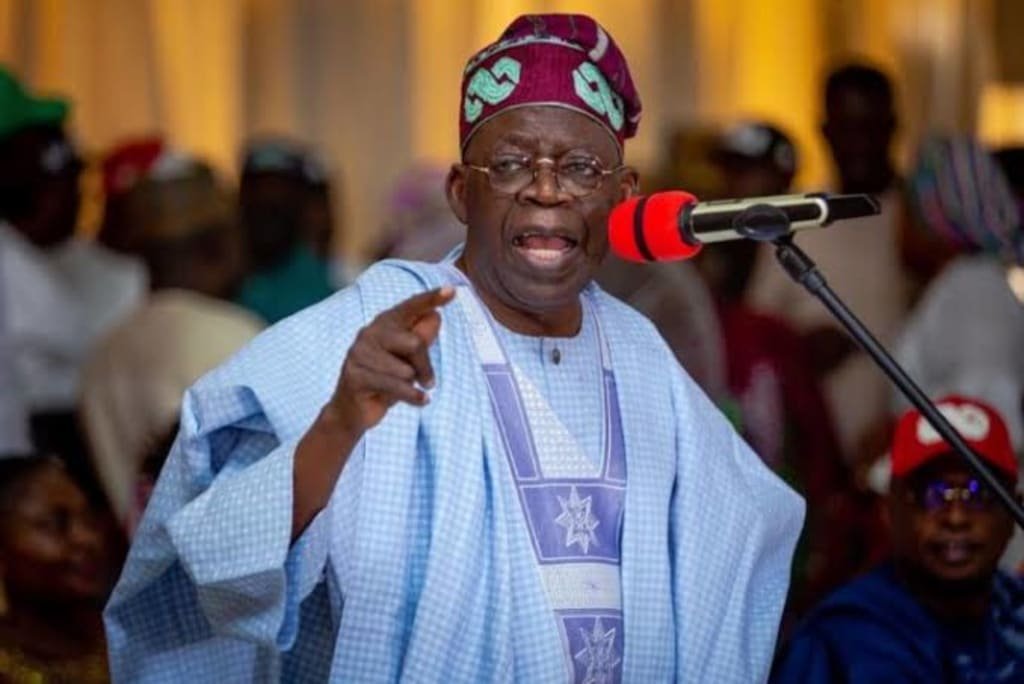
President Bola Tinubu has been under pressure to strengthen growth while stabilizing public finances. His administration has removed subsidies and launched fiscal reforms as part of broader efforts to reposition the economy. Last month, Tinubu announced a new 7 percent annual growth target, raising the bar from the 6 percent goal he set upon taking office in 2023.
The latest growth numbers suggest some progress toward this target. Nigeria’s economy grew 3.13 percent year-on-year in the first quarter of 2025, meaning the 4.23 percent expansion in the second quarter marks a significant improvement. The last time the country achieved quarterly growth above 4 percent was in 2021.
The bureau also emphasized the industry sector’s larger contribution to GDP.
“In terms of share of the GDP, the Industry sector contributed more to the aggregate GDP in the second quarter of 2025 at 17.31% compared to the corresponding quarter of 2024 at 16.79%.”
Also, the nominal value of Nigeria’s GDP in Q2 2025 stood at N100.73 trillion, compared with N84.48 trillion in the same period last year. This represents a 19.23 percent year-on-year increase in nominal terms.
The numbers reflect a stronger growth outlook, though challenges around fiscal stability, oil dependency, and structural reforms remain.
One major issue is persistent budget deficits, where government spending exceeds revenue. This deficit forces Nigeria to borrow extensively, resulting in a growing public debt that strains resources due to high interest payments.
Another critical problem is ineffective control over government expenditure, contributing to inefficient use of funds and worsening the fiscal gap. Additionally, Nigeria struggles with low tax revenue generation, partly due to corruption and weak tax administration, which limits available funds for public services. Inflation further complicates the situation by eroding citizens’ purchasing power, worsening poverty and economic hardship.
These fiscal challenges, combined financial mismanagement, create a cycle of deficit accumulation and economic instability, necessitating better fiscal discipline and reforms to enhance revenue and expenditure management.
READ ALSO: President Mahama to Launch “Accra Reset” at 80th UN General Assembly