Across West Africa the same screen often shows stories from different nations. Nollywood, Nigeria’s prolific film industry, has achieved continental reach through cinemas, streaming services, and satellite platforms such as MultiChoice’s DStv.
For Ghanaian filmmakers this cross-border exposure brings both opportunity and competition. The increasingly common practice of Ghanaian households relying on Nigerian-oriented DStv decoders and channel lineups, however, works against the sustained growth of a distinct Ghanaian movie industry.
Where distribution, revenue and audience attention flow toward Nigerian content, local producers struggle to earn returns, attract investment, and build a self-sustaining creative ecosystem.
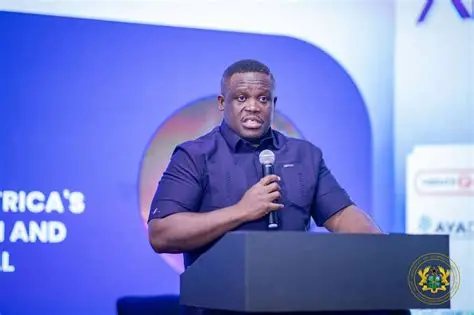
The Minister of Communication, Digital Technology, and Innovation, Sam George, has blamed the reliance on “Nigerian DStv decoders” for the decline of the local movie industry and called for greater patronage of homegrown content.
The MP argued that MultiChoice has a mandate to invest in local content within Ghana. “For every one Ghanaian contributing to the Ghanaian film or local content industry, five Ghanaians are contributing to the Nigerian industry,” he lamented.
According to him, this financial drain is a key reason for the decline of the Ghanaian film industry, while Nigeria’s film industry continues to grow.
“So, we are complaining that our Ghanaian movie industry or local content production is in decline. Our neighbors in Nigeria are seeing growth simply because for every one Ghanaian contributing to the Ghanaian film or local content industry, five Ghanaians are contributing to the Nigerian industry.”
Sam George
His remarks also addressed discussions about whether a shutdown of DStv services would affect the local movie industry.
Sam George framed the issue as a matter of national responsibility and alignment with the government’s vision.
“We want to fix our own country. It won’t be fixed by Nigerians, Kenyans, or South Africans. It will be fixed by us as Ghanaians. This government is a reset government. So let’s reset our Nigerian decoder boxes and reconnect the Ghanaian decoder boxes.”
Sam George
He announced that his Ministry, in collaboration with MultiChoice, will work to deactivate Nigerian decoders being used in Ghana.
Film industries grow not only by creating content but by capturing the economic value of that content, subscriptions, advertising, licensing fees, theatrical box office, and ancillary sales.
When viewers in Ghana consume films primarily through Nigerian-curated DStv packages or through channels that prioritize Nollywood content, a large share of subscription and advertising revenue goes to regional networks and owners that centralize programming choices.
Rights and licensing deals negotiated at a regional level often favor producers with volume, established sales channels and bargaining power, attributes Nollywood generally enjoys over Ghallywood.
Ghanaian producers face fewer reliable revenue streams. Without predictable licensing income from pay-TV, it is harder to finance higher production values, marketing, and talent retention.
Investors, both domestic and foreign, are less likely to back projects when local monetization channels are weak. That makes growth incremental rather than exponential.
Content Crowding and Cultural Homogenization
DStv’s regional channels and packages, which often carry heavy volumes of Nigerian films and serials, occupy programming slots and viewer mindshare that might otherwise showcase Ghanaian stories.
When audiences repeatedly consume Nollywood narratives with their stars, production styles and genre preferences, local filmmakers must either conform to those templates or struggle to find viewers for distinctly Ghanaian films.

The result is cultural homogenization, where unique Ghanaian voices get muted, and a younger generation begins to equate West African cinema largely with Nigerian aesthetics.
This is not merely artistic. Audience taste formation shapes box office and streaming metrics. If the default viewing diet is Nigerian content, Ghanaian films must fight harder for attention and risk being judged against different benchmarks that favor showcases of scale and star power.
Piracy and illicit decoder practices reduce the pool of paying viewers, which depresses advertising rates and undermines the business case for local broadcasters to invest in Ghanaian productions. While this is a continental problem, Ghana’s smaller industry is more vulnerable to the resulting revenue shortfall.
It is important to acknowledge positives: Nollywood’s success has created regional demand for West African stories and opened doors to co-productions, talent exchange and shared markets.
Some Ghanaian actors and producers have gained visibility and opportunities through Nigerian platforms. But those opportunities do not obviate the structural imbalance: visibility alone does not equal sustainable domestic industry growth if the financial and institutional foundations remain weak.
Ghanaian cinema coexist with Nigerian film excellence, but coexistence is not the same as growth. When distribution and revenue channels tilt predominantly toward Nigerian-focused DStv decoders and content lineups, Ghanaian filmmakers are left with fewer resources, less visibility and constrained creative choices.
A deliberate, multifaceted response, combining policy, investment, platform development and skills-building is necessary to transform exposure into sustainable industry growth.
With those changes, Ghana preserves its cultural voice and build a commercially viable movie industry that benefits creators and audiences alike.
READ ALSO: Ghana’s Skills Gap Widens Despite Growth in Secondary and Tertiary Education