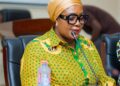

The Chairperson of Parliament’s Public Accounts Committee (PAC), Hon. Abena Osei Asare, has defended her eligibility to lead the committee, maintaining that she is qualified for the role and committed to ensuring accountability in public financial management.
Her remarks come amid controversy surrounding her appointment and renewed public scrutiny over the independence of parliamentary oversight institutions.
“The Committee Chairs are selected by the parties and the leadership of the respective caucuses. And so, my caucus chose me to head the Public Accounts Committee and to serve in that capacity. It’s something I want to do, and I’m qualified to do it as well”
Hon. Abena Osei Asare, Chairperson of Parliament’s Public Accounts Committee
Her response follows a petition submitted by the Member of Parliament (MP) for Gomoa Central, Hon. Kwame Asare Obeng, also known as A Plus, to the Speaker of Parliament, calling for her removal from the position.
The petition, dated November 3, 2025, alleged that Hon. Osei Asare’s previous role as Deputy Minister of Finance during the audited period created a conflict of interest that could compromise the integrity of the committee’s work.
Hon. Osei Asare dismissed the concerns, explaining that Parliament’s standing orders already contain safeguards to ensure transparency in cases where the chairperson has served in government during the period under review.
“Order 2294 of our Standing Orders says that when issues or reports from the Auditor-General pertain to the year in which the chairperson was in government, proceedings will be taken over by the ranking. Consistently, you see me announcing that “this pertains to a 2024 report for which I was in government, so I am ceding the chairmanship role to my ranking”
Hon. Abena Osei Asare, Chairperson of Parliament’s Public Accounts Committee

She added that the Public Accounts Committee remains independent and cannot alter or influence reports submitted by the Auditor-General. “There’s no conflict of interest in any way because the Public Accounts Committee is always chaired by a member from the opposition. Plus Parliament has taken steps to curb some of these things,” she explained.
The controversy has reignited national debate over political balance in the leadership of parliamentary committees, especially those charged with financial oversight. While some people have questioned the optics of her leadership, others argue that existing parliamentary procedures already provide sufficient checks to maintain impartiality.
ECG’s Financial Mismanagement
Beyond defending her position, Hon. Osei Asare admonished the Electricity Company of Ghana (ECG) to address internal financial lapses before seeking approval for additional tariff increases.
“The confirmed budget was GHS 144 million, they ended up doing a little over GHS 300 million. So the excess was about GHS 189 million.
“We felt that they should clean their house because the reason they claim they are increasing tariffs is because they claim they are not raising enough revenue to enable them to pay the IPPs and also take care of other equally important things”
Hon. Abena Osei Asare, Chairperson of Parliament’s Public Accounts Committee
Her comments followed the revelation that ECG’s foreign training expenditure had risen from a budgeted GHS 21 million to GHS 91 million, cleaning costs from GHS 2.8 million to GHS 10.4 million, and consultancy fees from GHS 40 million to GHS 58.6 million.
In view of this, the company has sought a 225 percent increase in its Distribution Service Charge for the 2025 – 2029 tariff period.

Hon. Osei Asare emphasised that accountability in state-owned enterprises is crucial to restoring public confidence. “There are a couple of CEOs and DGs who discharged themselves very well even though they were not there when all these infractions took place,” she said, citing recent examples of institutions that had shown transparency in responding to audit queries.
Defending Economic Decisions
As a former Deputy Minister of Finance, Hon. Osei Asare also reflected on her role in the Akufo-Addo administration’s economic policies, defending the Domestic Debt Exchange Programme (DDEP) as a difficult but needed intervention.
“The debt restructuring was one of the most painful but necessary exercises that we needed to take as a country. And even with that, the government made sure they secured pension funds and others who, for some reason, could not sign onto the DDEP”
Hon. Abena Osei Asare, Chairperson of Parliament’s Public Accounts Committee
She clarified that investors’ principal amounts were preserved under the programme. “Nobody lost money on their principal; it was their interests,” she added.
The DDEP, introduced in 2022, was part of Ghana’s broader efforts to restore debt sustainability and qualify for support under the International Monetary Fund (IMF) programme.
As chair of PAC, Mrs. Osei Asare has positioned herself as both a defender of parliamentary integrity and a voice for fiscal responsibility, stressing that oversight and stability must go hand in hand in Ghana’s path toward recovery.

Her leadership continues to draw mixed reactions within and outside Parliament, but she maintains that transparency and fairness remain at the core of her work. “Consistently, we want to promote fairness, proper accountability, and transparency. Parliament has already taken care of that,” she reaffirmed.
READ ALSO: Energy Minister Engages American Jewish Committee Over Energy Sector Reforms