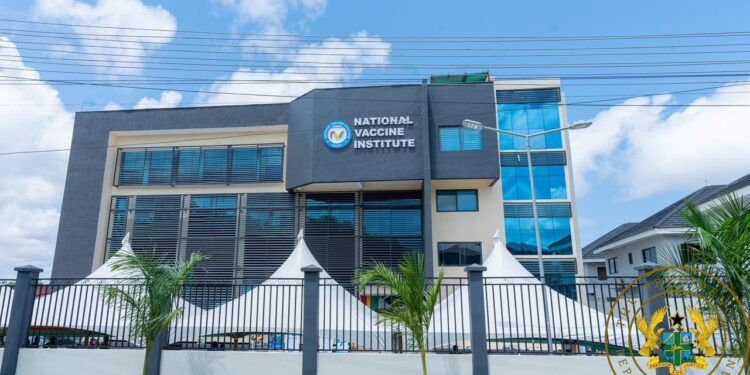
Ghana’s vaccine manufacturing vision, led by the National Vaccine Institute (NVI), has emerged as one of the country’s most significant post-pandemic undertakings – one that carries both national and continental implications.
According to IMANI Africa, the establishment of the NVI was not merely a bureaucratic move, but a recognition of Ghana’s strategic vulnerability exposed by the COVID-19 pandemic and the continent’s heavy reliance on external vaccine supplies.
When Ghana passed the National Vaccine Institute Act, 2023 (Act 1097), it signaled a shift in national security thinking from border protection to health sovereignty. The pandemic had revealed that even with financial resources, African nations were still at the mercy of global suppliers.
“The establishment of the National Vaccine Institute (NVI) under the National Vaccine Institute Act, 2023 marked Ghana’s strategic response to the vulnerabilities exposed by the pandemic. Beyond a health initiative, it represented a decisive shift in national security thinking”
IMANI Africa
The pandemic had made clear that access to vaccines could no longer depend on the discretion of global markets or donor generosity. Institutionalizing the NVI was therefore a moral and economic necessity, marking Ghana’s intent to build a self-reliant vaccine ecosystem.



The NVI’s current phase focuses on developing fill-and-finish capability – the process of importing bulk vaccine substances and completing packaging locally.

This transitional stage, IMANI noted, is designed to build technical expertise and regulatory credibility while paving the way for full biological manufacturing. The long-term ambition is to produce vaccines end-to-end, from raw active ingredients to final doses.
In its analysis, IMANI highlighted several milestones that demonstrate Ghana’s forward momentum, as reported by Dr. Sodium Tettey, Acting CEO of the NVI.
The partnership between Ghana’s Atlantic Lifesciences Ltd. and PT Bio Farma of Indonesia aims to accelerate local production of the Tetanus-Diphtheria vaccine by 2026, alongside research collaboration and biotechnology capacity building.
The government has also committed $50 million in seed funding to the NVI and is finalizing an Advance Market Commitment (AMC) framework to guarantee that locally produced vaccines receive procurement priority. Additionally, work is underway on a Legislative Instrument for Act 1097 to strengthen the Institute’s governance and financing mechanisms.
“The Food and Drugs Authority (FDA) has upgraded to WHO Maturity Level 3, a milestone that enables Ghana’s vaccines to meet global prequalification standards – a requirement for entry into international procurement channels such as UNICEF and Gavi”
IMANI Africa
Persistent Structural Challenges
Despite these advances, IMANI warned that the road ahead remains fraught with institutional and technical challenges.
Regulatory and quality assurance gaps persist, and without compliance with WHO prequalification criteria, locally made vaccines risk being excluded from global distribution networks.

IMANI noted that financial sustainability is another concern. Vaccine manufacturing demands heavy upfront investment, but without guaranteed demand, investor confidence remains low. Furthermore, bridging the divide between research and industrial production requires “significant investment in trials, intellectual property management, and technology transfer.”
In earlier statements, Dr. Abebe Genetu Bayih, Coordinator for Local Manufacturing at the Africa CDC, underscored the scale of these challenges:
“There is not just one challenge, it’s a multifaceted challenge, it’s an ecosystem. We need a workforce. Without appropriate workforce, whether you have a fantastic facility with good equipment and technology, you’re not going to manufacture the vaccines”
Dr. Abebe Genetu Bayih, Coordinator for Local Manufacturing at the Africa CDC
He emphasized that beyond infrastructure, Africa’s success depends on building the right institutions, funding mechanisms, and markets that make vaccine manufacturing sustainable.
IMANI pointed out that Ghana’s vaccine efforts are part of a continental strategy under the Partnership for African Vaccine Manufacturing (PAVM), launched by the Africa CDC and the African Union (AU).
The initiative aims for Africa to produce 60% of its vaccine needs locally by 2040 – a steep climb from less than 1% today. Dr. Bayih, however, cautioned that reaching that target requires patience and consistency.
“Vaccine manufacturing is a long process. Technology transfer alone can take five to ten years and millions of dollars. Achieving 60% by 2040 from 1% is significant, but it will require financing, research, infrastructure, and workforce development working in concert”
Dr. Abebe Genetu Bayih, Coordinator for Local Manufacturing at the Africa CDC

IMANI concluded that for Ghana and the continent, success will depend on sustained political commitment, firm local procurement policies, and the expansion of research and development infrastructure.
“The path to 2040 will test Africa’s ability to align policy, science, and economics in a way that builds genuine health sovereignty,” IMANI stated.
The challenge, IMANI stressed, is not just to build vaccine plants, but to build the systems that sustain them. Ghana’s progress represents hope – but only if that hope is matched by long-term commitment across institutions.
READ ALSO: Istanbul’s Jailed Mayor Charged With 142 Offences