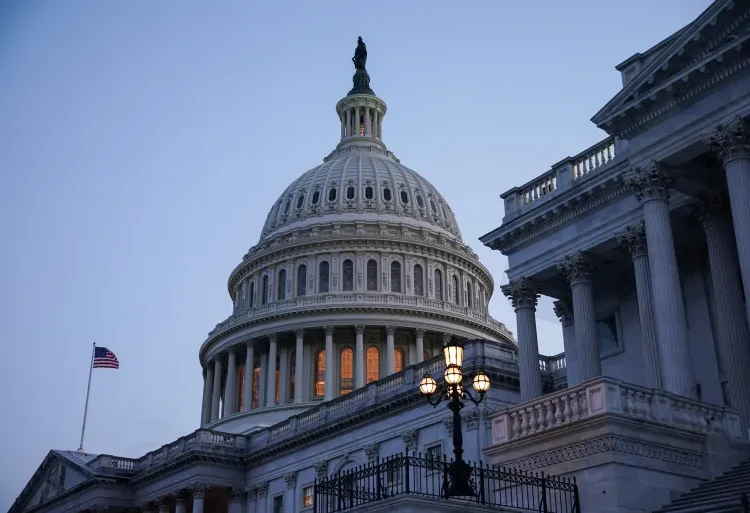
The US House of Representatives is scheduled to hold a final vote on a bill that would end the current shutdown and fund the federal government through January 30.
In mid-September, the House of Representatives adjourned to mark Rosh Hashanah, the Jewish new year. It has remained out of session ever since.
That changes today, as the House reconvenes for the first time to pass a funding bill expected to end the longest federal government shutdown in US history.
Critics say that it was all part of House Speaker Mike Johnson’s plan to force the Senate to take up a funding bill his chamber had already passed.
While the House was originally slated to reconvene in October, Johnson instead told representatives to stay in their home districts to do work there.
That way, Republicans would not be tempted to engage in negotiations with Democrats over the budget bill — and potentially cave into demands to extend healthcare subsidies.
With the House out of session, the Senate was forced to act. Only now, after the Senate passed a budget bill, has the House of Representatives come back to vote.
If the bill passes, it will head to the US President, Donald Trump’s desk to be signed into law.
Democrats in the House have expressed opposition to the bill, with House Minority Leader, Hakeem Jeffries seeking an amendment that would extend healthcare subsidies for the Affordable Care Act (ACA), the original cause of the impasse.
However, the bill is expected to pass in the Republican-controlled chamber, and Trump has expressed support for the bill.
The current government shutdown has stretched on for 42 days, breaking the previous record set under the first Trump administration.
Normally, vital services like the Supplemental Nutrition Assistance Programme (SNAP) — an initiative to help low-income residents by food — would continue to be financed during a shutdown.
However, in October, the Trump administration announced it would sever funding to the programme, leaving the nearly 42 million people who rely on SNAP in a state of uncertainty.
Continued funding for SNAP has been the subject of court challenges ever since, with critics accusing the Trump administration of leveraging food assistance as a means of forcing Democrats to vote for a new government spending bill.
On Tuesday night, the Supreme Court extended a pause on a lower-court order that would have forced the Trump administration to pay SNAP benefits for November. That pause is slated to continue through Thursday, by which time the US Congress is expected to have passed a funding bill and reopened the government.
Meanwhile, Airlines cancelled about 900 flights across the US on Wednesday as air traffic control absences decreased ahead of a likely reopening of the government.
Under orders from the Federal Aviation Administration (FAA), airlines had cut flights to decrease strain on air traffic control operations. As a result of the shutdown, many workers have gone unpaid and stayed home.
Flight reductions are set to rise to 10 percent on Friday, should there continue to be no agreement to reopen the government.
Speaker To Advance Republican legislative priorities After Bill To End Shutdown Passes
The Republican House Speaker, Mike Johnson has told reporters that he believes the bill to end the shutdown has enough votes to pass.
Once it does, he added that he plans to move forward with an “aggressive calendar” of Republican legislative priorities.
Johnson told reporters, “I just want to say that we’re very optimistic about the vote tally tonight. We think this is going to happen.”
“We’re ready to get back to our legislative agenda. We have a very aggressive calendar for the remainder of this year. There’ll be some long days and nights here, some long working weeks, but we will get this thing back on track.”
Mike Johnson
READ ALSO: TUC Links El-Wak Tragedy to High Youth Unemployment, Prompts Budgetary Solutions