The United Bank for Africa (UBA) has unveiled a comprehensive financing roadmap aimed at transforming Africa’s economic competitiveness and driving large-scale development across the continent.
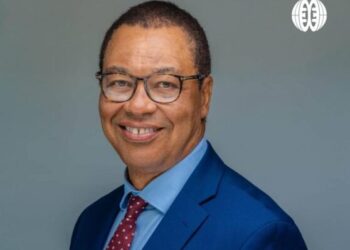
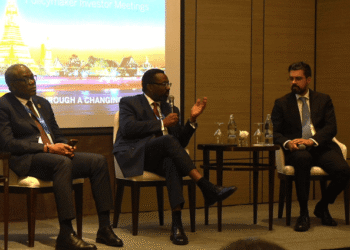
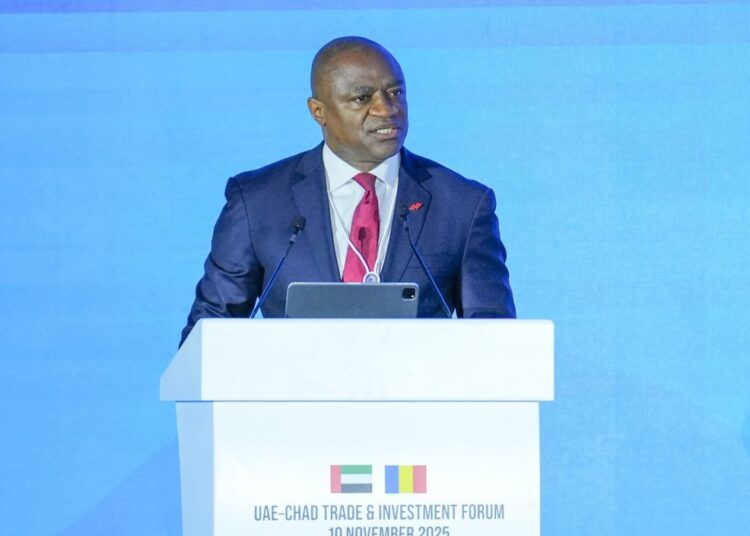
Speaking at the opening session of the UAE–Chad Trade and Investment Forum in Abu Dhabi, UBA Group Managing Director, Oliver Alawuba, called for a new era of execution—where African nations channel their resources and partnerships into productive ventures.
Addressing delegates under the theme “Financing African Competitiveness – Building Bridges, Powering Progress,” Alawuba emphasized that Africa must go beyond being labeled as a continent of potential and instead become a continent of results.
“For too long, the narrative around Africa has been one of potential,” he stated. “But I stand before you today to declare that the era of potential is over. We are now in the era of execution.”
At the heart of UBA’s new financing roadmap is a three-part agenda that seeks to mobilise capital, structure bankable projects, and deepen partnerships across Africa. The bank aims to work closely with development finance institutions (DFIs), Gulf-based investors, and global financial centres to provide the structure and credibility needed to attract sustainable financing into African-led projects.
Citing the findings of the Africa Finance Corporation (AFC), Alawuba noted that Africa’s domestic financial assets total nearly $4 trillion, with commercial bank assets accounting for $2.5 trillion, foreign reserves at $725 billion, pension assets at $455 billion, and insurance assets worth $320 billion. Yet, less than 15 percent of this capital is channelled into productive infrastructure and industrial ventures.
“At UBA, we have always believed that the capital to transform Africa exists both within and outside our continent. The challenge has never been a lack of capital, but a lack of bankable structures and credible partnerships.”
Oliver Alawuba
The 2030 Plan
The UAE–Chad Trade and Investment Forum, co-hosted by the United Arab Emirates and the Republic of Chad, also served as the official launchpad for Chad’s $30 billion national development plan, dubbed Chad Connection 2030. The plan, which features 268 projects across infrastructure, industrialisation, and human development, reflects Africa’s shift toward actionable, measurable strategies.
“The $30 billion Chad Connection 2030 plan is not just a document; it is a declaration of intent,” Alawuba said. “Competitiveness is not born in boardrooms; it is built on the ground.”
In his remarks, he outlined how UBA intends to work with Chad in structuring syndicated deals, financing solar and water treatment plants, and driving digital connectivity and regional energy-grid expansion. The goal, he said, is to align financing with real impact, ensuring that every dollar invested produces measurable development outcomes.
Oliver Alawuba highlighted UBA’s strong track record in financing transformative projects across the continent. He cited examples such as the $400 million commitment to Tanzania’s Julius Nyerere Hydropower Project, which will boost the country’s energy capacity and industrial base.
Similarly, in Nigeria, UBA invested over $700 million in the power sector after privatisation and participated in a $10 billion syndicated financing for the Dangote Refinery—Africa’s largest industrial complex.
“These investments are evidence of our commitment to building Africa’s productive capacity,” he said. “They show that African banks can be architects of transformation, not just intermediaries.”
Financing Africa’s Competitiveness: A Partnership Model
To finance Africa’s competitiveness sustainably, Alawuba proposed a partnership model that integrates three key players: International expertise and capital from Gulf and global financial centres; African institutional banking providing local knowledge and project insight; Development finance institutions (DFIs) offering risk-mitigation tools and concessional loans.
He explained that this tripartite collaboration will unlock funding for critical projects in energy, water, digital infrastructure, and manufacturing. “For Chad’s $30 billion plan, the multiplier effect is the key that unlocks the vault,” Alawuba stated.
Beyond the boardrooms and billion-dollar projects, UBA is ensuring that financial inclusion and SME empowerment remain central to its growth strategy. Alawuba reaffirmed UBA’s presence in emerging towns such as Beira in Mozambique, Nzérékoré in Guinea, and Gulu in Uganda, ensuring that farmers, entrepreneurs, and local businesses are not excluded from Africa’s growth narrative.
“Competitiveness is not just about large corporations,” he noted. “It is about ensuring that SMEs, farmers, and everyday entrepreneurs who form the backbone of our economy have access to finance and markets.”
By extending its operations to 20 African countries and global centres including Dubai, London, and New York, UBA is positioning itself as the financial bridge between Africa and the rest of the world.
Concluding his address, Alawuba reaffirmed UBA’s commitment to being the financial engine powering Africa’s next growth phase. “We are here to be the trusted partner and the bridge that connects visionary plans to tangible reality,” he said
The UAE–Chad Trade and Investment Forum also marked the signing of multiple memoranda of understanding worth billions of dollars, signalling the growing investor confidence in Africa’s development agenda.
READ ALSO:Mahama Assures Immediate Establishment of Farmers’ Service Centers