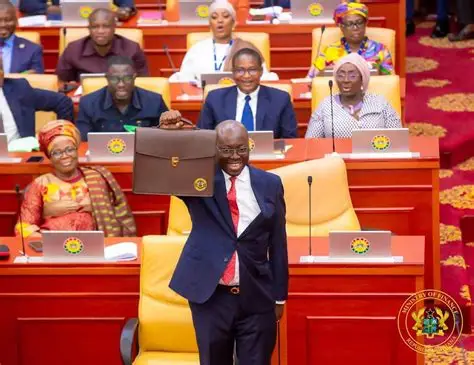
Finance Minister Dr. Cassiel Ato Forson has presented Ghana’s 2026 Budget Statement and Economic Policy to Parliament under the theme “Resetting for Growth, Jobs, and Economic Transformation.”
The budget under President John Dramani Mahama’s new administration, marks a turning point in the nation’s economic journey. It is designed to move Ghana from a period of recovery to one of transformation, driven by fiscal discipline, productivity, and job creation.
Dr. Forson, delivering the budget on behalf of the President, emphasized that this year’s budget aligns with Mahama’s firm commitment to “fix the economic crisis confronting our country and reset it on the path of growth and prosperity.”
Restoring Confidence and Discipline
“When this administration took office, we met an economy in distress, weighed down by debt, weakened by mismanagement, and stripped of confidence,” Dr. Forson stated. He noted that despite the challenges, Ghana has turned the corner through prudent management and the restoration of fiscal discipline.
“We have learned a powerful truth: Fiscal discipline is the backbone of national progress,” he said, stressing that the 2026 Budget is not merely about recovery but about a full economic reset.
“It is the story of a nation that refused to stay down. It is the story of Ghanaians who endured hardship with dignity and held on to hope when the road was rough.”
Dr. Cassiel Ato Forson
According to the Minister, the government has restored fiscal discipline, brought inflation under control, stabilised the cedi, and rekindled investor confidence. “Ghana’s economy is breathing again, stronger, steadier, and full of promise,” he declared.
Fiscal Targets: Tightening the Belt for Growth
At the heart of the 2026 Budget is a plan to narrow Ghana’s fiscal deficit from 2.8 percent of GDP in 2025 to 2 percent in 2026. Dr. Forson announced that this move reflects the government’s commitment to maintaining fiscal discipline while pursuing growth.
“Our focus is on expanding the tax net, not overburdening existing taxpayers,” he told Parliament, outlining a strategy that emphasizes revenue mobilization through efficiency and broadening the base rather than imposing additional burdens on citizens.
He explained that government expenditure will remain under tight control, rising modestly from 15 percent of GDP in 2025 to 15.4 percent in 2026. The goal is to sustain fiscal stability while providing resources for key national priorities such as infrastructure, health, and education.
Dr. Forson further revealed that the government is targeting a primary shortfall of 1.5 percent of GDP in 2026, in line with Ghana’s fiscal anchor. On a commitment basis, the overall fiscal deficit is projected at 2.2 percent of GDP, while on a cash basis, it is expected to stand at 4 percent.
“This fiscal stance balances consolidation with growth, maintaining discipline while safeguarding resources for productive investment under the Big Push Infrastructure Programme and other national priorities.”
Dr. Cassiel Ato Forson
Big Push Infrastructure Programme: Building for the Future
One of the flagship initiatives highlighted in the 2026 Budget is the “Big Push Infrastructure Programme.” The programme aims to inject substantial investments into critical sectors such as roads, energy, health, and education.
According to Dr. Forson, the initiative is designed to stimulate job creation and accelerate economic transformation by improving infrastructure across the country. “This government has chosen a harder but higher road, the road of reform, renewal, and resilience,” he said.
The Finance Minister explained that the infrastructure investments will not only create thousands of jobs but also enhance productivity, reduce the cost of doing business, and strengthen Ghana’s industrial base.
Three Key Priorities: Stability, Jobs, and Social Services
The 2026 Budget outlines three central priorities: consolidating macroeconomic stability, accelerating economic transformation and job creation, and strengthening security and social services for inclusive growth.
Dr. Forson reaffirmed that the government is determined to maintain single-digit inflation and ensure exchange rate stability to protect the gains made. “We will maintain fiscal discipline, strengthen revenue mobilisation, and anchor responsible borrowing to ensure debt sustainability,” he explained.
On job creation, the Finance Minister said the government will invest in energy, commercial agriculture, agribusiness, and road infrastructure. Initiatives such as the 24-Hour Economy and the Accelerated Export Development Programme will serve as engines of employment and industrial growth.
“We will accelerate economic transformation and job creation, driven by large-scale investment and job creation in key sectors alongside comprehensive land and natural resource reforms.”
Dr. Cassiel Ato Forson
The third priority, strengthening the social and security sectors, will focus on retooling the security services, modernising education, expanding healthcare access, extending electricity to all communities, and improving access to clean water. “We will protect the poor and the vulnerable,” Dr. Forson affirmed.
From Recovery to Transformation
Dr. Forson stressed that the 2026 Budget builds on the stability achieved in 2025 and transitions Ghana into a new phase of sustainable growth and transformation.
“Mr. Speaker, this budget moves Ghana from recovery to transformation, designed to deliver tangible results, reduce the cost of living, empower businesses, and create decent jobs.”
Dr. Cassiel Ato Forson
He added that the administration’s goal is to make 2026 “a year of progress, productivity, and shared prosperity for every Ghanaian.”
Under President Mahama’s leadership, Dr. Forson assured Ghanaians that public financial integrity will remain non-negotiable. “President Mahama has made it clear that under his watch, the integrity of our public finances will remain sacred,” he emphasized.
The 2026 Budget represents a renewed sense of optimism and responsibility for Ghana’s economy. With the government’s focus on fiscal discipline, infrastructure development, and job creation, the country is poised for a period of sustained growth and stability.
“This is not just a recovery; it is a reset,” Dr. Forson stated, reaffirming that Ghana’s economic transformation is already underway.
READ ALSO: Mahama Assures Immediate Establishment of Farmers’ Service Centers