
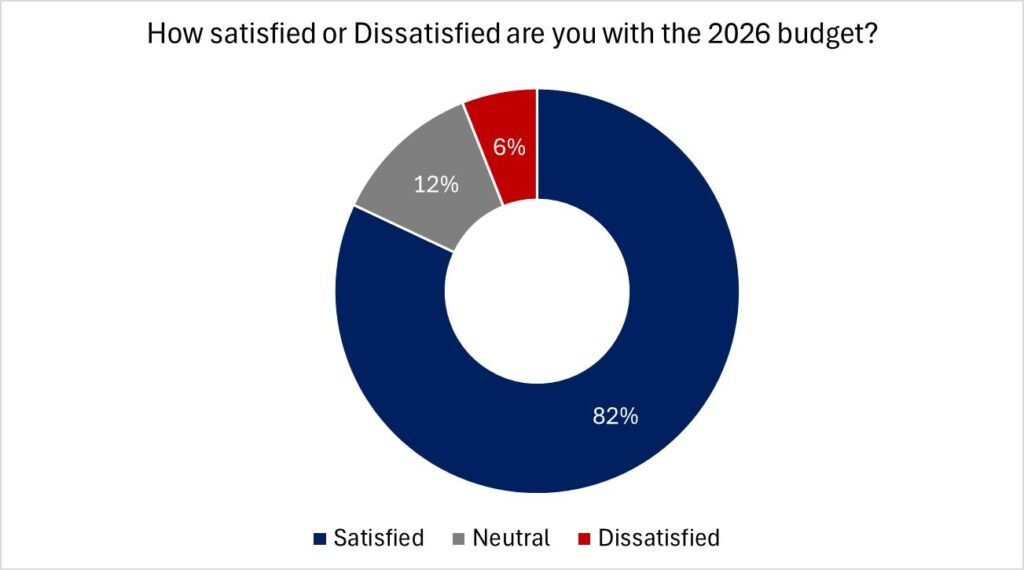
A new X-formerly Twitter poll by Global InfoAnalytics has revealed an overwhelming wave of public support for the 2026 Budget Statement presented by Finance Minister Dr. Cassiel Ato Forson.
The poll, released just days after the budget was read in Parliament, shows that 82 percent of respondents say they are satisfied with the government’s fiscal direction, while 6 percent expressed dissatisfaction and 12 percent remained neutral.
Despite criticism about the timing and methodology of the poll, the findings have sparked fresh national conversations about the public’s perception of the Mahama administration’s economic policies and the shifting mood of the electorate ahead of the 2026 fiscal year.
The Finance Minister presented the Budget under the theme “Resetting for Growth, Jobs, and Economic Transformation,” emphasising that the country had reached a critical turning point.
According to Dr. Forson, the 2026 Budget marks a “decisive shift” in national priorities, moving away from the emergency recovery posture that dominated recent years. He noted that the government is now focused on deepening transformation efforts, accelerating job creation, and consolidating macroeconomic gains.
Dr. Forson highlighted three core strategic pillars guiding the 2026 fiscal agenda: macroeconomic consolidation, accelerated job creation, and social sector strengthening.


These pillars, he said, would anchor the administration’s commitment to the 24-Hour Economy initiative, the Big Push infrastructure programme, and the National Oil Palm Policy.
Together, these interventions are projected to generate 800,000 jobs in 2026, including 250,000 direct employment opportunities under the Oil Palm Policy, supported by a $400 million financing package from the World Bank, the Development Bank of Ghana, and other international development partners.
The budget presentation was also framed against a backdrop of significant macroeconomic improvements. According to government data, Ghana’s economy expanded by 6.3 percent in the first half of 2025, outperforming the 5.1 percent growth rate recorded during the same period in 2024.
The services sector grew by a robust 8.8 percent, making it the key driver of national output, while agriculture posted a solid 6.0 percent expansion. Industry grew by 3.2 percent, and manufacturing saw a notable rebound with 6.3 percent growth, up sharply from 0.5 percent in 2024.
Historic Inflation Drop
Perhaps the most celebrated achievement is the dramatic decline in headline inflation, which dropped from 23.8 percent in December 2024 to 8 percent in October 2025, marking the lowest inflation in more than four years and the tenth consecutive monthly decline.
Fiscal performance has also strengthened considerably. The primary balance recorded a surplus of 1.6 percent by September 2025, shifting from a deficit of 3.0 percent of GDP in 2024, and outperforming the government’s target of a 1.5 percent surplus by year-end.

Ghana’s debt position has also seen significant progress. Public debt declined from GH¢726.7 billion (61.8% of GDP) at the end of December 2024 to GH¢630.2 billion (45.0% of GDP) by October 2025.
This represents a remarkable reversal in the debt accumulation trend, shifting from a +19.1 percent growth in 2024 to -13.3 percent by October 2025. The Minister credited the turnaround to prudent borrowing, disciplined fiscal management, effective liability operations, and the improved stability of the cedi.
Diverse Commendations
The 2026 Budget has since received broad commendation from civil society leaders and academics, further reinforcing the positive public response captured by the Global InfoAnalytics poll.
Prominent voices such as Professor Godfred Bokpin, Franklin Cudjoe of IMANI, and legal scholar Kofi Bentil have publicly praised the Finance Minister for what they describe as a disciplined, responsible, and forward-looking fiscal plan.
Many have applauded Dr. Forson’s firm commitment to fiscal consolidation, his transparent presentation of economic data, and the government’s renewed focus on jobs and growth.
Their endorsements, alongside the overwhelming voter approval, signal a growing confidence in the administration’s economic direction and the strategic choices guiding Ghana’s transformation agenda.
Against this backdrop, the Global InfoAnalytics poll appears to reflect strong public approval of the administration’s policy direction. However, the poll also sparked criticisms from sections of the public who questioned the timing and whether respondents had fully digested the budget’s content.

In response, Executive Director of Global InfoAnalytics, Mussa Dankwah, issued a spirited defence of the poll and the nature of public opinion. He rejected suggestions that the public should wait longer before forming opinions on the budget.
“Voters don’t care about the complexity of anything, and they still have an opinion on everything. Academics have always underestimated voters at their own peril. Voters like it simple. Keep dwelling on complexity while voters dwell on simplicity.”
Executive Director of Global InfoAnalytics, Mussa Dankwah
As national conversations continue, the poll suggests that many Ghanaians believe the 2026 Budget offers a promising pathway toward economic renewal, stability, and job creation.
READ ALSO: Police Service Joins ADB’s Transformation Wave After IGP’s Glowing Endorsement