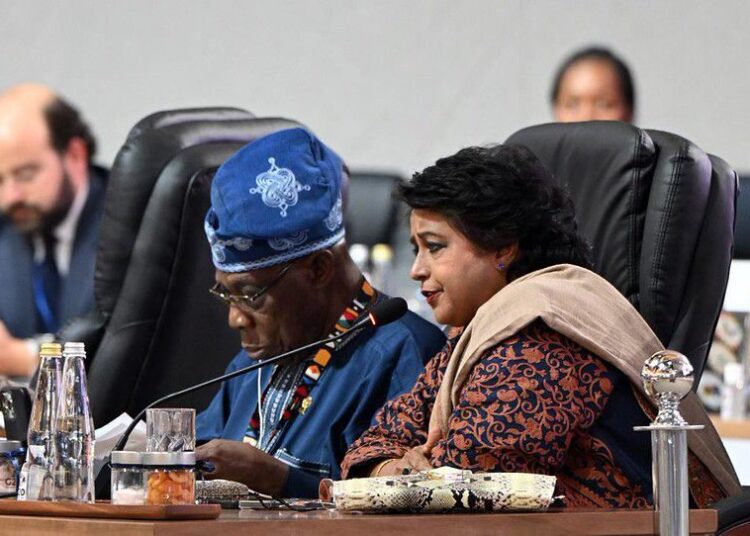
Former Nigerian President Olusegun Obasanjo has hailed President John Dramani Mahama’s expanding influence on global development reform, announcing at the G20 Leaders’ Summit in Johannesburg the formal commencement of the Accra Reset’s interim Secretariat in Ghana.
Delivering the address on behalf of President Mahama, Obasanjo described the initiative as a bold and necessary rethinking of global cooperation, one that places the Global South at the centre of a new, shared development philosophy.
Obasanjo told world leaders that the Accra Reset has rapidly grown into a force shaping international governance debates, with its Circle of Leaders expanding to include more than two dozen former Heads of State and senior figures from international organisations across Africa, Asia, Latin America, Europe, and the Caribbean.
He conveyed President Mahama’s gratitude to South African President Cyril Ramaphosa, praising his stewardship of the current G20 cycle as rooted in “clarity, courage, and profound commitment to justice.”
President Mahama, who now serves as the African Union Champion for Reparations, has positioned the Accra Reset as a platform for re-balancing the global governance structure and amplifying Global South leadership on issues that affect developing nations most.

A Fundamental Departure from Traditional Models of Development
At the heart of Obasanjo’s remarks was an argument that the Accra Reset embodies a fundamental departure from traditional models of development. He criticised the long-standing system of aid and loans, saying it has too often created “an economy of dependency,” which stifles domestic initiative and entrenches inequality between the Global North and Global South.
“To move forward, we must re-architect our economies based on trade and investment,” he said, underscoring President Mahama’s vision that development must be powered by structural transformation rather than perpetual external support.
Obasanjo stressed that the Accra Reset seeks to build a new form of cooperation that is “country-led, regionally empowered, and globally coherent.” This approach, he argued, breaks with decades of top-down development initiatives that have dominated North-South relations and allows nations of the Global South to shape solutions that reflect their own priorities, capacities, and long-term strategies.
The launch of the interim Secretariat in Accra, he noted, marks the beginning of an institutional phase in which the initiative will take on greater operational responsibilities and begin coordinating action at multiple levels.
Central to the next stage of the Accra Reset’s work is the establishment of a High-Level Panel tasked with preparing a landmark report on restructuring global governance.
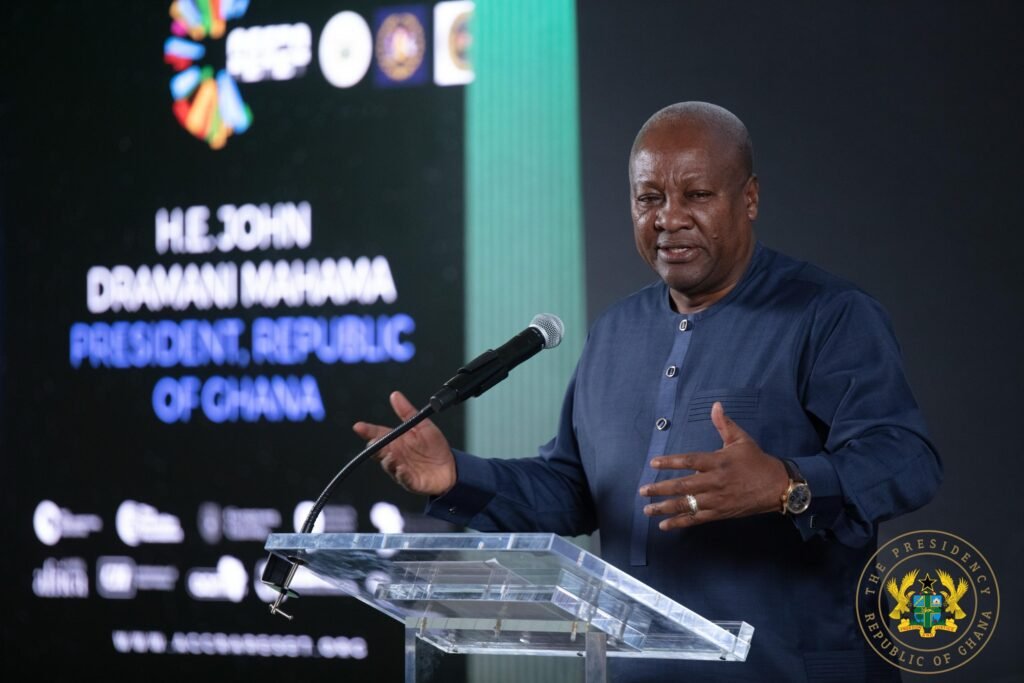
The report is expected to be submitted to a commissioning authority made up of Heads of State from both the Global North and the Global South, reflecting the initiative’s insistence on collaborative and equitable dialogue. Obasanjo said this panel will propose pathways for reforming international institutions and correcting historical imbalances in global decision-making.
The former Nigerian President also used the occasion to commend South Africa’s G20 Presidency under President Ramaphosa, noting that its priorities align closely with the Accra Reset’s mission.
These include reforming the global financial architecture to make it more equitable, strengthening global health systems, forging fair technology partnerships, and promoting broader Global South participation within multilateral institutions.
Obasanjo argued that these priorities dovetail with Mahama’s efforts to build a more inclusive and responsive development framework, particularly at a time when developing countries face mounting economic and geopolitical uncertainties.
Accra Reset as Connective Tissue
Highlighting the broader strategic ambitions of the initiative, Obasanjo described the Accra Reset as “connective tissue interlinking the public, private, and civil factions of Global South societies.”
By creating a platform that brings together governments, private sector actors, and civil society, President Mahama aims to build a coalition capable of advancing pragmatic reforms and driving lasting economic transformation.
This multi-sectoral approach, Obasanjo noted, reflects the complexity of modern development challenges and the need for solutions that move beyond aspirational policy rhetoric.
The initiative also seeks to shift global development discourse away from the perpetual setting of lofty targets that often remain unmet. Instead, it advocates for the adoption of practical business models that can deliver measurable and sustainable outcomes.
Obasanjo emphasised that this is one of the defining features of President Mahama’s leadership of the Accra Reset—an insistence on pairing ambition with workable implementation frameworks.
“The Accra Reset stands ready to work closely with the G20,” he said, signalling a readiness to collaborate on global reforms that are fairer, more transparent, and genuinely inclusive. For President Mahama, the Accra Reset represents both a philosophical and structural shift in the way global development is imagined and pursued.
It is a call for co-creation rather than imposition, for negotiations grounded in fairness rather than historical inheritances, and for partnerships that recognise the agency, capability, and aspirations of the Global South.
With the launch of its interim Secretariat in Accra, the initiative now moves from outline to institution, with the potential to reshape global governance debates for years to come.
READ ALSO: US Freezes Asylum, Immigration Benefits from 19 High-Risk Countries