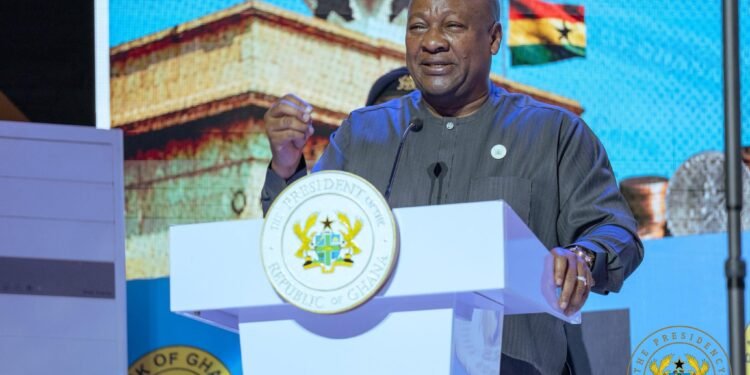
President John Dramani Mahama has underscored the urgent need for robust Public-Private Partnerships (PPPs) to revitalise Ghana’s healthcare system, arguing that the country can no longer depend solely on government resources or conventional public-sector models to sustain critical medical infrastructure.
Speaking at the WHX Leaders Africa Summit in Accra, President Mahama reflected on past efforts to equip Ghana’s hospitals and why those gains have deteriorated, making PPPs not just beneficial but indispensable.
He recalled the period when he served as Vice President under the late President John Evans Atta Mills, describing the state of healthcare facilities as “non-functional.”
In response, the government embarked on what he referred to as a “major retooling exercise,” installing MRI machines, CT scanners, X-ray equipment, and modern laboratory systems across various hospitals. “It cost us in excess of $250 million,” he noted. “Our assumption was that we had brought our health care back up to scratch.”
However, his recent return to office in January 2025 revealed a grim reality. While launching the Ghana Medical Trust Fund—popularly called Mahama Cares—the President was informed that the diagnostic and treatment equipment installed years earlier had largely broken down nationwide.

With the fund receiving a generous GHS 2.1 billion allocation from the Finance Minister to support the fight against non-communicable diseases, the technical capacity needed to deploy its benefits remains severely restricted.
“Yes, there is no diagnostic equipment. MRIs are broken down. CT scans are broken down. There are limited cancer treatments outside Accra and Kumasi, which are at a high cost of treatment. But even the equipment, both to diagnose and treat, is in limited supply”.
President John Dramani Mahama
A Broken Nine-Year-Old Hospital
President Mahama shared a troubling example: a major hospital completed nine years ago, equipped with advanced diagnostic tools, now has “not one single working equipment.” Patients requiring MRI or CT scans must be transported by ambulance to private facilities, burdening both families and the healthcare system.
He emphasised that the consequences extend beyond inconvenience—they determine survival. In many regions, lifesaving services such as cancer treatment and dialysis remain inaccessible.
He narrated the heartbreaking story of a former assemblyman in the northern part of the country who relocated his entire family to Kumasi for dialysis twice a week, only to die after exhausting his savings and leaving his household impoverished. “It’s not acceptable that you live or die depending on which part of Ghana you live in,” he stressed.

President Mahama admitted that earlier models of investing heavily in public hospital equipment without sustainable maintenance structures were flawed. To avoid repeating mistakes, he said the government will only invest in new diagnostic and treatment centres through partnerships with private actors who can ensure durability, maintenance, and operational efficiency.
“The private sector is better. We won’t repeat the mistake… of putting all that expensive equipment in government hospitals only to come back five, six, seven years later and all that equipment is not working.”
President John Dramani Mahama
The President also framed Ghana’s challenges within a broader continental context, noting that many African countries face similar structural deficiencies in healthcare delivery.
He expressed hope that a stronger PPP culture would accelerate progress toward universal health care and reduce the geographic inequalities that determine health outcomes for millions.
As Ghana works to modernise its healthcare system amid rising rates of non-communicable diseases—responsible for more than 45 percent of national morbidity—the call for innovative partnerships appears not just timely but necessary.

President Mahama emphasised that “Mahama Cares” is not merely a funding scheme but a commitment to equitable healthcare access. He urged private actors to seize the opportunity to collaborate in building a resilient, decentralised, and sustainable healthcare infrastructure.
READ ALSO: World Bank Hails Ghana’s New Digital System as a Breakthrough for Smallholder Farmers