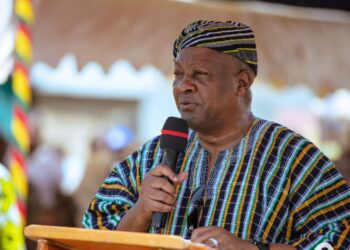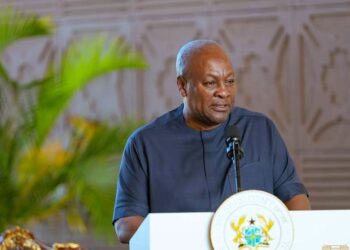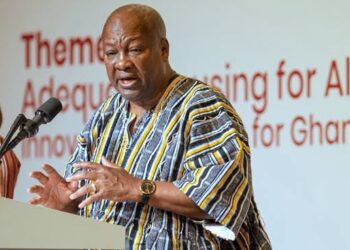

President John Dramani Mahama has praised the newly signed Memorandum of Understanding (MOU) on religious tolerance in mission schools, describing it as a decisive document that removes long-standing ambiguities in how faith-based, government-assisted schools should handle religious diversity.
Speaking during a courtesy visit by the National Peace Council (NPC) at the Jubilee House, the President said the MOU brings clarity to issues that have historically generated conflict—particularly as the Supreme Court considers a high-profile case involving Wesley Girls’ Senior High School.
President Mahama began his remarks by commending the Peace Council for facilitating the agreement, which was signed in September 2025 by 13 religious missions and endorsed by the Ghana Education Service (GES).
“Let me congratulate you on the MOU that was signed in respect of the faith-based schools. That has been a point of contention for quite a while, and so we took note that somebody filed a case before the Supreme Court.
“The Supreme Court is yet to pronounce on that issue, but if you read what the faith-based organisations agreed in their own MOU, I don’t see any point of dispute.”
President John Dramani Mahama
His comments were a clear reference to the lawsuit brought by private legal practitioner Shafic Osman against the administration of Wesley Girls’ SHS. The suit alleges that the school violated the religious rights of Muslim students by preventing them from fasting and observing their religious duties and compelling participation in Methodist Christian activities.
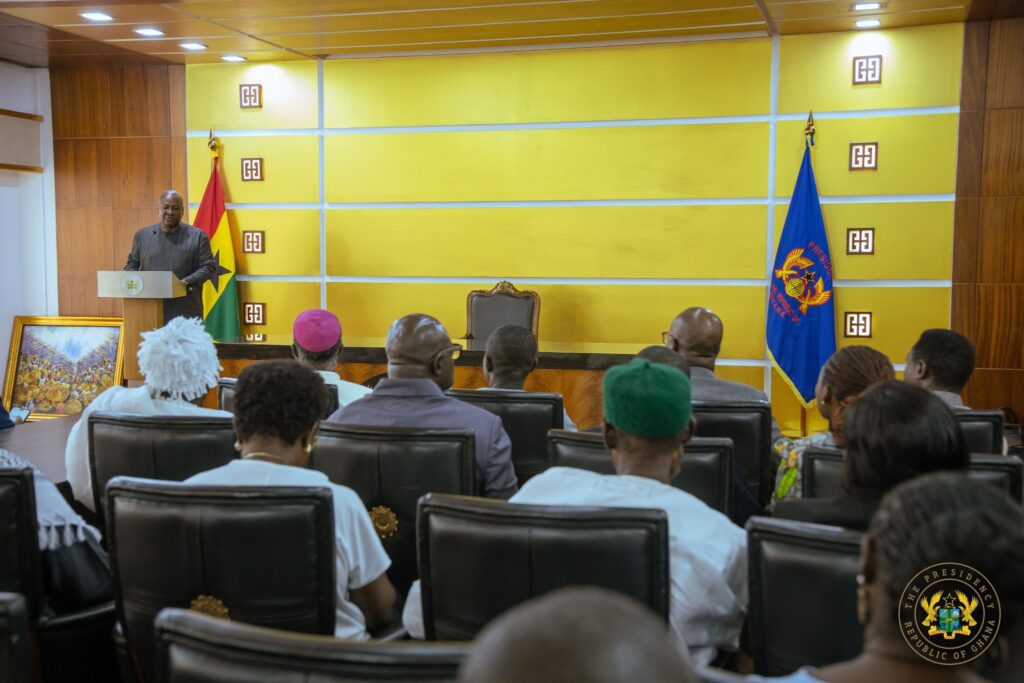
The Supreme Court has since directed the school’s Board of Governors to formally respond to the allegations, in what could become a significant constitutional ruling on religious freedom in education.
Already Made Agreement
However, President Mahama suggested that the very groups associated with the ongoing debate had already agreed on a balanced framework that respects both mission identity and constitutional rights.
“The same people have signed an MOU and so I don’t see what the contention there is,” he said. He pointed specifically to the provision on fasting, which had become a central issue in the Wesley Girls dispute.
“There’s even a place that talks about fasting, because Christians fast, Muslims fast. You can find a Christian student in a Muslim school or a Muslim student in a Christian school, and it talks about whether they should be allowed to fast, and it says that yes, the student can fast.
“Whereas following the fasting, the responsibility shall be that of the parent and not the school. I mean, that’s clear enough.”
President John Dramani Mahama
The President’s remarks follow increasing appeals from civil society leaders, including Kofi Asare of Africa Education Watch, who urged him to intervene in the matter.

For many observers, President Mahama’s statement signals confidence that the MOU itself serves as a strong guide for the ongoing national conversation about religious freedom, mission school identity, and student rights.
The MOU, developed by the Conference of Managers of Education Units (COMEU) with facilitation from the National Peace Council, seeks to foster religious harmony across government-assisted mission schools. It outlines how schools should accommodate students’ religious practices while maintaining the ethos of the founding missions.
The agreement states that students should be allowed to pray according to their faith, that schools must provide reasonable accommodations for prayer and fasting, and that no student should be compelled to participate in the worship practices of another religion. At the same time, schools retain the right to uphold their mission identity, so long as it aligns with constitutional protections.
This framework responds to years of inconsistent practices in mission schools and aims to prevent misunderstandings that have sometimes escalated into national controversies.
By codifying best practices and establishing clear expectations, the MOU provides a unified guidance system intended to strengthen peaceful coexistence in multi-faith learning environments.

National Value
President Mahama emphasised the broader national value of this achievement. “I think that it’s something that we can be proud of, and I want to congratulate the Peace Council for being the facilitators of that understanding between the faith-based institutions.”
His comments underscored Ghana’s longstanding reputation for religious tolerance and the need to preserve that tradition within the education sector.
The President also acknowledged the diversity that characterises mission schools today. Many institutions founded by Christian missions now enroll Muslim students, just as Islamic schools serve students of other faiths.
This diversity has enriched the educational landscape but has also presented challenges when school traditions intersect with religious obligations. The MOU aims to manage this complexity by ensuring that schools do not infringe on constitutional rights while also preserving their foundational values.
As the Supreme Court deliberates on the Wesley Girls case, the MOU is expected to influence both public opinion and institutional responses. While the Court’s ruling will determine the legal dimensions of the dispute, the framework agreed upon by major religious bodies has already set a strong moral and administrative foundation.

With the national debate ongoing, President Mahama’s endorsement of the MOU reinforces his administration’s commitment to protecting the rights of all students while promoting unity within Ghana’s education system. The Peace Council, for its part, has pledged to continue supporting faith-based institutions as they implement the agreement.
READ ALSO: Fresh Hope for Economy as Ghana Signs Landmark Bilateral Debt Deal with Czech Republic