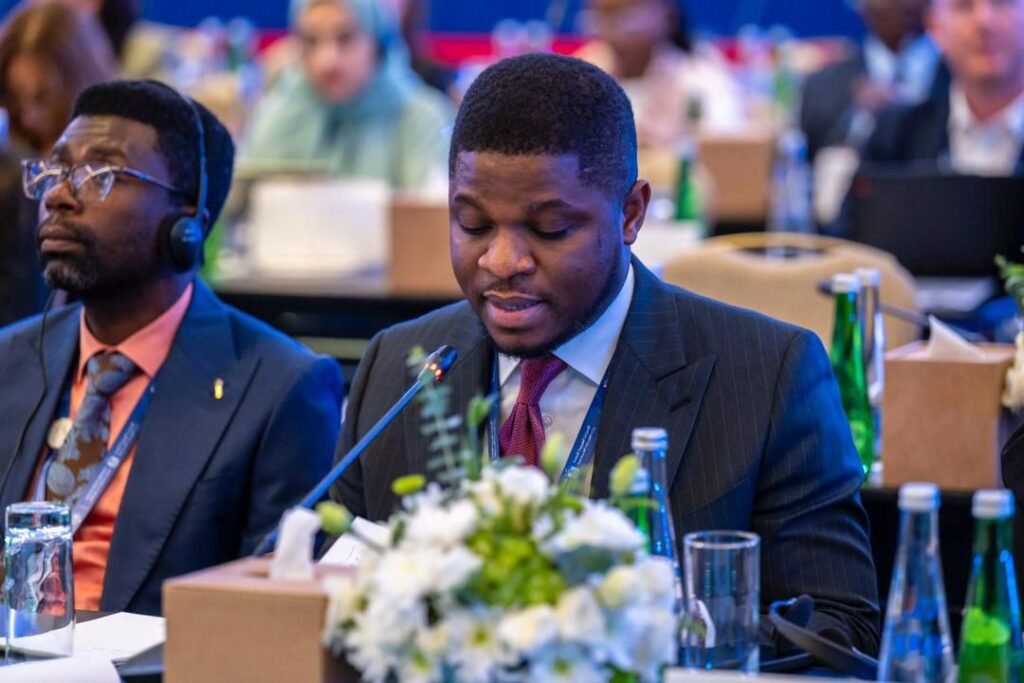
Senyo K. Hosi, a prominent Entrepreneur and Finance & Economic Policy Analyst, has called for an urgent national pivot from the mere extraction of gold to a sophisticated framework of leveraging the precious metal for long-term economic resilience, industrialization, and sustainable prosperity.
The current decline in Large-Scale Mining (LSM) production serves as a stark warning of waning investment, signaling that the nation can no longer rely on traditional “dig and ship” models to secure its fiscal future.
To avoid the pitfalls of resource exhaustion, Hosi argues that the government must explore bold regulatory and fiscal incentives that revitalize exploration while simultaneously building a domestic ecosystem that treats gold as a strategic financial asset rather than just an export commodity.
“Ghana must transition from extracting gold to leveraging gold- for national resilience, industrialisation, and long-term prosperity. As Africa’s largest gold producer, we should position Accra as a West African gold trading and settlement centre.”
Senyo K. Hosi
This shift toward “leveraging” gold involves a multidimensional approach that integrates monetary policy with industrial ambition.
By sustaining the Bank of Ghana’s gold-for-reserve program, the nation can build a hard-asset buffer that protects the cedi and provides a foundation for national wealth that outlasts the mines themselves.
Furthermore, as Africa’s leading producer, Ghana is uniquely positioned to transform Accra into a West African gold trading and settlement hub.
This would allow the country to capture value from the entire regional supply chain, transitioning from a primary producer to a sophisticated financial services provider for the global extractive industry.
The Ticking Clock of Global Gold Depletion

The urgency for this policy shift is underscored by the reality of global gold depletion, which is described by experts as accelerated and irreversible in the medium term.
With global reserves estimated to be exhausted by 2050, the Oregon Group (2025) suggests that the window for maximizing the benefits of remaining deposits is closing rapidly.
For Ghana, this represents a “strategic moment” where a shrinking global supply will naturally drive up the value of domestic reserves.
However, capitalizing on this scarcity requires a departure from over-reliance on raw extraction, which often leaves the country vulnerable to price volatility and environmental degradation without creating lasting industrial linkages.
Research indicates that an over-reliance on mere extraction has historically limited the actual gold benefits for the Ghanaian economy. While mining contributes significantly to GDP, much of the value is expatriated through capital costs and dividends, leaving the local economy with a disproportionately small share of the wealth.
This extraction-heavy model often results in “Dutch Disease” symptoms, where the focus on gold neglects the development of value-added industries like local refining and jewelry manufacturing. To counter this, Hosi argues that “smarter fiscal, environmental, and industrial policy” must be deployed to ensure that the remaining life-span of Ghana’s mines fuels a broader economic transformation.
Transforming the ASM Sector through GoldBod and Technology

The Artisanal and Small-Scale Mining (ASM) sector remains a critical yet controversial pillar of Ghana’s gold landscape.
While the dominance of the Ghana Gold Board (GoldBod) in the ASM sector is a commendable step toward formalization, Hosi suggested that this influence must be leveraged beyond simple regulation.
The goal should be to enforce a culture of “environmental responsibility and accountability” that has been missing for decades.
By integrating GoldBod’s market power with strict environmental mandates, the state can begin to heal the scars left by unregulated mining while ensuring that the sector continues to provide a livelihood for thousands of Ghanaians.
The ongoing struggle against illegal mining, or galamsey, is fundamentally an economic war fueled by the abnormal profits available in the ASM sector.
Recognizing that this battle is difficult to win through force alone, the policy recommendation favors a “win-win situation” through the adoption of cleaner, more efficient technology.
By facilitating high-output recovery tools for ASM operators, the government can incentivize regularisation. A pivotal shift in this strategy involves “redirecting ASM operations from Alluvial to Hardrock mining,” a move recommended by industry aggregators to significantly reduce the catastrophic environmental degradation currently affecting Ghana’s water bodies.
Strategic Reserves and the Path to 2050
As the global community nears the 2050 depletion horizon, the Bank of Ghana’s Domestic Gold Purchase Programme stands as a vital tool for securing the nation’s future. By converting locally mined gold into national reserves, Ghana creates a sovereign hedge against global economic instability.
This program does more than just stabilize the currency; it serves as the primary engine for the “leveraging” strategy, ensuring that a portion of every ounce mined stays within the national balance sheet. This accumulation of “hard assets” is what will ultimately fund the transition toward a post-mining industrial economy.
The path forward for Ghana lies in a disciplined departure from its history as a primary extractor. By embracing Hosi’s vision of a gold-backed industrial and financial hub, the country can ensure that its most famous resource leaves behind a legacy of strength rather than empty pits.
The transition from extracting to leveraging is not merely an economic choice; it is a necessity for national survival in a world where gold is becoming increasingly scarce.
Through technological innovation in the ASM sector and the strategic management of national reserves, Ghana can redefine its role in the global economy and secure prosperity for many years after the last mine has closed.
READ ALSO: Lebanese Army Completes First Phase Of Disarming Non-state Groups