
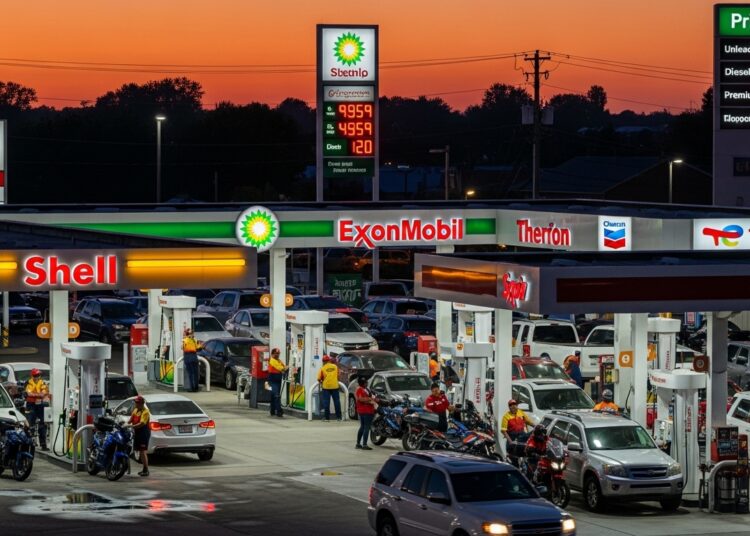
The Institute for Energy Security (IES) has called on the National Petroleum Authority (NPA) to step up enforcement of fuel price floor and price uniformity policies, warning that weak compliance is steadily eroding confidence and sustainability in Ghana’s downstream petroleum market.
In a statement, the energy policy think tank said recent market trends point to worsening structural and regulatory lapses, some of which have also been highlighted by industry players themselves.
“The most pressing concern is the persistent over-licensing of oil marketing firms.
“Ghana’s downstream petroleum market currently hosts more than 229 Oil Marketing Companies (OMCs) and Liquefied Petroleum Gas Marketing Companies (LPGMCs), far exceeding what the market can sustainably support.”
Institute for Energy Security (IES)
IES observed that many of these firms are either dormant or consistently non-compliant, undermining regulatory discipline and fair competition.
“At least 53 non-operational entities still retain active licences, weakening regulatory discipline and distorting competition.”
Institute for Energy Security (IES)
The think tank warned that allowing inactive firms to hold licences erodes the credibility of regulatory oversight and creates loopholes that can be exploited for regulatory arbitrage.
Price Floor Breaches Raise Red Flags
IES also expressed concern over pricing behaviour during the January 16–31, 2026 pricing window. During this period, the NPA-administered price floors are set at GH¢9.80 per litre for petrol and GH¢10.47 per litre for diesel.
While acknowledging that several OMCs are pricing above the approved minimum, the institute said market checks indicate that some retailers are selling fuel dangerously close to, or marginally below, the floor. “Any pricing below the floor, however marginal, constitutes a serious regulatory violation,” IES warned.
According to the institute, such practices weaken the authority of the NPA, create unfair advantages for non-compliant firms, and may signal deeper issues such as tax and levy evasion within the supply chain.
IES cautioned that inconsistent enforcement of the price floor sends the wrong signal to market participants, particularly those that invest heavily in compliance, safety standards, and tax obligations.
By tolerating marginal breaches, the institute argued, regulators risk normalising non-compliance and encouraging a culture where firms test the limits of enforcement rather than adhere to policy.
IES stressed that the price floor is not merely an administrative guideline but a core regulatory tool designed to ensure order, transparency, and fiscal discipline in a deregulated market.
Beyond the price floor, IES criticised what it described as growing violations of the Price Uniformity Policy across OMC retail networks. The institute pointed to selective discounting practices, where fuel prices vary across outlets operated by the same company.
“Selective discounting disproportionately benefits consumers in competitive urban centres, while consumers in less competitive or remote areas, who are intended beneficiaries of the UPPF, end up paying higher prices despite contributing equally to the fund.”
Institute for Energy Security (IES)
IES warned that such disparities weaken public trust in the pricing system and defeat the social equity goals underpinning uniform pricing.
Calls for Stronger Enforcement

To restore discipline, IES urged the NPA to intensify retail-level monitoring and take decisive action against offending companies. The institute recommended that OMCs found pricing below the approved floor be sanctioned without exception.
It also called for strict enforcement of uniform pricing across all retail networks, arguing that consistency is essential for the credibility of the UPPF and the broader deregulated framework.
In addition, IES advocated a comprehensive clean-up of the licensing regime, including the withdrawal of licences from dormant operators that fail to meet minimum operational thresholds.
IES warned that failure to enforce existing rules could push the downstream petroleum market into what it described as a “destructive race to the bottom.”
Such a scenario, the institute said, would be characterised by widespread non-compliance, fiscal leakages, compromised safety standards, and long-term harm to both consumers and law-abiding industry players.
According to IES, while competition is a core feature of deregulation, it must be anchored in strong regulatory discipline to prevent market abuse and protect public interest.
As fuel pricing continues to influence inflation, transport costs, and household spending, IES said the credibility of the NPA is increasingly under scrutiny. The institute maintained that consistent enforcement, not policy revision is the immediate priority.
Without firm regulatory action, IES cautioned, the downstream petroleum sector risks drifting away from stability toward disorder, with consequences that could take years to reverse.
The institute concluded that strict enforcement of existing rules remains the surest path to a fair, transparent, and sustainable fuel market in Ghana.
READ ALSO: Rubber Sector Crisis: Yaeric Company Faces Feedstock Shortage