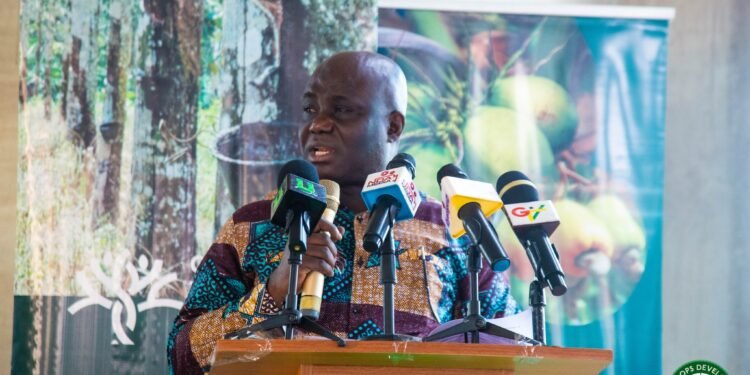
The Chief Executive Officer (CEO) of the Ghana Infrastructure Investment Fund (GIIF), Mr. Nana Dwemoh Benneh, has concluded a high-level investment mission to the People’s Republic of China, marking a decisive step in the mobilization of capital for Ghana’s industrial reset agenda.
Following a strategic study tour and investment promotion initiative in January 2026, the GIIF leadership signaled during an interview that the fund is moving beyond traditional financing models to secure co-investment for the 24H+ Programme.
This mission, conceived as a “tactical follow-up to the 2024 State visit to Beijing,” aims to align Ghana’s critical infrastructure needs with China’s advanced capabilities in industrial technology and precision engineering.
“Under the current vision for economic transformation, key infrastructure development is the starting point. On this trip, the mission is to find partners who can share investment ideas and invite them to co-invest in projects under the 24-hour economy.
“This is intended to kick-start the program that will transform the national economic development and transition the country toward a more resilient, industrial footing”
Mr. Nana Dwemoh Benneh, CEO of GIIF
According to Mr. Benneh, the 24-hour economy is being positioned as the primary catalyst for sustainable job creation and export-led growth in the Mahama-led administration.

For GIIF, a quasi-sovereign fund tasked with bridging Ghana’s infrastructure gap, the China mission was focused on identifying partners willing to share the risk and reward of large-scale industrial projects.
Mr. Benneh emphasized that the success of the 24H+ Secretariat’s agenda depends on the rapid deployment of specialized infrastructure – ranging from industrial parks to energy hubs – that can sustain round-the-clock productivity.


Industrial Parks and Import Substitution
A central pillar of the GIIF investment pitch in China involved the development of light manufacturing hubs and industrial parks. The GIIF CEO noted that these zones are intended to drive Ghana’s import substitution strategy, particularly in the textile and machinery sectors.
By leveraging China’s decades of expertise in industrial cluster development, GIIF aims to establish “plug-and-play” manufacturing environments that allow local and international firms to scale operations with minimal overhead.
During discussions with Chinese investors, the GIIF delegation highlighted the competitive advantage of Ghana’s skilled, young human capital. The objective is to move from being an import-driven economy to one that is self-sustaining and export-ready.
Mr. Benneh noted that the manufacturing sector currently remains one of the lowest contributors to Ghana’s GDP, a reality that the 24-hour economy seeks to reverse by focusing on secondary value addition and smart technology.

“We believe that economic transformation lies in further developing our manufacturing sector and the secondary agri-sector. These are areas where we see China has excelled and built expertise over the years. Therefore matching with investors from China can move the country closer to its industrial aspirations”
Mr. Nana Dwemoh Benneh, CEO of GIIF
Beyond domestic growth, the GIIF leadership pitched Ghana as the indispensable gateway to the West African sub-region. With a regional population of approximately 400 million people, the “ready market,” of the ECOWAS and Sahel regions provides a compelling case for Chinese firms looking to localize production.
Mr. Benneh explained that by establishing manufacturing hubs in Ghana, partners can mitigate the logistics costs associated with shipping finished goods from Asia while benefiting from the duty-free access provided under the African Continental Free Trade Area (AfCFTA).
The mission concluded with a reaffirmed commitment to bilateral cooperation that transcends simple debt-financing models. Instead, GIIF is advocating for a sustainable, viable business model where Chinese investors become long-term stakeholders in Ghanaian infrastructure.
As the Chinese economy pivots toward high-end manufacturing and AI-integrated systems, GIIF sees an opportunity for a “technological marriage,” that can propel Ghana’s digital and industrial sectors into a new era of efficiency.

“We have seen different business models come out of the West and alternatives coming out of China. We are looking for the best kind of alternative to drive our destinies forward.
“Empirical evidence has shown that as we have opened ourselves more to a variety of models, we have found strategies that truly work for our sustainable growth”
Mr. Nana Dwemoh Benneh, CEO of GIIF
READ ALSO: India, EU Reach Free Trade Agreement