
Africa’s push toward industrial growth will depend less on ideas or talent and more on fixing fragmented energy, infrastructure and trade systems, Ghana’s Deputy Minister for Energy, Richard Gyan-Mensah, has said.
Speaking at the Africa Trade Summit 2026, he called for stronger regional coordination to unlock trade-led industrial growth across the continent.
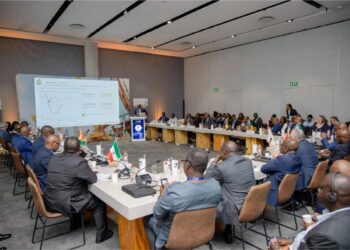
Mr Gyan-Mensah made the remarks while delivering the keynote address at the Roundtable on Energy, Infrastructure and Trade Connectivity, where he represented the Minister for Energy and Green Transition, Dr John Abdulai Jinapor.
“I emphasised that Africa’s industrial ambitions are not constrained by a lack of talent or ideas, but by fragmented energy, infrastructure and trade systems.”
Richard Gyan-Mensah, Deputy Minister for Energy
According to the Deputy Minister, Africa’s development challenges are often misunderstood. He argued that the continent’s slow industrial progress is not due to a lack of innovation or skilled human capital, but rather to disconnected systems that prevent economies from scaling efficiently.
He noted that many African countries have pursued industrial policies in isolation, resulting in duplicated infrastructure, weak cross-border linkages and inefficient markets.
This fragmentation, he explained, raises production costs and limits the competitiveness of African industries both within the continent and globally.
Three Pillars of Industrial Economies

Drawing from global examples, Mr Gyan-Mensah outlined what he described as the foundation of successful industrial economies. “Successful industrial economies are built on three pillars; reliable energy, resilient infrastructure and efficient trade systems,” he said.
He stressed that reliable energy supply remains critical for industrial productivity, particularly for manufacturing and processing industries that require consistent power. Without stable electricity, he warned, industrial investments struggle to deliver returns and job creation remains limited.
Resilient infrastructure, he added, must go beyond physical assets such as roads and ports to include maintenance systems and climate-resilient design. Efficient trade systems, meanwhile, are essential to ensure that goods produced can reach markets quickly and at competitive costs.
The Deputy Minister placed strong emphasis on regional solutions, noting that national-level investments alone cannot deliver the scale required for industrial transformation. He highlighted the importance of regional power pools in addressing energy deficits and improving supply reliability across borders.
According to him, energy and transport infrastructure only achieve their intended impact when supported by modern trade systems. He warned that without harmonised customs procedures and digital trade platforms, infrastructure investments risk underperforming.
Infrastructure Must Enable Movement of Goods

Mr Gyan-Mensah underscored that infrastructure should be viewed as an enabler of trade rather than an end in itself. “Infrastructure delivers value only when goods can move efficiently across borders,” he said.
He pointed out that delays at borders, inconsistent regulations and manual processes continue to undermine Africa’s trade potential, even where modern roads and ports exist. Addressing these bottlenecks, he argued, would significantly boost intra-African trade and support industrial value chains.
The Deputy Minister noted that initiatives under the African Continental Free Trade Area (AfCFTA) provide a strong framework for tackling these challenges, but require coordinated implementation and political commitment.
“I concluded by calling for stronger regional coordination, infrastructure diplomacy, and innovative financing to close Africa’s infrastructure gap and unlock trade-led industrialization.”
Richard Gyan-Mensah, Deputy Minister for Energy

He explained that traditional public financing alone is insufficient to meet Africa’s vast infrastructure needs. Instead, he advocated blended finance, public-private partnerships and regional investment vehicles that can mobilise long-term capital at scale.
Infrastructure diplomacy, he added, will be essential in aligning national priorities with regional goals and ensuring that cross-border projects move from planning to execution.
Representing Ghana at the summit, Mr Gyan-Mensah reaffirmed the country’s commitment to regional integration through energy cooperation and trade facilitation.
He noted that Ghana’s energy and green transition agenda aligns with broader continental efforts to build sustainable, interconnected economies.
As Africa seeks to position itself as a competitive industrial hub, the Deputy Minister said the choices made today on energy, infrastructure and trade integration will shape the continent’s economic trajectory for decades.
READ ALSO: Mahama Commissions 263 Officer Cadets into Ghana Armed Forces