
Fuel price pressures are expected to persist in the coming weeks despite intense competition among oil marketing companies, as currency depreciation and rising global crude oil prices continue to drive costs upward, an energy law expert has warned.
Energy law expert Lom Nuku Ahlijah has cautioned that while competition among Oil Marketing Companies (OMCs) could provide short-term relief at the pumps, broader economic and geopolitical factors will continue to exert upward pressure on fuel prices in Ghana.
Speaking in an interview with Vaultz News, Mr Ahlijah said recent projections by the Chamber of Oil Marketing Companies (COMAC) reflect deeper structural challenges within Ghana’s fuel pricing regime. According to him, although some OMCs may delay immediate price increases, such measures are unlikely to be sustainable in the long run.
“Operational competition among OMCs may temporarily buffer against immediate price hikes,” he said, adding that this buffer depends largely on the financial strength of individual companies and prevailing market conditions.
Currency Depreciation Remains a Key Driver
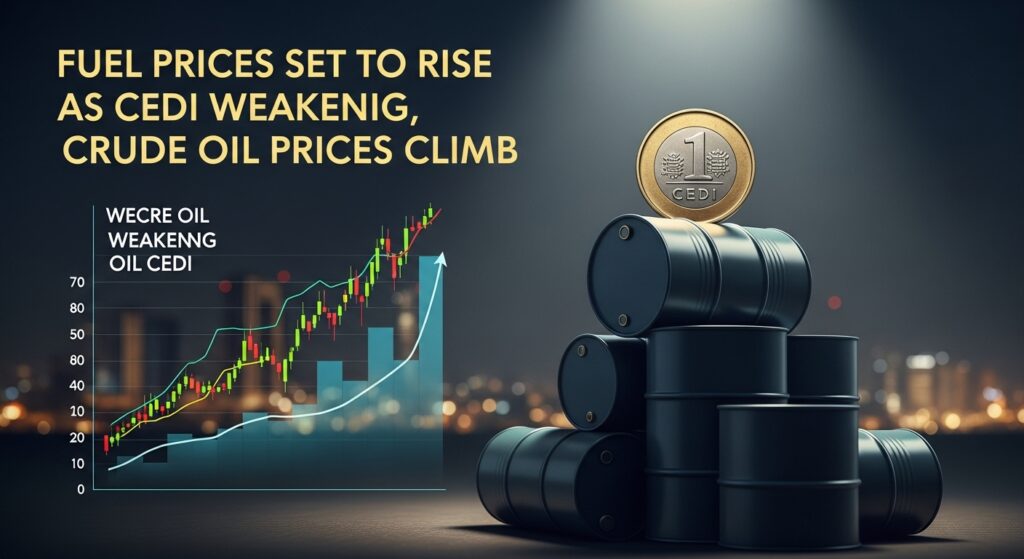
Mr Ahlijah identified the depreciation of the Ghanaian cedi as one of the most significant factors influencing fuel prices. He explained that Ghana’s reliance on imported petroleum products makes domestic prices highly sensitive to foreign exchange movements.
“The rise in fuel prices is influenced by multiple factors, including currency depreciation and global crude oil volatility.
“Ghana’s currency, the cedi, faces continuous depreciation, impacting fuel prices.”
Energy law expert Lom Nuku Ahlijah
He acknowledged ongoing efforts by the Bank of Ghana and other state institutions to stabilise the currency and manage foreign exchange pressures. However, he suggested that these interventions may take time to reflect meaningfully in fuel pricing.
“The central bank and other entities like the Goldbod are working to stabilize the currency and manage foreign exchange pressures,” Mr Ahlijah said, while cautioning that sustained stability is required to achieve lasting relief at the pumps.
Beyond domestic currency issues, the energy law expert pointed to rising global crude oil prices as another major contributor to higher fuel costs.
“Global crude oil prices are affected by international geopolitics and conflicts, which Ghana cannot control.”
Energy law expert Lom Nuku Ahlijah
The biggest driver last week has been a sharp escalation in U.S.–Iran tensions, injecting a sizeable risk premium into both benchmarks.
Reports that President Trump is considering targeted strikes on Iranian leadership have pushed Brent to around $70.70 and WTI to the mid-$60s, the highest levels since mid-2025.
NPA and Impact on OMCs

Mr Ahlijah also explained the regulatory framework governing fuel pricing in Ghana, noting that the National Petroleum Authority (NPA) provides the pricing floor that guides OMCs in adjusting pump prices.
He pointed out that not all OMCs are equally positioned to absorb rising costs. Smaller companies, in particular, face greater challenges due to limited financial capacity compared to larger industry players.
“Smaller OMCs may struggle to absorb costs due to their limited capacity compared to larger players,” he explained, suggesting that prolonged cost absorption could threaten their sustainability.
Touching on the broader impact on consumers, Mr Ahlijah observed that previous reductions in fuel prices did not always translate into proportional decreases in transport fares.
“Consumers have experienced fare decreases despite previous relief in fuel prices,” he said, adding that future fare adjustments will largely depend on how fuel prices and exchange rates evolve.
According to the energy law expert, while OMCs may benefit during periods of favourable economic conditions, prolonged losses during difficult times are not sustainable.
“The current economic climate makes it difficult for OMCs to absorb costs long-term without affecting their bottom line.”
Energy law expert Lom Nuku Ahlijah
As a result, he urged consumers to adjust expectations, noting that temporary relief at the pumps may eventually give way to necessary price corrections.
Call for Collaborative Action

Mr Ahlijah concluded by calling for a coordinated approach among key stakeholders to manage the impact of fuel price volatility. He stressed the need for collaboration between OMCs, the central bank and other relevant institutions to ensure a balanced pricing regime.
“A collaborative effort is needed among OMCs, the central bank, and other stakeholders to manage fuel price impacts,” he said, noting that fuel pricing is influenced by multiple, constantly shifting elements.
Mr Ahlijah emphasised that fuel pricing remains a critical issue affecting households and businesses alike, requiring careful and coordinated management to protect both consumers and industry players.
READ ALSO: Finance Minister Backs Commercial Farming for Jobs