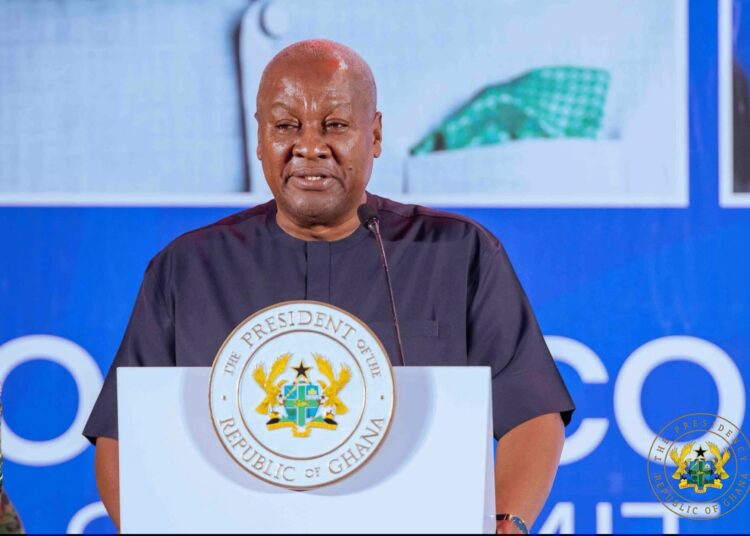
President John Dramani Mahama has outlined bold strategic pillars designed to reposition Ghana’s mining industry from a largely extractive model to a value-driven industrial engine at the Mining Sector Local Content Summit.
Speaking at the 2026 summit held at Palms by Eagle in Takoradi on February 18, the President emphasized that local content must move beyond procurement targets and evolve into a framework that fosters industrial transformation.
“Local content must evolve from transactional procurements to transformational partnerships,” he declared, setting the tone for what he described as a new chapter in Ghana’s extractive sector governance.
Reforming Legal and Regulatory Framework
Central to the President’s address was a commitment to review and refine Ghana’s mining legislation to enable indigenous enterprises to climb higher in the mining value chain.
“This government is reviewing and refining our mining legislation and regulatory frameworks to ensure that Ghanaian enterprises move up the mining value chain.”
President John Dramani Mahama
The objective, he explained, is to shift local businesses from merely supplying consumables to manufacturing critical components and developing innovative solutions for the industry.
For decades, Ghana’s mining sector has generated substantial export earnings, particularly from gold. However, the President noted that high-value technical services, equipment manufacturing, and processing activities are often carried out outside the country.
The proposed reforms aim to correct this imbalance by embedding stronger capacity-building mechanisms within the regulatory framework.
According to President Mahama, meaningful local participation must extend beyond surface-level compliance.
“We’ll incentivise mining firms to build local capacity and not simply purchase locally,” he said, stressing that equity participation, technology transfer, and knowledge sharing must become standard practice rather than rare exceptions.
This approach signals a shift from short-term supply contracts to long-term industrial partnerships capable of fostering domestic expertise and innovation.
Ending Raw Ore Exports
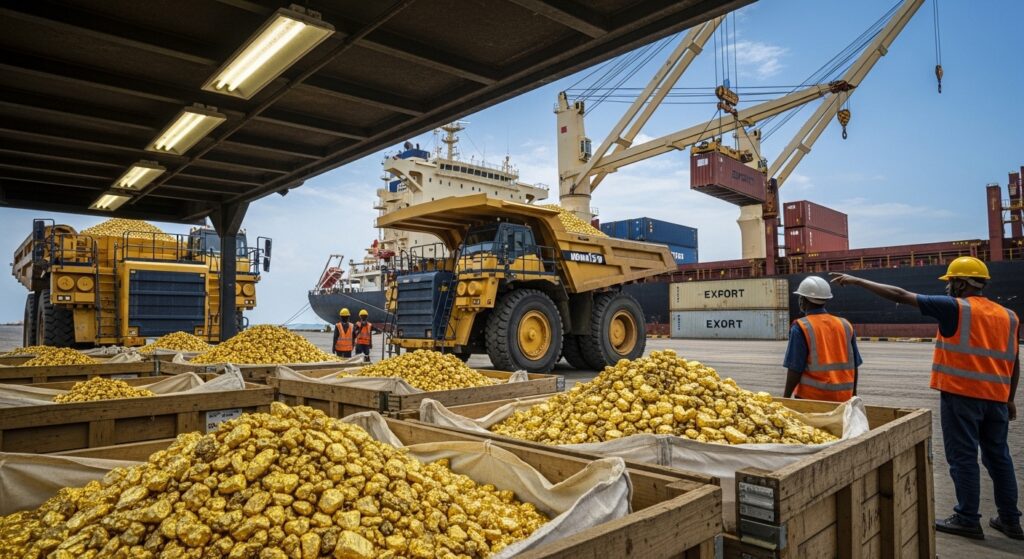
The second strategic pillar announced at the Mining Sector Local Content Summit focuses on value addition through domestic processing.
“It is no longer acceptable for Ghana to continue to export raw ores and import finished products,” the President stated firmly. He proposed an ambitious timeline, declaring that Ghana must aim to eliminate raw ore exports within the next five years.
To achieve this, the government plans to support the establishment of refineries and bullion infrastructure that would enable more minerals to be processed locally before export.
Such facilities would not only increase revenue retention but also create skilled jobs and stimulate auxiliary industries.
The President’s comments reflect growing calls across resource-rich countries to capture greater value from natural resources rather than relying solely on raw commodity exports.
By committing to build refining capacity, Ghana seeks to deepen its industrial base while strengthening fiscal resilience.
Building Mineral-Based Industrial Clusters

Beyond refining, President Mahama outlined plans to promote mineral-based industrial clusters that integrate upstream extraction with downstream processing and manufacturing. He added that Ghana should facilitate downstream processing of bauxite, manganese, and lithium.
These minerals hold strategic significance in the evolving global economy. Lithium, in particular, has become critical to electric vehicle batteries and renewable energy storage systems.
By aligning mining strategy with the global green energy transition, Ghana could position itself as a competitive player in emerging supply chains.
“Our mineral wealth must power Ghana’s industrialisation, not merely sustain export dependence,” the President emphasized. The statement underscores a broader ambition to ensure that mining contributes directly to industrial diversification and economic transformation.
Local Content Policy
The Mining Sector Local Content Summit provided a platform for stakeholders to reflect on the future direction of Ghana’s mining industry.
President Mahama’s strategic pillars signal a departure from incremental reforms toward a more comprehensive transformation agenda.
By emphasizing partnerships over transactions, capacity building over procurement quotas, and value addition over raw exports, the government aims to reshape the structural foundations of the sector.
If successfully implemented, these measures could redefine Ghana’s role within the global mining landscape. Rather than remaining primarily a supplier of raw materials, the country could emerge as a hub for mineral processing, manufacturing, and innovation.
As discussions from the summit continue, the challenge will lie in translating policy ambition into measurable outcomes.
Yet the message delivered in Takoradi was clear: Ghana’s mineral wealth must serve as a catalyst for industrial growth, technological advancement, and long-term economic resilience.
READ ALSO: Reset or Rerun? Where is the Scorecard – Kay Codjoe Writes