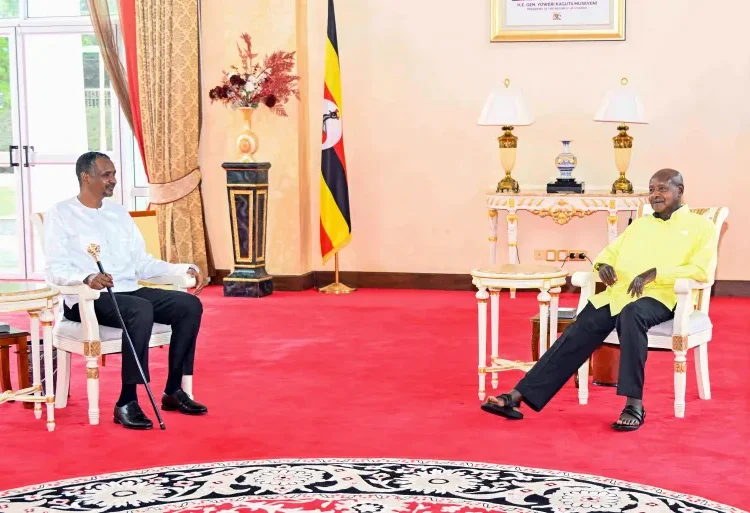
Sudan has condemned Uganda for hosting the head of the paramilitary Rapid Support Forces (RSF), Mohamed Hamdan Dagalo, calling it an “insult” to humanity and the Sudanese people.
In a statement issued today Sunday, February 22, 2026, Sudan’s Ministry of Foreign Affairs denounced the reception of Dagalo, also known as “Hemedti”, and his meeting with Ugandan President Yoweri Museveni, on Friday, February 20, 2026.

Hemeti met with Ugandan President Yoweri Museveni at Entebbe’s State House, a day after a United Nations probe found his forces had committed acts of genocide in Darfur.
Sudan’s foreign ministry on Sunday criticised the meeting, saying, “This unprecedented step insults humanity before it insults the Sudanese people, and at the same time, it disregards the lives of innocent people killed due to the behaviour of Hemedti and his terrorist militia.”
Sudan’s foreign ministry stated that the RSF’s atrocities had been “documented by the international community and condemned by regional organisations of which Uganda is a member,” including the African Union and the Intergovernmental Authority on Development (IGAD).
In 2023, Sudan was plunged into a civil war between the Sudanese army, led by Abdel Fattah al-Burhan, and the RSF. According to the Office of the United Nations High Commissioner for Refugees (UNHCR), at least 11.7 million people have been displaced by the conflict and an estimated 150,000 people have been killed.
Rights groups and international organisations have accused the RSF of war crimes and targeting civilians in Sudan.
Last week, the United States imposed sanctions on three RSF commanders over their alleged roles in the 18-month siege and capture of el‑Fasher, the capital of North Darfur State in western Sudan.
In a statement, the US Department of the Treasury accused the RSF of perpetrating “a horrific campaign of ethnic killings, torture, starvation, and sexual violence” during the siege and capture of el-Fasher, which fell to the RSF in October.
Separately, a UN mission found that the RSF campaign in el-Fasher was a “planned and organised operation that bears the defining characteristics of genocide.”
Khartoum said that hosting Dagalo “disregards” human values. It “completely disregards the laws governing relations between member states of regional and international organisations that prohibit providing any support for rebel forces against a legitimate, internationally recognised government,” the Foreign Ministry added.
Khartoum further asserted that the step taken by Uganda does not respect human reason, nor does it take into account the psychological harm suffered by Sudanese citizens.
Uganda’s Ministry of Foreign Affairs issued its own statement on Dagalo’s visit and said his meeting with Museveni focused on “ending the ongoing conflict in Sudan and restoring regional stability.”
Museveni reiterated in his remarks to Hemedti that peace in Sudan could only be achieved through dialogue and warned against what he described as identity politics.
“When I last came to Sudan, I met [former] President [Omar al-] Bashir and advised against the politics of identity instead of the politics of interest. Identity politics is poisonous. It does not yield good results. What is important are shared interests that unite people.”
Yoweri Museveni
He called for both parties to prioritise “peace over military confrontation.”
According to a statement released by the Ugandan government, Dagalo, for his part, thanked Museveni and said that he shares the Ugandan President’s “principles and your commitment to peace.” “He noted that Sudan continues to face serious humanitarian and institutional challenges as a result of the conflict and stressed the need for a peaceful resolution,” the statement added.
Concern Raised Over Visit Being New Policy By Ugandan Government Toward Sudan
At the same time, the Sudanese foreign ministry acknowledged that the Government of Sudan recognizes that the Ugandan government has the sovereign right to receive whomever it wishes on its territory and to define its bilateral relations in accordance with what it considers to be its interests.
“From this standpoint, the Government of Sudan expresses its deep concern over this step if it reflects a new policy by the Ugandan government toward Sudan, by sponsoring a rebel who has shed the blood of the Sudanese people, violated their sanctities, and committed all forms of crimes, including genocide, ethnically motivated killings, and other violations that make one’s forehead sweat in shame.”
Sudan Foreign Ministry
Emphasizing its commitment to bilateral relations and a policy of good neighbourliness and non-interference, Sudan said that it hopes “the Ugandan government will distance itself from any association with Hemeti and not allow him to exploit Ugandan territory, land or airspace, to carry out a campaign of genocide.”