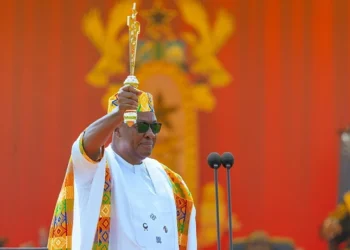
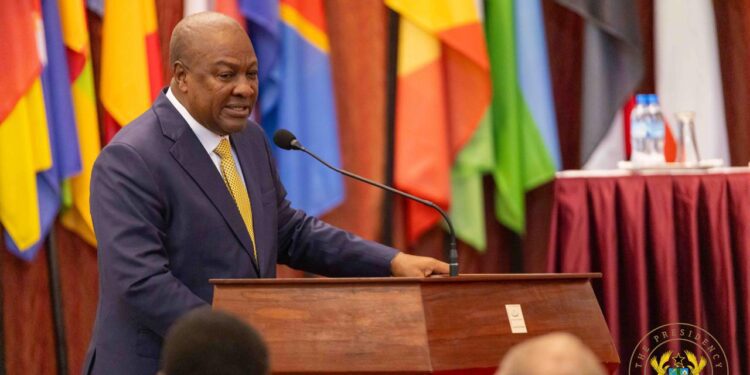
President of Ghana HE John Dramani Mahama has called on all African Union member states to fully ratify and support the African Court on Human and Peoples’ Rights, describing the institution as indispensable to safeguarding justice, dignity, and accountability across the continent.
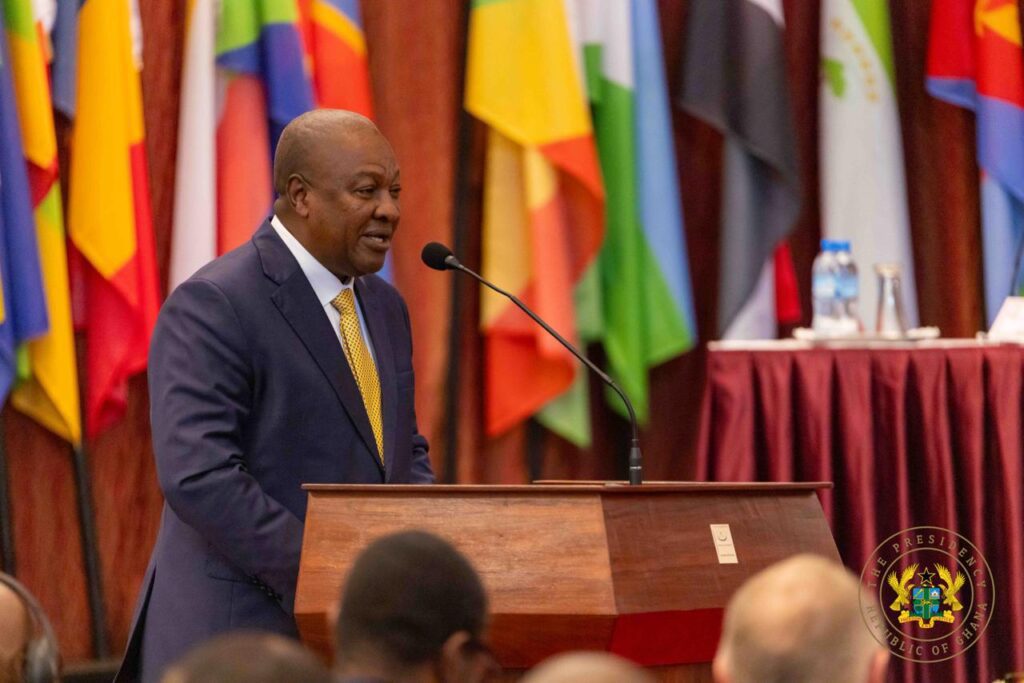
He made the appeal while delivering the inaugural address at the opening of the 2026 Judicial Year of the African Court on Human and Peoples’ Rights in Arusha, Tanzania, an event that also marked the launch of the court’s 20th anniversary celebrations.
Addressing a full bench of judges, diplomats, and legal practitioners, President Mahama noted that as of August 2024, only 34 of the African Union’s 55 member states had ratified the protocol establishing the court.
He urged the remaining states to do so without delay, arguing that Africa’s commitment to human rights must be matched by concrete legal mechanisms capable of enforcing them.
“I humbly ask all African nations and individuals to respect and implement the court’s judgments in good faith and to also make the declaration to allow individuals and non-governmental organisations direct access to this court.”
President of Ghana, HE John Dramani Mahama
President Mahama emphasised that the court can only fulfil its mandate if it is empowered and respected. He further encouraged governments to make the declaration allowing individuals and non-governmental organisations direct access to the court, describing this step as essential to deepening accountability and public trust.
He reassured his fellow heads of state that they had nothing to fear from the court, arguing that a strong judicial institution ultimately protects both citizens and governments by entrenching the rule of law and preventing abuses that undermine stability.

Personal Reflections on Justice and Rule of Law
President Mahama began his address on a deeply personal note, acknowledging that standing before judges was both an honour and an intimidating experience shaped by his childhood memories.
He recounted how his father, a former minister of state in the government of Ghana’s first president, Kwame Nkrumah, was detained following the 1966 coup d’état. He explained that those early experiences left a lasting impression on his understanding of justice, due process, and the dangers of unchecked power.
Even years later, when his father had withdrawn from public life and was working as a farmer, he was detained again after writing a letter offering unsolicited advice to the then-military ruler Ignatius Kutu Acheampong, cautioning him not to hold onto power for too long.
President Mahama said these moments taught him how easily those in authority could act with impunity when institutions were weak.
“My connection to these themes is rooted in my family’s history, which has shaped my own perspectives on justice and human rights. I’ve spent much of my life reflecting on justice, due process, and the rule of law.
“Why are these rights afforded to some and not to others? The same applies to human rights and dignity, which have been on my mind in recent days since I received your invitation.”
President of Ghana, HE John Dramani Mahama
Africa’s Shared Destiny and Collective Responsibility
Drawing broader lessons from his family’s experience, President Mahama said injustices never affect individuals alone but ripple through families, communities, and nations.
He stressed that despite being made up of 55 sovereign states, Africa’s destinies remain closely intertwined. He observed that just as liberation movements and later military coups spread rapidly across borders in past decades, so too must Africa’s commitment to justice and human rights be collective.
It is within this context, he said, that the African Court on Human and Peoples’ Rights serves a critical purpose as an institution that serves all but is beholden to none.
Over its two decades of operation, the court has demonstrated courage in recalibrating Africa’s moral compass and reminding states of their obligations under the Banjul Charter, which all African nations have endorsed.
Ghana’s Contribution to Continental Justice
In highlighting Ghana’s own commitment to the court, President Mahama noted with pride that the country has contributed distinguished jurists to its work since inception.
He referenced the service of Sophia Akuffo, who served on the court from 2006 to 2014 and later became Chief Justice of Ghana, as well as Justice Sir Dennis Adjei, who is currently serving a six-year term following his election in 2022.
He said these contributions reflected Ghana’s longstanding belief in independent justice systems and its broader efforts to strengthen domestic courts and uphold constitutional governance.
The President reflected on the many Africans who suffered grave injustices before the existence of a continental human rights court. He invoked the names of historic figures such as Patrice Lumumba, Thomas Sankara, Nelson Mandela, and Steve Biko, describing them as martyrs of Africa’s struggle for dignity and freedom.
“Had the African Court of Human and Peoples’ Rights existed earlier in our past, these grave instances of human rights abuses and injustices would have been a very important case for you to adjudicate.
“..would have secured justice against racist apartheid criminals, colonialists, and even our own oppressive African dictators who tortured and sent many of their countrymen to death and countrymen and women to death.”
HE John Dramani Mahama, President of Ghana
Their sacrifices, he said, underscore the urgency of ensuring that future generations inherit a continent where rights are protected by law rather than the goodwill of those in power.

A Call to Africa’s Future
Concluding his address, President Mahama said that Africa stands at a pivotal moment. He noted that judicial systems across the continent have strengthened over the past decade, offering hope that the nightmares of arbitrary detention and injustice that marked earlier generations need not be repeated.
Standing in Arusha, a city synonymous with international justice, he urged African leaders to deepen their commitment to the court so that when its 40th anniversary is marked in two decades, it will stand as a leading global judicial institution and a model for others.
He said the time had come for Africa to step fully into its greatness by honouring the promises made to its people and future generations.
READ ALSO: 91-Day T-Bill Rate Falls to 5.3%