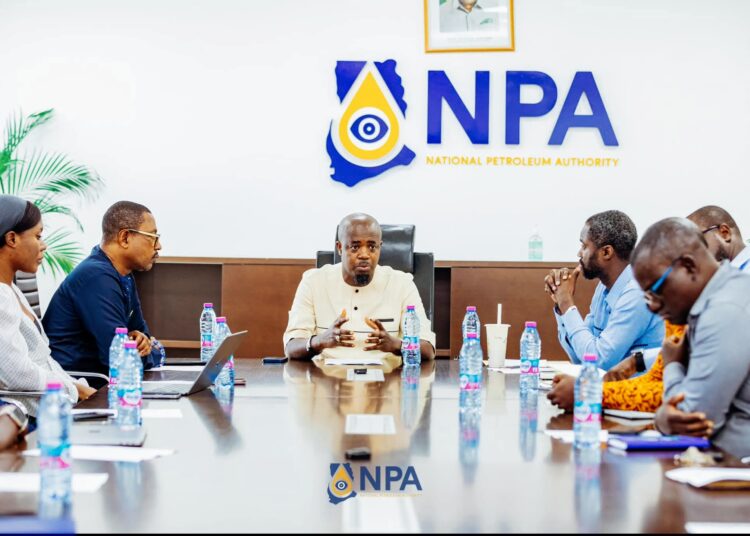
The National Petroleum Authority (NPA) has firmly rejected claims that it has banned fuel discounts, insisting that its recent directive on uniform fuel pricing merely enforces an existing legal requirement applicable to oil marketing companies.
According to the regulator, the directive does not abolish competition within Ghana’s deregulated petroleum sector but reinforces a long-standing rule that requires each company to maintain the same pump price across all its retail outlets.
Speaking on the matter, the Director of Economic Regulation and Planning at the NPA, Abass Ibrahim Tasunti, said the legal framework governing the downstream sector has always mandated uniform pricing within the same network of filling stations.
Legal Basis for Uniform Pricing
Mr Tasunti explained that Ghana’s petroleum pricing regime underwent significant reforms in 2015 when the country transitioned to a deregulated system that allows Oil Marketing Companies (OMCs) to determine their own prices.
“In 2015, when we did regulated pricing, where we now allow the OMCs to determine their price independently, when we started seeing competition in the industry, LI was amended to LI222, by Parliament.
“The LI still mandates oil marketing companies to keep a uniform price across their retail outlets.”
Abass Ibrahim Tasunti, Director of Economic Regulation and Planning at the NPA
He clarified that although companies are free to set their own ex-pump prices under deregulation, the rule requiring a single price across stations belonging to the same company has never been removed.
This means that while different OMCs may charge different prices based on their cost structures and strategies, each individual company must apply one consistent price throughout its network during a pricing period.
Link to the Unified Petroleum Price Fund

Mr Tasunti emphasized that the uniform fuel pricing requirement is closely tied to the operation of the Unified Petroleum Price Fund (UPPF), a mechanism designed to equalize fuel distribution costs across the country.
“The cost of distributing petroleum products from the depots to the retailer is borne by this fund.”
Abass Ibrahim Tasunti, Director of Economic Regulation and Planning at the NPA
The UPPF absorbs transportation costs that would otherwise vary depending on the distance between fuel depots and retail stations. This ensures that consumers in remote areas are not disadvantaged by higher logistical expenses.
He illustrated the impact of the system by noting that consumers in different parts of the country are expected to pay the same pump price for the same product within a given company’s network.
“So, oil marketing companies, on their own, do not pay for that cost. At the end of every month, they submit claims to us to pay for the cost of transportation.
“This is to ensure that the consumer in Wa, for example, pays the same price as the consumer in Accra, the consumer in Akokobi pays the same price as a consumer in Tema.”
Abass Ibrahim Tasunti, Director of Economic Regulation and Planning at the NPA
Because distribution costs are reimbursed through the fund, companies are not permitted to charge different prices at stations within the same network to reflect transport variations.
Balancing Competition and Stability

The NPA official noted that the Authority has consistently refined its pricing guidelines to strike a balance between promoting competition and safeguarding industry stability.
“We are trying to make sure that, as much as we deregulated, competition is promoted, but competition must be healthy. It shouldn’t be a competition that kills the industry.”
Abass Ibrahim Tasunti, Director of Economic Regulation and Planning at the NPA
According to him, deregulation does not mean the absence of rules. Instead, it allows market forces to operate within a structured legal and regulatory framework.
Mr Tasunti also recalled earlier guidelines that required OMCs to maintain a fixed price throughout each bi-monthly pricing window.
However, the Authority later reviewed that provision after determining that it restricted competitive adjustments within the window.
“This, we realise, does not really allow competition, because within the cost of the window, several factors can allow an oil marketing company to revise its price.”
Abass Ibrahim Tasunti, Director of Economic Regulation and Planning at the NPA
Clarifying Public Misconceptions
The NPA’s clarification comes amid widespread public discussion suggesting that the regulator had scrapped fuel discounting entirely.
By reiterating the legal basis for uniform fuel pricing, the Authority seeks to dispel misconceptions and reassure stakeholders that competition remains central to Ghana’s deregulated petroleum market.
The key distinction, according to Mr Tasunti, is that competition occurs between companies, not within different outlets of the same brand.
As the downstream sector adapts to the reinforced enforcement of uniform pricing rules, the regulator maintains that transparency, fairness and adherence to established regulations are essential for long-term sustainability.
For consumers, the directive means consistent pricing within individual fuel brands, while market competition among different companies continues to influence overall pump price movements across the country.
READ ALSO: NATO Condemns Iran’s Targeting Of Turkey