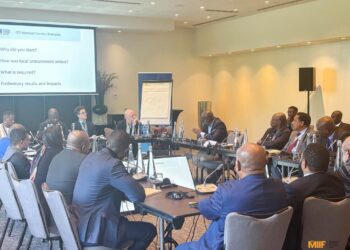
Ghana Extractive Industries Transparency Initiative (GHEITI) is leading a strategic advocacy for the Ministry of Lands and Natural Resources to expand the newly implemented sliding-scale mineral royalty regime to include the Artisanal and Small-scale Mining (ASM) sector.
This call for reform is predicated on the belief that a flexible and reduced royalty framework, tailored specifically to the operational realities of small-scale miners, will serve as a powerful catalyst for industry formalization and improved regulatory compliance.
Beyond the immediate goal of capturing revenue, the transparency body argued that integrating this progressive fiscal model into the ASM space is essential for creating a more supportive business environment for indigenous enterprises.
“The Minister for Lands and Natural Resources should also consider introducing a reduced mineral royalty regime for small-scale miners, to get them into the tax/royalty-paying pool, while at the same time creating a necessary favourable business climate for such indigenous businesses.”
Ghana Extractive Industries Transparency Initiative (GHEITI)

While the recent legislative focus has primarily favored large-scale mining entities, GHEITI points out that the small-scale sector remains a significant pillar of Ghana’s gold production and a primary source of rural livelihoods.
By adapting the sliding-scale principle where royalty rates adjust in tandem with global gold prices the state can ensure a fairer distribution of economic returns while providing a necessary “fiscal cushion” for local miners during periods of market volatility.
Bridging the Gap in Sector Formalization

For decades, the ASM sector has been characterized by widespread informality, with thousands of operators remaining outside the government’s tax net due to what they perceive as “prohibitively high” regulatory costs.
The flat-rate obligations often fail to account for the unique financial constraints of small-scale operations compared to their multi-national counterparts.
GHEITI insists that a “tailored sliding-scale royalty structure” could lower the barriers to entry into the formal economy. By making compliance more “attractive and practical,” the government can transform a sector often maligned for its lack of oversight into an organized, contributing segment of the national economy.
This shift is not merely about taxation; it is about building a comprehensive database of miners to enhance environmental accountability and strengthen administrative oversight.
Expanding the Revenue Base and Fiscal Resilience

The primary advantage of the sliding-scale model is its inherent responsiveness to the London Bullion Market Association (LBMA) price benchmarks.
Under the framework recently matured into law for large-scale miners, the state captures significantly higher percentages reaching up to 12% when gold prices exceed $4,500 per ounce, thereby allowing the state to generate more revenue.
Extending a calibrated version of this to small-scale miners would allow the government to “significantly expand the number of contributors to public revenue.”
Research suggests that even a reduced rate, when applied to a larger, formalized pool of miners, could yield higher aggregate revenue than the current high-cost, low-compliance system.
This approach creates a “win-win” scenario: the state maximizes its share during commodity “super-cycles,” while indigenous miners are protected from bankruptcy when prices tumble.
Supporting Sustainable Indigenous Mining Enterprises

Strengthening the ASM sector through smart fiscal policy is viewed as a vital step toward long-term “indigenous economic empowerment.”
By easing the burden on local companies through a “flexible royalty structure,” the government provides these enterprises with the reinvestment capacity needed to adopt more environmentally responsible technologies.
This proposal aligns with the broader national agenda to sanitize the mining landscape and eradicate the environmental degradation associated with illegal mining operations.
As these local businesses become more sustainable and profitable under a fair tax regime, they become better positioned to drive community development and provide stable employment in mining-affected regions.
READ ALSO: BPA to Host Special Agro-Economic Zone