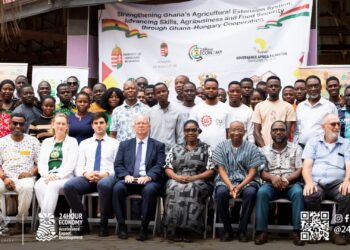
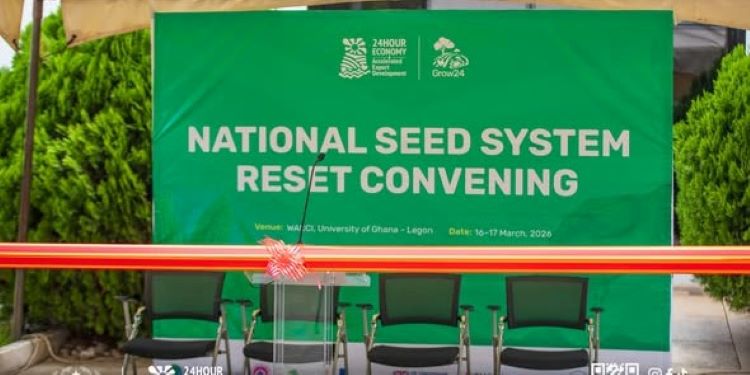
The 24-Hour Economy Secretariat, under the leadership of Presidential Advisor Augustus Goosie Tanoh, has signaled a move toward rigorous implementation of national agricultural priorities during the National Seed System Reset Convening commenced at the West Africa Centre for Crop Improvement (WACCI).
The event, which took place at the University of Ghana was a pivotal gathering of government officials, research institutions, private seed companies, and farmer organizations, all tasked with dismantling the bottlenecks that prevent high-quality, high-yield seeds from reaching Ghana’s farmers.
“Private and public capabilities are not Ghana’s constraint; architecture, coordination, and execution are. Quality seed constitutes economic infrastructure equivalent to roads, electricity, or communications”
Augustus Goosie Tanoh, Presidential Advisor and Head of the 24-Hour Economy Secretariat
For the Secretariat, this convening was not another academic exercise in policy design but the beginning of an aggressive “execution programme,” aimed at transforming Ghana’s agriculture from a low-yield, rain-fed system into a high-performance, export-oriented engine.
Mr. Tanoh observed that the core philosophy driving the government’s reset is the recognition of seeds not merely as biological inputs, but as critical economic infrastructure on par with road networks, power grids, and telecommunications.
He added that without reliable access to genetically superior, climate-resilient seeds, the nation’s aspirations for a 24-Hour Economy mandate – and the sustained, round-the-clock industrial production that it demands – would remain fundamentally crippled.
Aggressive Execution
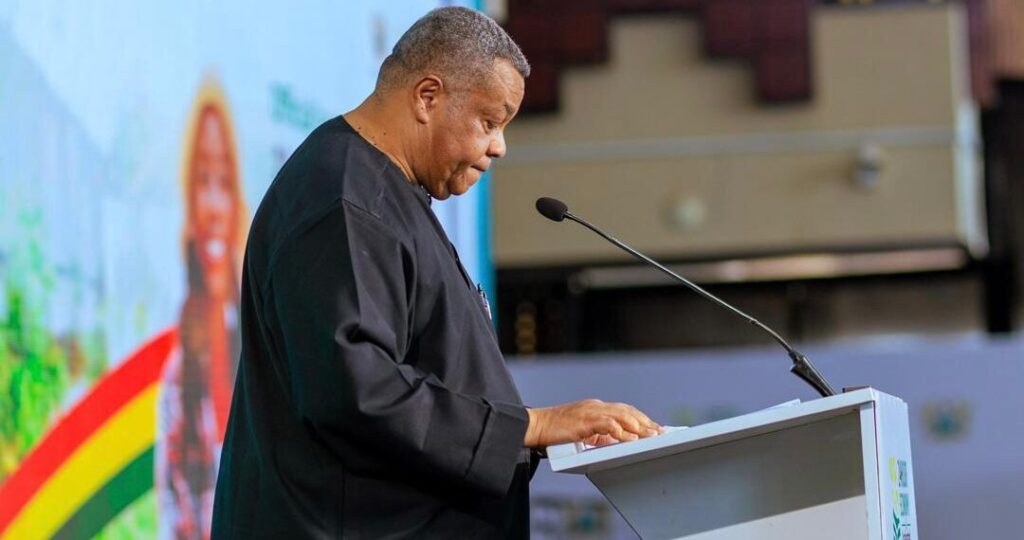
As the convening got underway, Goosie Tanoh set a demanding tone for the stakeholders in attendance. His message to the assembly was stark: Ghana possesses all the necessary public and private capabilities to lead the continent in agricultural productivity, arguing that failure to do so, is not a failure of innovation or human capacity.
The objective of the two-day summit is to re-engineer the seed delivery architecture so that it operates independently of political cycles, ensuring consistency for the SMEs and cooperative enterprises that form the backbone of the nation’s agricultural parks and corridors.
The Secretariat’s focus this year is on tangible metrics as the 24H+ initiative is no longer looking for policy papers but for “jobs created, SMEs financed, and parks and corridors that are actually producing.”
By synchronizing the seed system with anchor demand and logistics, the government intends to make high-quality seed access the first link in a chain that leads directly to the global export market.
The Secretariat linked this with the broader Accelerated Export Development programme, which relies on the availability of standardized, high-quality agricultural products that can meet the stringent requirements of international trade.
Foundational Economic Infrastructure
The reset convening at WACCI aims to bridge the disconnect between the laboratory – where research institutions develop drought-resistant and high-yield varieties – and the farm gate. Historically, this gap has been the graveyard of many agricultural projects.
The 24-Hour Economy Secretariat is building a pipeline that ensures research breakthroughs actually reach the soil, by coordinating the efforts of research institutions like WACCI with the distribution networks of private seed companies.

Quality seed was positioned as the primary determinant of success for the government’s industrialization strategy, noting that when the state activates an industrial corridor or an agro-processing zone, the return on that investment is entirely dependent on the quality of the raw material entering the facility.
If the seed is inferior, the yield is low; if the yield is low, the processing plant sits idle. Goosie Tanoh’s insistence on “reliable access to quality seed” is, therefore, a strategy to secure the profitability of the nation’s entire manufacturing sector.
“When we discuss activating parks, corridors, export platforms, and cooperative enterprises, we are essentially talking about reliable access to quality seed, combined with anchor demand, finance, and logistics”
Augustus Goosie Tanoh, Presidential Advisor and Head of the 24-Hour Economy Secretariat
Systems Beyond Political Cycles
A recurring theme in the Secretariat’s message was the need for “systems that outlive political cycles,” citing the seed system as one of the most critical areas where long-term continuity is required.
Because agricultural research and development are long-term endeavors, the infrastructure – legal, financial, and logistical – must be robust enough to withstand changes in governance. The Reset Convening is the forum for creating these institutional guardrails, ensuring that the farmers of 2030 and beyond have the same guaranteed access to quality inputs as those of 2026.
Mr. Tanoh highlighted how central to the execution strategy the integration of SMEs into this process is. He explained that by financing seed enterprises and creating clear market linkages, the Secretariat will empower local entrepreneurs to take over the distribution of inputs.
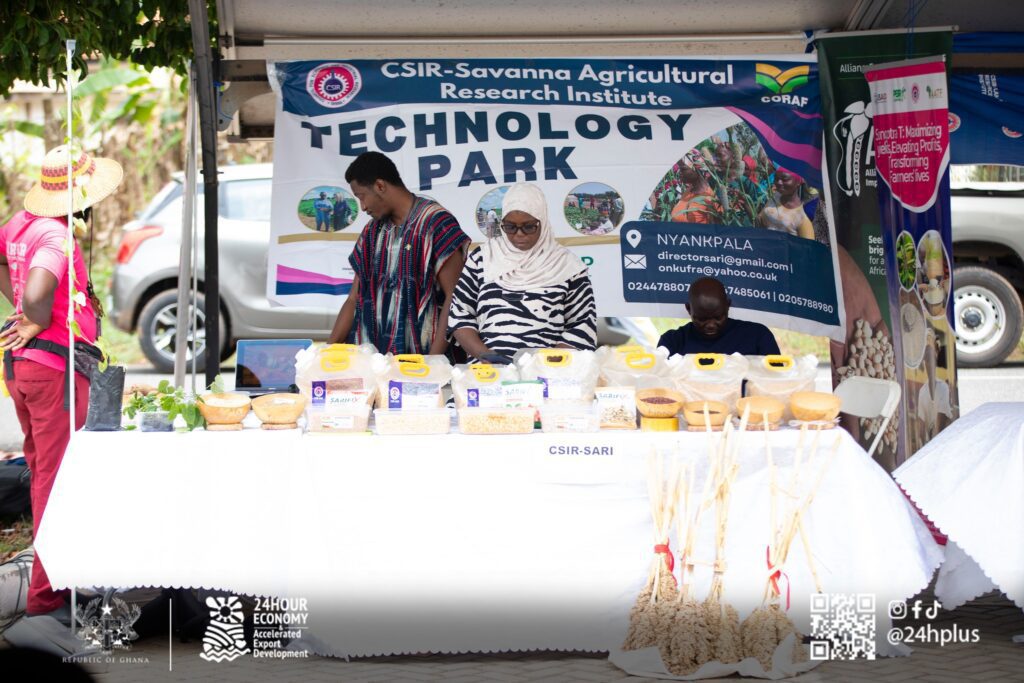
This creates a self-sustaining ecosystem where seed quality becomes a market-driven imperative rather than a bureaucratic hurdle, thus creating a system where private sector vitality is supported by, rather than stifled by, public sector architecture.
As the convening concludes tomorrow, the focus will shift from debate to deployment. The 24-Hour Economy Secretariat is determined to ensure that every participant – from the research scientist to the rural farmer – is locked into a coordinated execution plan.
READ ALSO: President Mahama Directs Expansion of Security Recruitment to Forty Thousand