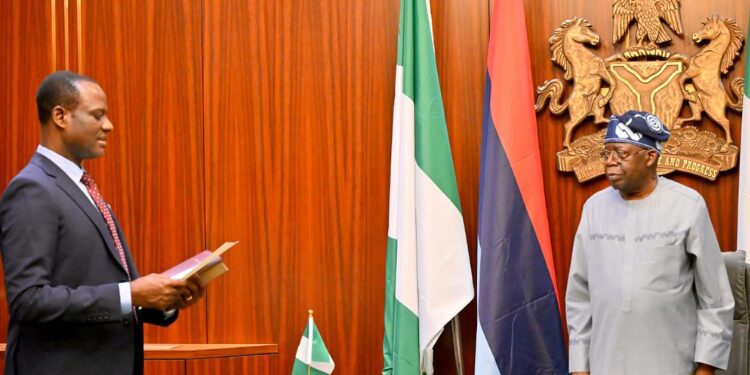
Newly appointed Minister of State for Finance, Taiwo Oyedele, has pledged to prioritize the effective execution of Nigeria’s sweeping tax reforms, stressing that policies alone cannot transform the country’s fiscal landscape unless they are implemented with discipline and focus.
Speaking shortly after taking the oath of office from President Bola Ahmed Tinubu at the Aso Rock Presidential Villa, Oyedele emphasized that the success of Nigeria’s new tax framework will hinge not on policy design alone, but on the government’s ability to carry out reforms efficiently and consistently.
“The reforms are only as good as the paper on which they are written. What matters most is diligent execution, moving from policy formulation to practical implementation. We are excited about the responsibility ahead and ready to meet the challenges.”
Taiwo Oyedele
Before assuming his ministerial role, Oyedele served as chairman of the Presidential Committee on Fiscal Policy and Tax Reforms, where he led efforts to overhaul the country’s tax system.
The Senate confirmed the appointment of Taiwo Oyedele as a minister-designate under the administration of President Bola Tinubu thereafter and the Senate President, Senator Godswill Akpabio, announced the confirmation after lawmakers cleared the nominee through a voice vote at the Committee of the Whole.
Oyedele is expected to replace Mrs Doris Uzoka-Anite as Minister of State for Finance. His appointment comes at a crucial moment for Nigeria, as the government seeks to modernize fiscal administration while boosting revenue to meet growing public demands.
The reforms developed under Oyedele’s leadership are among the most ambitious in recent years, aiming to simplify Nigeria’s complex revenue system.
More than 60 separate taxes are being consolidated into fewer than 10 statutes, a move intended to reduce compliance burdens on businesses and individuals and make the tax framework more transparent and efficient.
Analysts note that this restructuring could help close loopholes, improve collection efficiency, and encourage investment by creating a more predictable tax environment.
Revenue mobilization is at the center of Oyedele’s agenda. He stressed that adequate income generation is essential to meet rising demands on the treasury at both federal and sub-national levels. “Our priorities are focused on generating sufficient revenue to respond to the increasing needs of the public. We also aim to ensure that every naira earned is utilized efficiently, optimizing value for citizens,” he said.
Balancing Economic Pressures with Opportunities for Growth
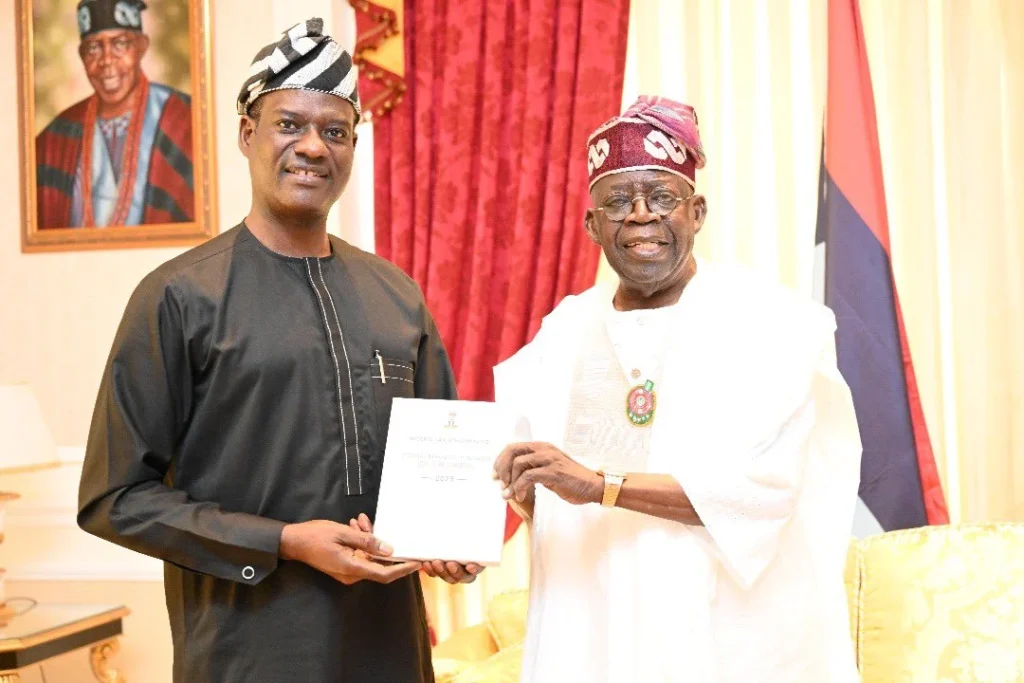
President Bola Ahmed Tinubu, who presided over the swearing-in, praised Oyedele’s contributions to Nigeria’s fiscal reform agenda, describing him as a dedicated professional capable of delivering results. “You have rewritten the entire tax policy of this country, which was obsolete, archaic, and fundamentally against progressive economic thinking. You are a very determined and committed individual,” he said.
The President also noted that, while Nigeria has experienced economic stability in certain sectors, it has yet to achieve the rapid growth required to meet the needs of its expanding population. “Managing fiscal responsibility at a time of stability but without exponential growth is extremely challenging. Oyedele’s expertise makes him well-suited to lead this effort,” he added.
Nigeria’s economy, though showing signs of stabilization, faces structural challenges, including revenue shortfalls, inflationary pressures, and reliance on borrowing to finance infrastructure and development projects.
Effective debt management will remain critical, as unsustainable borrowing could pose long-term risks if revenue growth does not keep pace. In this context, the successful implementation of tax reforms is viewed as essential to strengthening public finances and supporting sustainable development.
Beyond fiscal stability, the reforms could encourage greater private-sector participation in the economy. By simplifying the tax system, reducing administrative inefficiencies, and increasing transparency, the government hopes to foster an environment that attracts domestic and international investors, supports job creation, and enhances economic growth.
Oyedele, acknowledging both the challenges and opportunities ahead, expressed confidence in the Ministry of Finance’s capacity to deliver. “One thing I can promise Mr. President and the Nigerian people is that I will give my very best at every stage. With the team in the Ministry and strong leadership working together, there is no challenge we cannot overcome,” he admonished.
Achieving fiscal sustainability will require careful prioritization of government spending, improved financial management, and the creation of mechanisms to ensure that public funds translate into tangible benefits for citizens. Successful execution of these reforms could also enhance trust in government institutions and improve overall economic confidence.