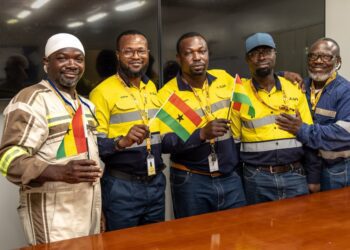
Ing. Wisdom Gomashie, a distinguished mining consultant and Fellow at Africa Policy Lens (APL), has called for a comprehensive national policy directive to safeguard the interests of local stakeholders and ensure long-term stability in Ghana’s extractive sector.
Speaking in an exclusive interview with The Vaultz News, the seasoned mining engineer emphasized that without a clear, bipartisan framework, the country risks losing its sovereign grip on mineral wealth to the whims of political cycles and external investor dominance.
“We need to have a clear policy directive as a country. We should be able to raise local champions to be able to get higher local stake in various mining activities.”
Ing. Wisdom Gomashie

The proposed directive seeks to insulate the mining industry from the “winner-takes-all” political culture that often sees mining concessions and properties targeted or reassigned following a change in government.
Ing. Gomashie argued that the international community must perceive Ghana as a jurisdiction where property rights are sacrosanct, regardless of whether the New Patriotic Party (NPP) or the National Democratic Congress (NDC) is in power. By formalizing these protections into law, the state can foster an environment where “local champions” can show the capacity to acquire and develop mines without the fear of arbitrary contract cancellations.
Curbing Political Risk and Ensuring Contractual Sanctity

A primary pillar of the expert’s advocacy is the elimination of political interference in the ownership of mineral assets.
Ing. Gomashie noted that for Ghana to achieve true resource sovereignty, the state must ensure that a multinational or local mining company’s concessions are not taken away from them to “certain individuals” based on their political affiliation which could erode investor confidence.
This requires the passage of robust legislation that prevents a succeeding administration from working to “cancel” the licenses of those who have demonstrated the technical and financial capacity to help develop the nation.
This level of certainty is essential for attracting the multi-billion-dollar capital required for deep-level extraction.
When laws protect the investor whether they are an “NDC or NPP” supporter, the broader international community gains confidence in the Ghanaian market. Such a policy directive would shift the focus from political patronage to “raising local champions” who can secure a higher local stake in various mining activities, ensuring that the wealth generated stays within the domestic economy.
The “Owner-Investor” Hybrid Model

The directive further challenges the traditional “landlord” approach, where the state merely waits for royalties and taxes.
Ing. Gomashie pointed out that “having the gold in the down there” belongs to Ghana alone, but it does not automatically translate into maximum benefit because the extraction process “requires money and costing.“
By shifting to an “owner-investor” model, the state can capture a larger portion of the value chain.
Implementing a directive that mandates state-led investment, similar to the sovereign wealth strategies employed by Chile and Botswana, would allow Ghana to move beyond the 10% carried interest model.
As the expert warned, if the state is not “positioned to also invest within the sector,” private investors will naturally “take their cut before they will share the profit.”
Direct state participation ensures that the public treasury benefits not just from taxes, but from the direct dividends of production.
Economic Resilience through Strategic Funds

The long-term impact of such a directive would be the creation of a permanent financial buffer against commodity price volatility.
By setting aside dedicated funds to reinvest in mining exploration and development, the country reduces its reliance on external debt to finance its mineral growth.
“For the country to get enough benefit from its natural resources, the country should be able to also put or set aside fund, money aside to also invest into it like Chile has done, like Botswana has done. And if we are able to also invest in our own mineral, then the benefit will become more bigger. But if you just own the mineral and the investors come and you give the mineral to them, certainly, they are going to take their cut before they will share the profit with you.”
Ing. Wisdom Gomashie
This strategy aligns with the broader goals of the Ghana Accelerated National Reserve Accumulation Policy (GANRAP), which aims to build significant buffers.
Furthermore, a clear policy directive would formalize the artisanal and small-scale mining (ASM) sector, integrating “local champions” into the formal value chain.
This would not only curb illegal mining but also maximize gold export revenues.
As the expert concluded, the state must be proactive rather than passive; only by being a co-investor in its own minerals can Ghana ensure that the “benefit will become more bigger” for current and future generations.
READ ALSO: President Mahama Directs Expansion of Security Recruitment to Forty Thousand