UK Prime Minister, Keir Starmer, has issued a 48-hour deadline to the British Medical Association (BMA) to call off a planned six-day strike by doctors in England, warning that failure to do so could lead to the loss of 1,000 additional training places.
The ultimatum follows the BMA’s rejection of what the government has described as a “historic deal” aimed at resolving the protracted standoff.
Central to the proposal was a 3.5% pay rise for this year, which the prime minister characterised as above inflation and part of a broader package that would bring the total increase in resident doctors’ pay to approximately 35% over the past three years.
Beyond salary adjustments, the deal included a range of additional measures intended to address longstanding concerns within the medical profession. These included reimbursing the cost of Royal College exams, accelerating progression through pay bands to better reflect doctors’ growing experience and responsibilities, and expanding specialty training opportunities by up to 4,500 posts over the next three years.
According to the Prime Minister, these measures were “the result of months of collaborative negotiations with the BMA.”
“That is why walking away from this deal is the wrong decision. It is a reckless decision, and doing so without even giving resident doctors themselves the chance to vote on it makes it even worse.”
Keir Starmer
The impact of this industrial strike can never be underestimated. According to Starmer, “No one benefits from rejecting this deal.”
“Resident doctors will be worse off. Instead of the improved pay, progression and support on offer, they will receive the standard pay award this year, with none of the additional reforms that would have strengthened their working lives.
“The NHS will be worse off. Each strike costs the NHS £250m in cover costs, and patients will be worse off. Of course, we will do everything we can to protect care. But it would be wrong to pretend there is no impact.”
Keir Starmer
Despite the government’s position, the BMA has maintained that the proposed pay increase fails to adequately address the long-term erosion of earnings experienced by resident doctors. The union argues that, even with recent pay rises, real-term income remains significantly below 2008 levels when adjusted for inflation. It has also pointed to broader economic pressures, warning that inflation is expected to rise further due to global developments, including the war with Iran.
Jack Fletcher, Chair of the British Medical Association’s (BMA) UK Resident Doctors Committee, said in a statement that, “We cannot ignore that, thanks to global events, economic indicators now point to years of greatly increased inflation,” adding, “We are simply not going to put an offer to doctors that risks locking in further erosion of pay at a time when doctors continue to leave the UK for other countries.”
Meanwhile, Health Secretary Wes Streeting has consistently defended the government’s position, stating that further pay increases are not feasible given that resident doctors have already received rises totalling nearly 30% over the past three years.
Training Bottlenecks and Pay Disputes Deepen NHS Workforce Crisis
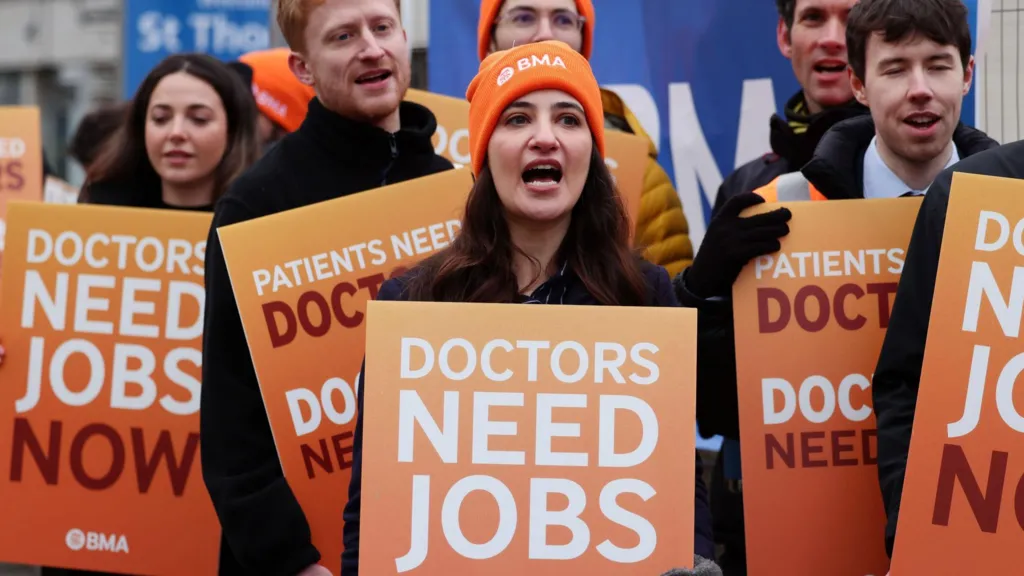
At the heart of the dispute lies not only disagreement over pay but also deeper structural challenges related to workforce planning and career progression within the NHS. Resident doctors, who account for nearly half of all medical staff in the system and of whom roughly two-thirds are members of the BMA, face mounting pressure as they navigate an increasingly competitive and constrained training environment.
A key concern is the limited availability of specialty training positions, which play a critical role in shaping doctors’ long-term careers. The transition into specialist training typically occurs in a doctor’s third year, at which point they must choose a field such as general practice, surgery, or another area of medicine.
However, demand for these positions far exceeds supply, creating a bottleneck that has become a source of frustration across the profession.
Recent figures highlight the scale of this imbalance, with approximately 30,000 applicants competing for around 10,000 training posts last summer. This disparity has left many qualified doctors unable to secure placements in their chosen specialties, delaying career progression and, in some cases, prompting them to seek opportunities outside the UK.
This issue has therefore become a central element of negotiations, with both sides acknowledging the need for expanded training capacity.
The potential withdrawal of a portion of these training places in response to continued industrial action has introduced further uncertainty into an already strained system. With application processes set to open in April, any delay in finalising these positions could disrupt the entire recruitment cycle, exacerbating workforce shortages in critical areas of the NHS.
READ ALSO : Humanitarian Operations In Africa Strained By Iran War Effects