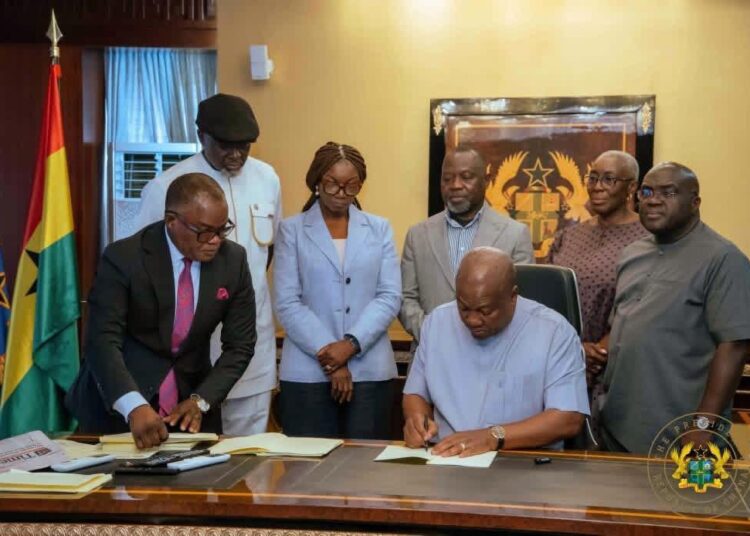
President John Dramani Mahama has assented to the Growth and Sustainability Levy (Amendment) Bill, 2026, marking a strategic pivot in Ghana’s fiscal policy to balance national revenue needs with the operational viability of the extractive sector.
The move, which effectively slashes the GSL rate for mining companies from 3% to 1% of gross production, comes as a direct response to the industry’s rising fiscal burden following the implementation of the new sliding-scale royalty regime.
By signing this amendment into law, the government seeks to provide a necessary “fiscal cushion” for large-scale miners who now face significantly higher royalty payments due to the unprecedented surge in global commodity prices.
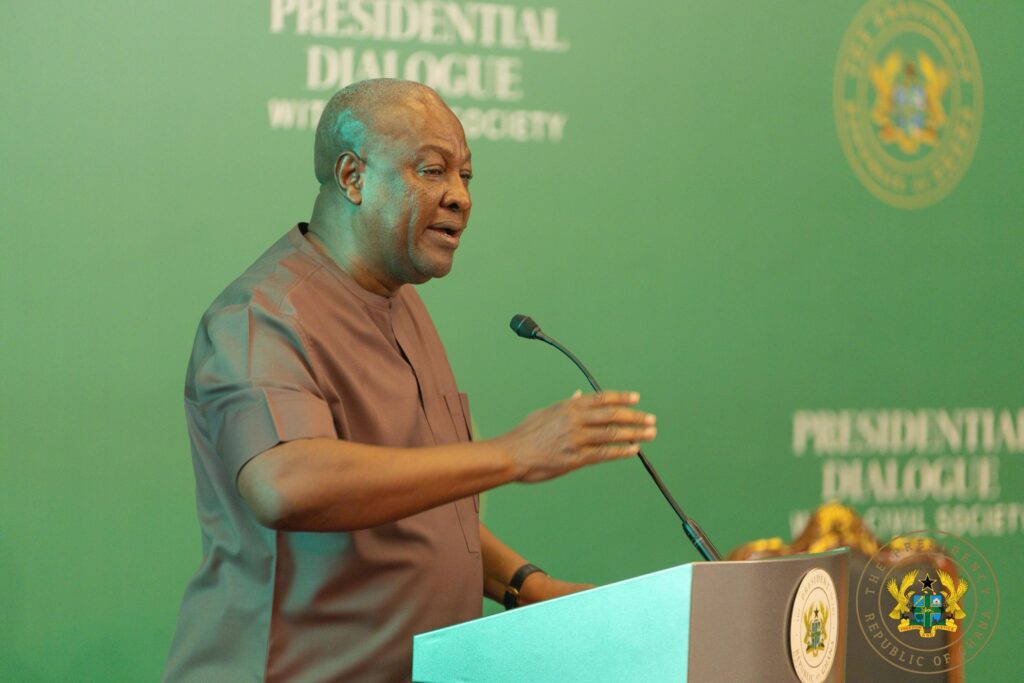
According to Hon. Felix Kwakye Ofosu, Minister in charge of Government Communications, the decision to revert the GSL to its original 1% rate is underpinned by a “middle ground” approach designed to ensure the state captures a fair share of mineral windfalls without stifling private investment.
“Particularity I know that there are those who have misunderstood this to mean that Ghana is going to get less, but that is not the case It has only been adjusted in order that the implementation of the sliding scale makes it palpable for people to continue to invest in our mining sector.”
Hon. Felix Kwakye Ofosu, Minister in charge of Government Communications

While the 2025 fiscal adjustments had initially hiked the levy to 3% to bolster the Treasury, the simultaneous enforcement of the sliding-scale royalty which can peak at 12% when gold prices exceed $4,500 per ounce threatened the financial equilibrium of several major firms.
Government communications indicate that this legislative “give-and-take” was essential to maintaining a “continual and conducive” environment for the mining firms to operate, ensuring that Ghana remains a competitive destination for extractive capital amidst volatile international market developments.
“Now, once that happens, it means that the mining firms are going to have to commit more resources to royalty payments, Hon. Kwakye Ofosu added.
Balancing the Fiscal Scale: Royalties vs. Levies
The centerpiece of this reform is the synchronization of the GSL with the newly matured Minerals and Mining (Royalties) Regulations, which came into force on March 9, 2026.
Under the previous flat-rate system, mining firms paid a consistent 5% royalty regardless of the prevailing market price of gold or lithium.
However, the current “sliding-scale” mechanism introduces a progressive trigger: as the price of the commodity rises on the world market, the percentage of royalty payments increases accordingly.
While this ensures that the “people of Ghana get more from the resources taken from our land“ during price booms, it also requires mining firms to “commit more resources to royalty payments” during periods of high profitability.
Industry analysts note that the reduction of the GSL is a vital concession to address concerns raised by the Ghana Chamber of Mines regarding “impact on operations and financial balance.” By lowering the GSL to 1%, the government has effectively reduced the non-deductible tax burden on gross production.
This is particularly significant because the GSL, unlike corporate income tax, is applied to the total value of minerals produced, meaning firms must pay it even before accounting for operational costs. The amendment thus serves as a stabilizer, preventing the total effective tax rate from reaching levels that could lead to the mothballing of marginal mines.
Investor Confidence and National Revenue Optimization
Beyond immediate financial relief for miners, the Presidential assent signals a commitment to “fiscal predictability” and long-term sector stability.
For the country at large, the benefits are two-fold: optimized revenue during commodity peaks and sustained employment through industry longevity.
The sliding scale allows the national budget to benefit directly from the current “developments in the international market,” where gold has recently traded at historic highs.
Meanwhile, the GSL cushion protects the industry’s ability to fund community development projects and maintain its workforce.
This “middle ground” strategy reflects a sophisticated understanding of resource nationalism one that prioritizes maximum state take without compromising the “conditions that are continual for the mining firms to operate well.”
A New Era of Extractive Governance

The transition to this dual-layered fiscal framework represents one of the most significant overhauls of Ghana’s mining tax law in recent decades.
The successful passage and assent of the GSL Amendment Bill suggest a maturing legislative process that listens to industry “concerns about impact” while remaining steadfast in its mandate to secure the best deal for the Ghanaian taxpayer.
Ultimately, the goal is to create a “win-win” scenario where the state’s revenue grows in tandem with the miners’ success.
By adjusting the GSL downward as the royalty scale slides upward, the government has created a self-regulating fiscal environment.
This move is expected to bolster Ghana’s position in the global mining landscape, proving that the nation can enforce rigorous “mineral resource governance” while remaining a sensitive and rational partner to the private sector.
READ ALSO: srael’s Death Penalty Law To Constitute War Crime