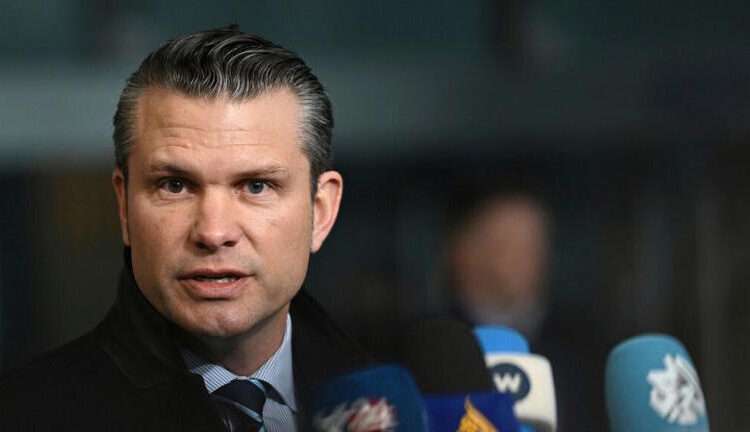
US Pentagon Chief, Pete Hegseth has said that the military blockade of Iran’s ports will continue “as long as it takes,” saying that Washington remained “locked and loaded” to attack Iran’s energy facilities.
Hegseth made the comment as a tenuous pause in fighting agreed to last week continued. On Monday, President Donald Trump had announced the military would blockade Iran’s ports in the Strait of Hormuz and the Gulf after US-Iran talks in Pakistan failed to reach a breakthrough.
Speaking at a news conference, the Pentagon Chief said that the US would prefer to resolve the conflict, which began with US-Israeli attacks on Iran on February 28, through diplomacy.
“You, Iran, can choose a prosperous future, a golden bridge, and we hope that you do for the people of Iran. In the meantime and for as long as it takes, we will maintain this blockade, successful blockade, but if Iran chooses poorly, then they will have a blockade and bombs dropping on infrastructure, power and energy.”
Pete Hegseth
Also at the news conference, General Dan Caine, the Chairman of the Joint Chiefs of Staff, said so far, 13 ships leaving Iranian ports have turned around in response to US military warnings. “If you do not comply with this blockade, we will use force,” Caine said.
During questions with reporters, Hegseth shot down reports that China was planning to send weapons to Iran amid the pause in fighting. Hegseth said that Washington had received assurances from Beijing that this was not the case.
Hegseth also used a large portion of the news conference to attack US media coverage of the war, which is criticising the Trump administration over its shifting objectives and justifications for launching the conflict. Hegseth called the coverage “incredibly unpatriotic.”
US Monitoring Iran’s Military Movements

The Defence Secretary struck an aggressive tone as he maintained that the US was monitoring Iran’s military movements during the pause in fighting, which currently is meant to extend through early next week.
“We are reloading with more power than ever before … even more importantly, better intelligence than ever before.
“As you expose yourself with your movement to our watchful eye, we are locked and loaded on your critical dual-use infrastructure, on your remaining power generation and on your energy industry.”
Pete Hegseth
Admiral Brad Cooper, the Head of US Central Command (CENTCOM), meanwhile, said that the US is using the war to rearm and reposition its forces.
“We’re rearming, we’re retooling, and we’re adjusting our tactics, techniques and procedures. There’s no military in the world that adjusts like we do, and that’s exactly what we’re doing right now during the ceasefire.”
Admiral Brad Cooper
On Wednesday, a Pakistani delegation arrived in Tehran to coordinate a new round of talks. While both sides have indicated they remained open to further negotiations, Major-General Ali Abdollahi, the Commander of the Khatam al-Anbiya Central Headquarters of the Islamic Revolutionary Guard Corps (IRGC), warned that the US blockade could end the current pause in fighting.
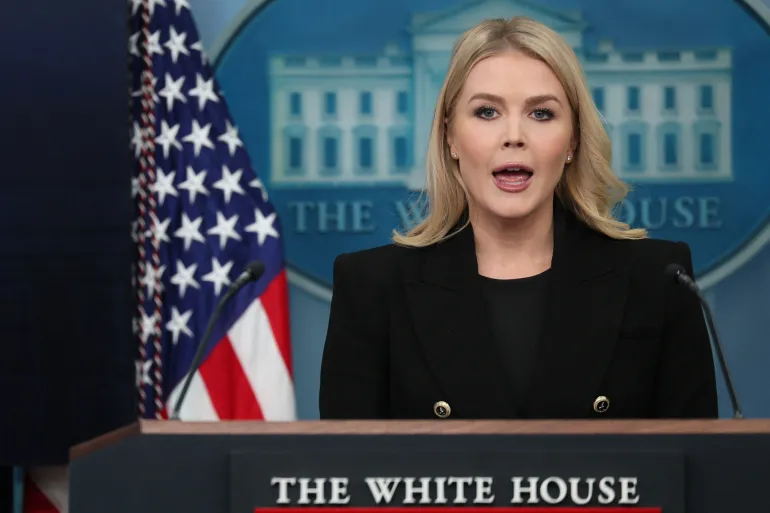
White House Spokesperson Karoline Leavitt, meanwhile, indicated that the US maintained a positive outlook on future talks. “At this moment, we remain very much engaged in these negotiations, in these talks,” she said.
Iran’s Speaker of parliament, Mohammad Bagher Ghalibaf, who led the Iranian delegation in the talks with Iran, told his Lebanese counterpart that a ceasefire in Israel’s invasion and ongoing bombardment of Lebanon is “as important” as the pause in fighting in Iran.
Getting Israel to agree to a Lebanon ceasefire has emerged as one of the main sticking points in talks, which also include control of the Strait of Hormuz and the future of Iran’s nuclear programme.
READ ALSO: GFZA Scales Industrial Aftercare as Green Energy Exporters Hit US$12M Milestone