A delegation from the Ghana Free Zones Authority (GFZA), led by Chief Executive Officer (CEO) Dr. Mary Awusi, has recently paid a working visit to the heart of the Tema Industrial Area for a strategic audit of two enterprises that have become the poster children for Ghana’s green industrial revolution: Aburi Energy and TetraCore Gas Ghana Limited.
For the Authority, this shift in operational focus from mere licensing to aggressive industrial aftercare is to protect the country’s fastest-growing export engines, especially at a volatile time for global supply chains – where the ability of a regulator to troubleshoot operational bottlenecks in real-time determines whether a multi-million-dollar investment survives or stalls.
“The visit formed part of the Authority’s ongoing efforts to deepen engagement with licensed Free Zones enterprises, assess their operational challenges, and reinforce its commitment to industrial growth and effective aftercare support”
Ghana Free Zones Authority
The mission was geared towards ensuring that the bureaucratic promise of a Free Zone – tax holidays, duty-free imports, and streamlined regulation – is actually translating into floor-level efficiency for the companies driving Ghana’s non-traditional export (NTE) growth.
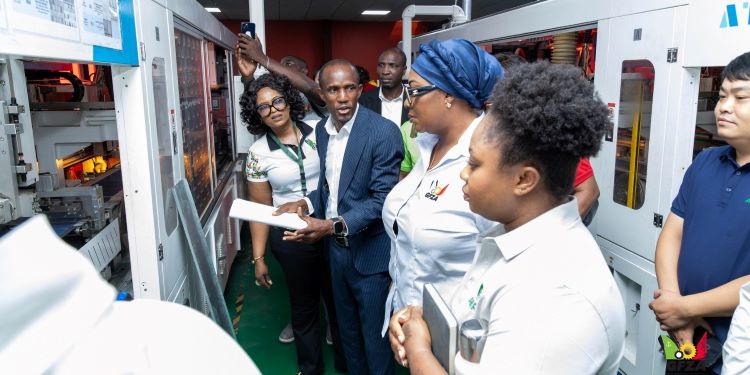
The first leg of the CEO’s tour focused on Aburi Energy, a renewable energy powerhouse that has redefined the speed of industrial scaling in Ghana. Since commencing operations in July 2025, the company has transformed a 30,000-square-metre facility into a massive production hub for solar photovoltaic (PV) modules and other clean energy solutions.
The Free Zones Authority noted the company’s staggering numbers positioning it as a key player in Ghana’s emerging green energy sector: in less than a year, Aburi Energy has exported over 300 containers valued at approximately US$12 million, while providing immediate employment to 240 local staff.

However, with a projected manufacturing capacity of 4 gigawatts by the end of 2026, the company is entering a high-friction phase. Scaling at this velocity requires more than just capital; it requires a regulator that can synchronize with its pace.
Dr. Mary Awusi’s engagement with management was focused on commending the company for its impressive growth and contribution to export earnings and “aftercare support” – a GFZA term for removing the regulatory friction that often hampers rapid expansion.
The CEO also called for a balance between automation and job creation reflecting a sophisticated policy tightrope – where the government needs the efficiency of robotics to compete globally, but it also demands that Free Zones act as primary engines of domestic employment.
Energy Reliability
The delegation’s second stop at TetraCore Gas Ghana Limited highlighted the “hidden infrastructure of the industrialization drive.” A subsidiary of the TetraCore Energy Group, the company specializes in delivering compressed natural gas (CNG) via trucks – a mobile pipeline that is effectively de-risking the entire Tema Industrial Area.
For factories that cannot wait for permanent gas infrastructure or face the instability of the national grid, TetraCore’s model provides the thermal and electrical reliability necessary to maintain 24-hour operations.
The presence of the GFZA’s Director of Monitoring and the Head of Compliance on this tour, signaled that the Authority views energy security as a collective Free Zone priority. It highlighted how TetraCore’s ability to scale is not just a win for its shareholders; it is a strategic asset for every other Free Zone enterprise that relies on clean, efficient energy to meet its own export targets.
The GFZA’s commitment to “fostering a conducive business environment,” was, in this context, a pledge to ensure that energy providers like TetraCore face zero administrative delay in fueling the rest of Ghana’s industrial base.
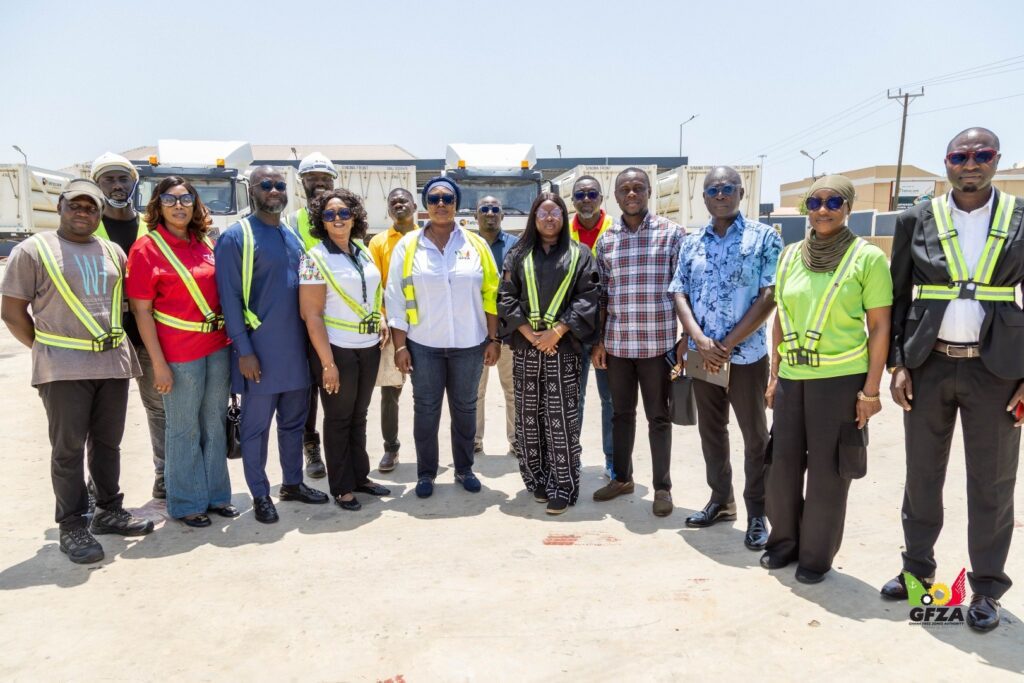
The composition of the CEO’s entourage – including the Deputy CEO of Operations, Mr. Lateef Apau Wiredu, and the Director of Corporate Affairs, Dr. Patience Acorlor – underscored the commitment with which the GFZA’s undertook this exercise.
“The team was taken on guided tours at both companies. The CEO commended both companies for their contributions to Ghana’s industrialization agenda and reiterated the Authority’s unwavering support in fostering a conducive business environment for Free Zones enterprises”
Ghana Free Zones Authority
The Authority emphasized that it is no longer just a gatekeeper; it is becoming a business partner ready to depart from the trend of regulators only being seen during the licensing or auditing phases of companies. In the current global landscape, where the AfCFTA has intensified regional competition for manufacturing capital, the GFZA’s new doctrine is a survival tactic.
Dr. Awusi described her visit as a calculated move to prove that the GFZA has the “monitoring and compliance,” agility to keep pace with the 2026 industrial agenda. She explained that if Ghana cannot troubleshoot the operational challenges of a 4GW solar plant or a CNG distribution hub, those investments will eventually migrate to more responsive jurisdictions.
For the GFZA, the strategic alignment between these two companies – one producing solar hardware and the other distributing cleaner transition fuel represents its attention toward a Green Industrial Zone model.
As international buyers increasingly demand “carbon-traceable” products, the presence of Aburi Energy and TetraCore within the Free Zone is bound to create a comparative advantage for Ghana. The success of the 300 containers already exported by Aburi Energy is proof that this model works.
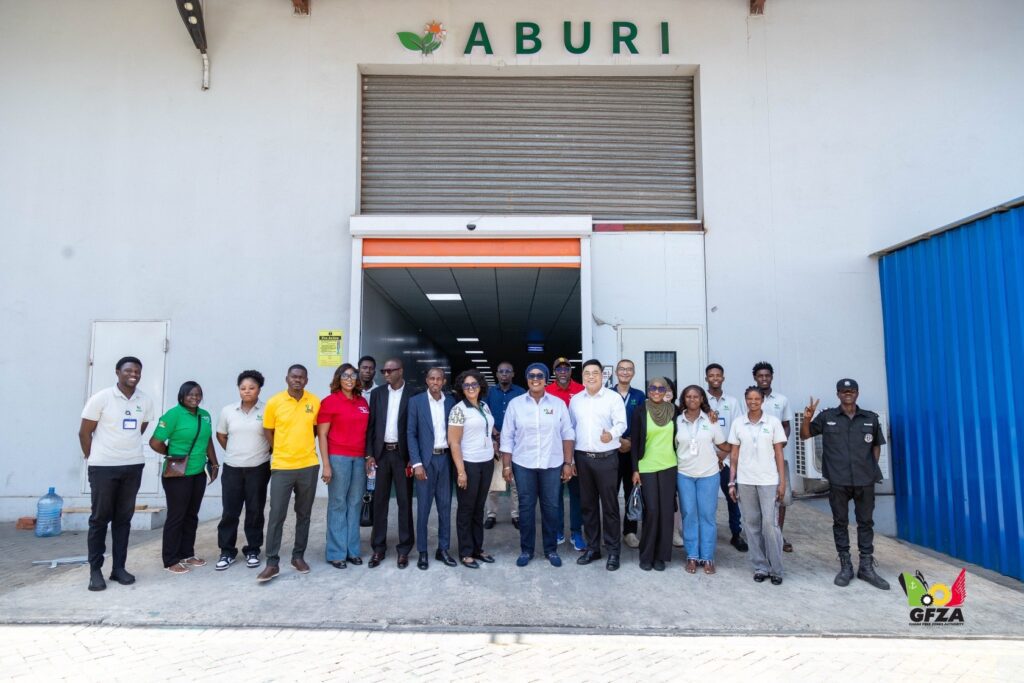
It has generated US$12 million in foreign exchange at a time when the Ghanaian economy is desperate for hard currency liquidity, making it a more than deserving beneficiary of the GFZA’s aftercare package.
The Authority’s “unwavering support,” must now translate into concrete policy wins: faster customs clearance for green energy components, better integration with the national power grid, and perhaps a specialized labor framework that supports the automation-plus-employment model Dr. Awusi is championing.