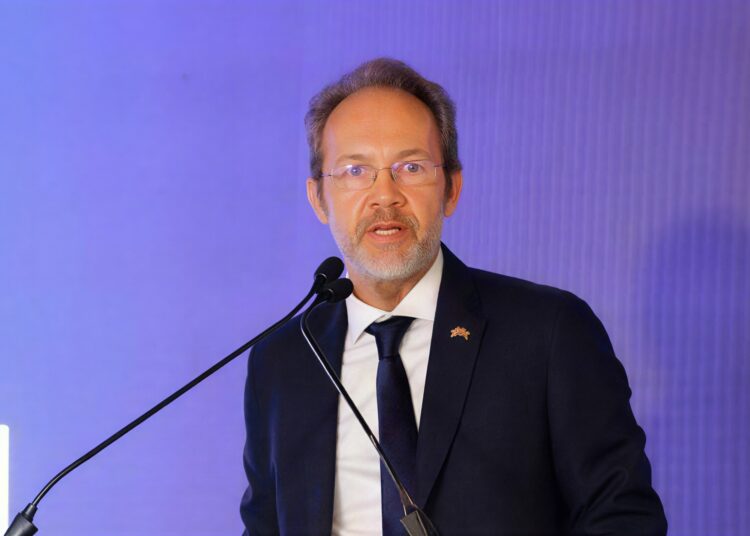
The British High Commissioner to Ghana, Christian Rogg, has commended the Government of Ghana for its decisive move from passive observer to active leader in the global artificial intelligence space.
Speaking at the formal unveiling of Ghana’s National Artificial Intelligence Strategy, the envoy congratulated the President, the Minister for Communications, Digital Technology and Innovation, Samuel Nartey George, and the Government of Ghana for their leadership and drive in harnessing technology and artificial intelligence to support economic growth and national development.
He noted that the milestone reflects Ghana’s ongoing digital and innovation journey; and also demonstrates deliberate leadership and a clear long-term ambition to position the country at the forefront of technological advancement.
He emphasised that leadership in the AI era is no longer defined by invention alone, but by the ability to apply technology at scale to solve real problems. According to him, countries that effectively deploy AI across public systems will shape the future global order.
Rogg drew a clear distinction between developing algorithms and embedding them into public services that improve citizens’ lives. He noted that some of the most efficient digital systems globally are emerging outside traditional technological superpowers.
Ghana, he said, stands out for pairing ambition with a strong ethical framework, ensuring that innovation remains inclusive and aligned with national development priorities.
He pointed to major opportunities in healthcare delivery and agricultural productivity, where AI-driven systems could significantly improve outcomes while creating sustainable employment, particularly for young people.
Reaffirming the United Kingdom’s commitment, the High Commissioner described the Ghana–UK partnership as a key pillar of their Science, Technology and Innovation cooperation framework. He stressed the importance of moving beyond strategy into measurable results that directly benefit citizens.
“Artificial intelligence is reshaping global technologies, economies, public services, and redefining competitiveness around the world. We’ve heard about huge opportunities, from improving healthcare delivery and agricultural productivity to strengthening public administration and creating sustainable jobs, especially for young people.”
Christian Rogg, British High Commissioner to Ghana
British support, he noted, includes co-funding advanced research facilities at Kwame Nkrumah University of Science and Technology, aimed at strengthening regional innovation capacity and ensuring solutions are locally grounded.
He also highlighted the complementary strengths of both countries, with Ghana focused on immediate human impact while the UK advances long-term technological possibilities.

UK Rallies Behind Ghana’s AI Vision And Digital Growth Agenda
High Commissioner Christian Rogg has reaffirmed the United Kingdom’s commitment to supporting Ghana’s digital transformation, describing the partnership as one built on shared values and long-term ambition.
“Standing here, speaking on behalf of the United Kingdom, we are very proud to have worked in partnership with Ghana, providing expertise in the development of the strategy. This partnership on artificial intelligence is, in fact, just one strand of the UK-Ghana Science, Technology, and Innovation Memorandum of Understanding. That framework we are using here is a strong foundation to do many other things.”
Christian Rogg, British High Commissioner to Ghana
He highlighted the role of the Tony Blair Institute for Global Change and local academic institutions in influencing Ghana’s evolving AI strategy. He also pointed to the upcoming National Research Fund as a critical step toward securing the country’s technological future.
Rogg stressed that sustained success will depend on strong institutions, skilled talent, and the ability to translate advanced technologies into practical governance solutions.
He identified the Responsible AI Lab as a key initiative positioning Ghana as a continental hub for innovation, capable of guiding other African nations on their digital transformation journeys.
According to the envoy, the partnership benefits from a unique synergy: Ghana’s focus on solving immediate challenges combined with the UK’s long-term technological vision.
He noted growing momentum across Ghana’s media and business sectors, with increasing recognition that AI could drive a broad economic transformation. He expressed confidence that Ghana has the capacity to maintain its emerging leadership in the region.
Rogg further explained that Ghana’s approach goes beyond adoption, actively shaping ethical standards to ensure that technological growth does not widen social inequalities.
He added that both Ghana and the UK are at similar stages of implementing AI-driven systems, creating opportunities for shared learning and mutual advancement.
READ ALSO: Ghana Must Guide How AI Is Used, Samuel Nartey George