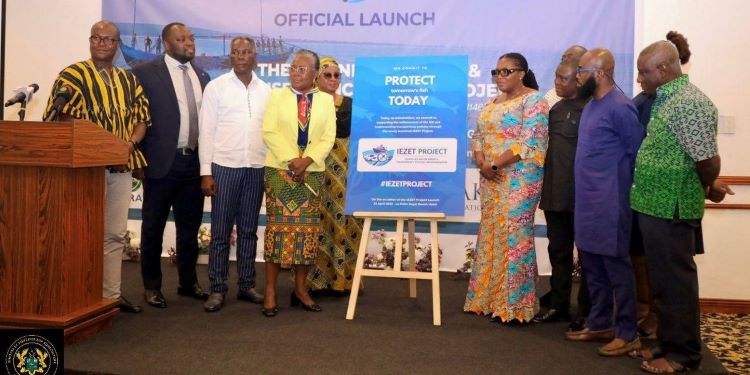
The administrative architecture of Ghana’s maritime sector has entered a critical phase of operationalization with the formal launch of the IEZ Enforcement and Transparency Policies Implementation (IEZET) Project.
Held at the La Palm Royal Beach Hotel, the launch represents the first major mechanical deployment following the passage of the Fisheries and Aquaculture Act, 2025 (Act 1146). Led by the Minister for Fisheries and Aquaculture Development, Hon. Emelia Arthur, the IEZET initiative bridges the gap between legislative mandates and the realities of on-water enforcement.
According to the Ministry of Fisheries and Aquaculture Development (MoFAD), this three-year project, backed by a consortium of civil society and international donors, signals a move toward open-source governance in the fisheries sector, where data transparency and spatial protection are used to rebuild the nation’s depleted marine stocks.
“The project will be implemented by the Ghana Fisheries Alliance in partnership with Hen Mpoano and Environmental Justice Foundation. It is being carried out in collaboration with MoFAD and the Fisheries Commission, with funding support from the Oak Foundation and Oceans 5”
Ministry of Fisheries and Aquaculture Development
The IEZET Project is not a standalone policy but a functional implementation pathway for the country’s new legal framework. While Act 1146 provides the statutory power to regulate the industry, the IEZET project provides the infrastructure for that regulation.
The primary focus is the Inshore Exclusion Zone (IEZ), a vital marine corridor reserved for artisanal fishers. Historically, this zone has been vulnerable to encroachment by industrial trawlers, leading to conflict and resource depletion.

By focusing on IEZ enforcement, the project aims to create a “protected industrial buffer” that ensures the survival of small-scale fisheries, which remain the backbone of coastal livelihoods and national food security. A key feature of the IEZET Project is its focus on the Fisheries and Aquaculture Act, 2025.
Many legislative reforms in the past have struggled with implementation lag, where a law is passed, but the technical protocols for enforcement are delayed for years. The IEZET project seeks to eliminate this lag by creating a structured reform pathway that focuses on institutional capacity.
This includes training for the Fisheries Commission and the development of new compliance benchmarks that align with the 2025 Act, ensuring that the statutory protections for Ghana’s waters are translated into daily operational procedures at the ports and on patrol vessels.
Global Market Prerequisite
MoFAD added that from an industrial standpoint, the IEZET Project’s focus on transparency across the value chain is its most commercially significant feature.
In the modern global economy, fisheries products are subject to intense scrutiny regarding their origin and legality, with major markets like the European Union and North America instituting strict Illegal, Unreported, and Unregulated (IUU) fishing protocols.
Through enhancing transparency – ranging from vessel licensing to catch documentation – Ghana is de-risking its fisheries exports. The project seeks to build a trail that proves compliance with international standards, thereby securing and expanding market access for Ghanaian seafood.
Socrates Segbor, Country Director of Global Fisheries and Resilience (GFRA), emphasized that this transparency is aligned with national priorities. The goal is to move the sector away from a “shadow economy” toward a formal, data-driven industry.

This involves not only tracking where fish are caught but also ensuring that the governance systems managing those resources are inclusive and accountable. He noted that this institutional strengthening is what will eventually allow Ghana to transition into a fully realized blue economy, where marine resources are managed as high-value national assets rather than commodities for extraction.
“Minister Emelia Arthur described the initiative as both timely and strategic, noting its strong alignment with Ghana’s reform agenda under the new fisheries law,” MoFAD reported.
One of the most ambitious components of the IEZET Project is the groundwork it lays for a National Marine Protected Areas (MPA) policy, representing a shift toward biological spatial planning. The project aims to create nurseries for fish stock replenishment by identifying and protecting critical habitats, such as the Volta Estuary.
The Volta Estuary, in particular, is a high-priority zone for intervention, as it serves as a vital transition point between riverine and marine ecosystems. Establishing MPAs in these areas is a mechanical necessity for reversing the trend of overfishing; it creates refuge zones where stocks can recover without the pressure of industrial or artisanal extraction.
The project’s three-year timeline, supported by funding from the Oak Foundation and Oceans 5, provides the fiscal stability needed to execute these spatial protections since MPAs require consistent surveillance and community engagement to be effective.
For MoFAD, the IEZET project provides the resources to develop these management plans and to pilot new models of community-led conservation. This is a critical step in Ghana’s broader blue economy transformation, as it proves that ecological protection can be integrated into a functional economic strategy.
Despite the optimism of the launch, Minister Emelia Arthur was candid about the obstacles that lie ahead.

The “real challenge,” as she noted, is the transition from launching a project to delivering real results on the water, as effective implementation of IEZ enforcement requires constant coordination between the Fisheries Commission, the Ghana Navy, and local fishing communities.
It also requires the political will to hold violators accountable, regardless of their industrial standing. For her, the success of the IEZET Project will be measured by the measurable rebuilding of fish stocks and the reduction of IUU incursions into the Inshore Exclusion Zone.
Her call for “sustained collaboration” was a reminder that the IEZET project is a collective responsibility, and, as such, academia, policymakers, and fisheries organizations must remain united in their commitment to the 2025 Act.
READ ALSO: Fiscal Discipline Has Made Banking Sector and Ghana’s Economy Stronger, ADB MD