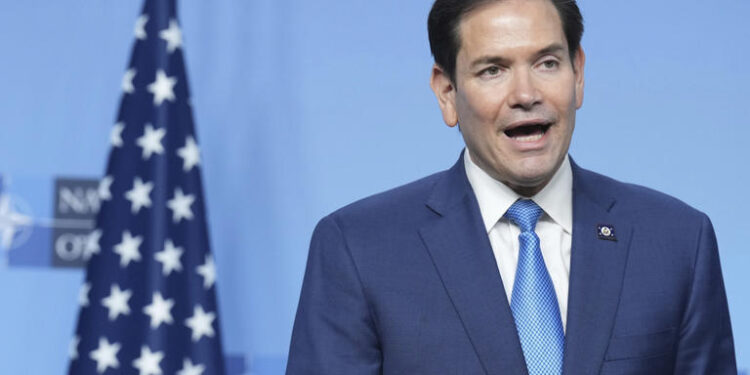
U.S. Secretary of State Marco Rubio warned ASEAN leaders today that Iran’s demand to control and collect tolls in the Strait of Hormuz would threaten the world’s economy and set a precedent that could be repeated elsewhere in the world.
Rubio made the remark at the opening session of Association of Southeast Asian Nations (ASEAN) Foreign Ministers’ annual meeting in the Philippine capital, Manila. Top diplomats from the U.S., China, Russia and several other countries are in Manila this week to take part in at the ASEAN ministerial gathering.
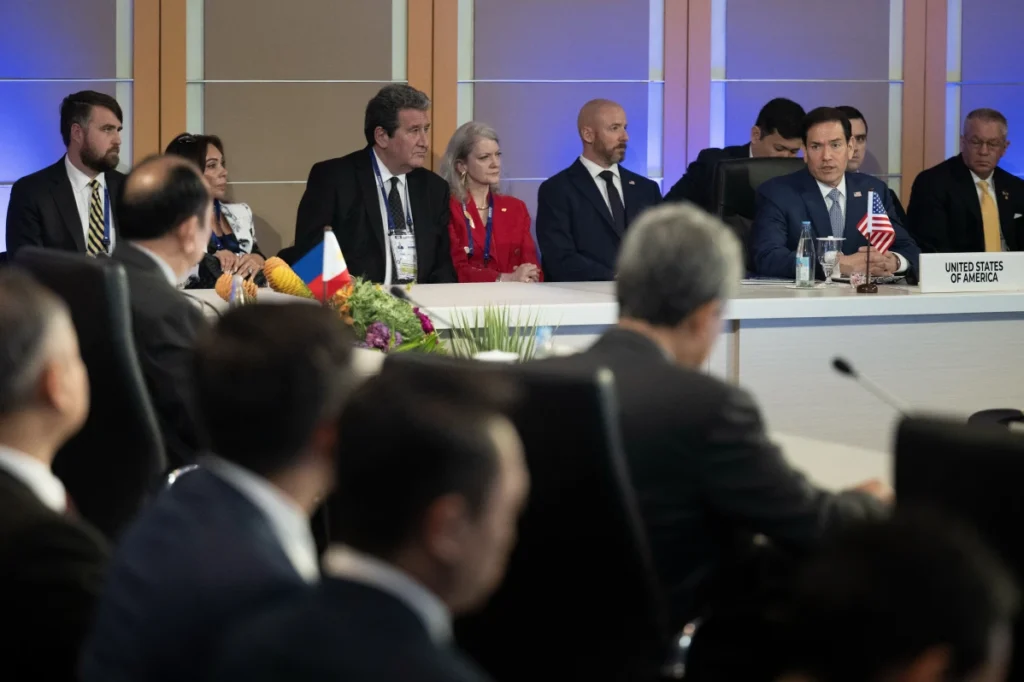
ASEAN diplomats have expressed alarm over the resurgent fighting in the Middle East that has impacted their region. Despite Washington’s preoccupation with Iran, Rubio said that the U.S is “with ASEAN 100%.”
“If we create a precedent in the Middle East where a nation-state can decide that they are going to control an international waterway, charge a toll and if you don’t pay them, blow up your ships, we have created a very dangerous precedent which will repeat itself in other parts of the world, including in this region.”
Marco Rubio
Rubio also renewed allegations that Iran has reneged on commitments under a collapsed interim ceasefire deal. Rubio said that Iran “has been reaching out to the United States, both directly and indirectly, to engage in talks about settling the differences.” He said that while “the U.S. would love to reach a diplomatic settlement,” the Trump administration is “not going to sit by and let ships be blown up or Americans be attacked.”
According to the International Energy Agency, which called the crisis a “stark wake-up call” for the region’s energy security, overreliance on fossil fuel imports from the Middle East has made Southeast Asia particularly vulnerable to the energy shock triggered by the Iran war. The IEA said that Asian markets imported about 80% of the crude oil and almost 90% of the liquefied natural gas, or LNG, transiting through the Strait of Hormuz in 2025.
Speaking to reporters, Australian Foreign Minister, Penny Wong underscored her country’s concern over the renewed attacks in the Middle East, warning that “the situation could deteriorate further without much warning.”
“We want to see an end to this war. We want to see a ceasefire. We want to see negotiations and we want the strait to be opened. People are being affected by what is happening and has happened to global energy markets and the effect on people has been direct and personal.”
Penny Wong
Sergey Lavrov, Russia’s Foreign Minister, told reporters that Moscow would like to see a quick settlement between the U.S. and Iran.
“There are those eager to incite each party to keep the conflict going, but we aren’t one of those. We would like to see it stop — it impacts the global economy and Russia is part of the global economy.”
Sergey Lavrov
Lavrov added that Moscow is “interested in stable global energy prices to pursue long-term economic policies.”
Aside the Iran war, ASEAN Foreign Ministers discussed the territorial disputes, welcoming progress in yearslong negotiations between China and their regional bloc on a proposed non-aggression pact that aims to prevent a major conflict in the disputed waters that could draw in the United States.
Rubio Meets Quad Counterparts
Rubio also met with counterparts in the four-nation Quad partnership, which is made up of the U.S., Australia, India and Japan.
They discussed maritime and transnational security, among other issues, and issued a joint statement that reaffirmed their commitment to maritime security initiatives aiming to counter China’s growing influence in the region.
During the meeting, Japanese Foreign Minister Toshimitsu Motegi voiced strong opposition to any attempts to change the status quo by force in the region, including in the disputed South China Sea and East China Sea, where China’s increasingly aggressive actions have sparked concern. Tokyo has a long-running dispute over Japan-controlled islands, which Beijing also claims, in the East China Sea.
The Trump administration has repeatedly criticized China’s assertive actions in the South China Sea to the disadvantage of smaller claimant countries like the Philippines, Washington’s oldest treaty ally in Asia.
Rubio met separately with Chinese Foreign Minister Wang Yi, telling reporters later that they discussed a new altercation this week between Chinese and Filipino forces in a disputed shoal. Rubio called the incident “escalatory.”
“It speaks to areas of disagreement when it comes to our policies with China. Those need to be managed very carefully, because obviously, a conflict — be it economic or otherwise — between the U.S. and China would have a dramatic global impact.”
Marco Rubio
He said that they also talked about a trade board that is meant to allow the two governments to discuss certain goods, and that he hopes it can be a “deliverable” from a planned meeting in the U.S. in September between President Donald Trump and Chinese leader Xi Jinping.
READ ALSO: Nigeria’s Boko Haram Trials Fall Short of Justice Standards- Human Rights Watch