

Ethiopia’s Tigst Assefa delivered another landmark performance at the TCS London Marathon as she successfully defended her title while breaking her own women’s-only world record with a time of 2:15:41 in a race that will be remembered as one of the greatest in marathon history.
The 29-year-old shaved nine seconds off the previous mark of 2:15:50 she set on the same course last year, reinforcing her dominance in the women’s field.
Coming into the race as the favourite, Assefa once again justified expectations, combining discipline and precision pacing to produce a run that steadily dismantled the clock.
In the build-up to the race, she had been widely tipped to retain her crown following her commanding victory the previous year, and she delivered with authority.
She remained composed through the early kilometres before gradually asserting control after the halfway mark.

By the closing stages along The Mall, Assefa had opened a massive gap, her stride still fluid as she surged toward the finish line. “I am happy to win again especially in a way that is historic“, the Ethiopian said.
The performance not only secured back-to-back London titles but also pushed the boundaries of women’s-only marathon running even further.
Men’s Race Redefines the Limits
While Assefa’s brilliance headlined the women’s race, the men’s event produced an unprecedented breakthrough that reshaped the sport entirely.
Kenya’s Sabastian Sawe became the first athlete in history to run a marathon under two hours in official race conditions, storming to a staggering 1:59:30. Unlike previous sub-two-hour efforts achieved under controlled or exhibition settings, Sawe’s time now stands as a legitimate competitive benchmark.
He was not alone in rewriting history. Ethiopia’s Yomif Kejelcha, on his marathon debut, also dipped under the two-hour barrier with an astonishing 1:59:41, immediately announcing himself as a major force over the distance.
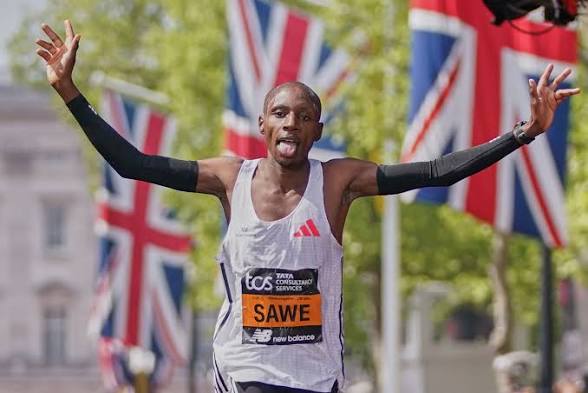
Uganda’s Jacob Kiplimo followed with 2:00:28, a time that also eclipsed the previous world record, underlining the extraordinary depth and pace of the race. The trio’s performances marked a defining shift in marathon running, long considered one of the last frontiers in endurance sport.
For years, the two-hour barrier had stood as an almost mythical target under official conditions, even after Eliud Kipchoge famously ran 1:59:40 in a controlled exhibition in Vienna in 2019. What London witnessed, however, was the barrier not just broken, but emphatically shattered in open competition.
All together, the results from both the men’s and women’s races signal a new era. Assefa continues to stretch the limits of women’s marathon performance with remarkable consistency, while the men’s field has now entered previously uncharted territory.
The TCS London Marathon has often produced iconic moments, but this edition stands apart, delivering a convergence of record-breaking feats that may redefine expectations for years to come.
READ ALSO: Ghana Boosts LEAP Programme, Adds 400,000 Vulnerable Households