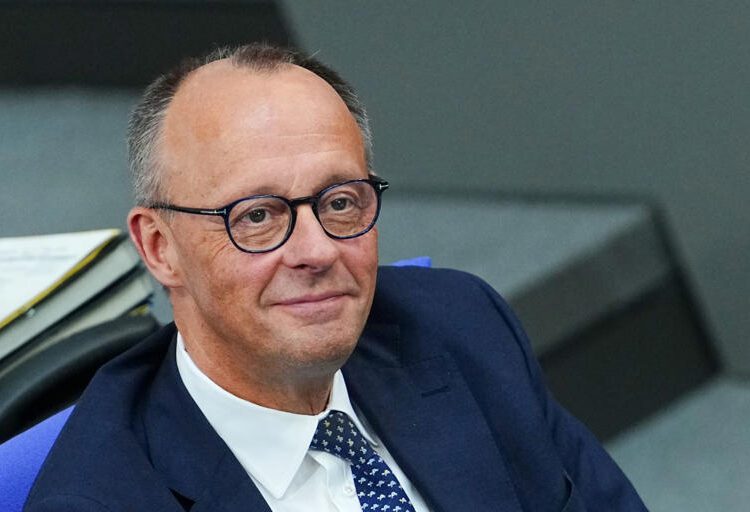
German Chancellor, Friedrich Merz has warned that Washington lacks a clear path out of its war with Iran, saying that the United States is being “humiliated” in the conflict.
Merz made the comments as concerns are growing across Europe over the wider impact of the conflict, including energy disruptions and economic instability.
Speaking to students in the German town of Marsberg, Merz said that the situation has exposed a deeper strategic problem for the US as he drew comparisons with past military debacles.
“The Iranians are clearly stronger than expected and the Americans clearly have no truly convincing strategy in the negotiations either. The problem with conflicts like this is always you don’t just have to get in – you have to get out again. We saw that very painfully in Afghanistan for 20 years. We saw it in Iraq.
“At the moment, I do not see what strategic exit the Americans will choose, especially since the Iranians are clearly negotiating very skillfully — or very skillfully not negotiating.”
Friedrich Merz
The Chancellor’s visit to the Carolus-Magnus-Gymnasium school was part of the EU Project Day, which sees schools across Germany hold events focused on the European Union.

Merz added that “an entire nation is being humiliated by the Iranian leadership” particularly by the Islamic Revolutionary Guard Corps.
Merz urged a rapid end to the war, warning that the fallout was already hitting Germany’s economy.
“It is, at the moment, a pretty tangled situation and it is costing us a great deal of money. This conflict, this war against Iran, has a direct impact on our economic output.”
Friedrich Merz
The German leader said that Berlin remains ready to deploy minesweepers to help secure shipping routes through the Strait of Hormuz, a vital artery for global petroleum supplies, but stressed that such steps depend on a cessation of hostilities.
However, Merz said, a prerequisite for this was that hostilities must first come to an end.
Merz stressed that Germany must now take on a leading role in the EU, and pointed out that the bloc has 100 million more inhabitants than the US. “If we were to unite more effectively and do more together, we could be at least as strong as the United States of America,” he said.
German Foreign Minister Johann Wadephul warned that nuclear threats continue to shape the security environment, even as Berlin reaffirmed its commitment to nonproliferation. “As long as nuclear threats against us and our partners continue, we will need a credible deterrent,” he said before meetings at the United Nations on the Treaty on the Non-Proliferation of Nuclear Weapons.
France and Germany have recently moved to deepen cooperation on nuclear deterrence, reflecting mounting anxiety in Europe over both the Iran war and broader regional instability.
Merz Links Ukraine Land Concession To EU Membership
Moreover, German Chancellor Friedrich Merz suggested that Ukraine may have to accept that parts of its territory could remain outside Kyiv’s control in a future peace deal with Russia, linking such concessions to the country’s prospects for joining the European Union.
“At some point, Ukraine will sign a ceasefire agreement; at some point, hopefully, a peace treaty with Russia. Then it may be that part of Ukraine’s territory is no longer Ukrainian.
“If President (Volodymyr) Zelenskiy wants to communicate this to his own population and gain a majority for it, and he needs to hold a referendum on it, then he must at the same time tell the people: ‘I have opened the way to Europe for you'”
Friedrich Merz
Kyiv’s EU accession progress had been blocked by Hungary’s nationalist premier Viktor Orban, but his defeat in elections earlier this month raised hopes it can move to the next step. Ukraine currently has the status of an official EU candidate.
Merz cautioned against raising hopes for rapid accession, however, saying Ukraine cannot join the bloc while at war and must first meet strict criteria including those regarding the rule of law and on fighting corruption.
“Zelenskyy had the idea of joining the EU on January 1, 2027. That will not work. Even January 1, 2028 is not realistic.”
Friedrich Merz
He proposed intermediate steps such as observer roles for Ukraine in EU institutions, which he said met broad approval among European leaders at their summit last week in Cyprus, which Zelenskyy attended.
The European Union last week approved a 90 billion euro loan to Ukraine, covering most of its needs through 2027, but the bloc remains divided over the pace of accession talks.
READ ALSO: King Charles to Proceed With US Visit Amid Security Concerns